Garden and Heatwave: Protect Your Estate
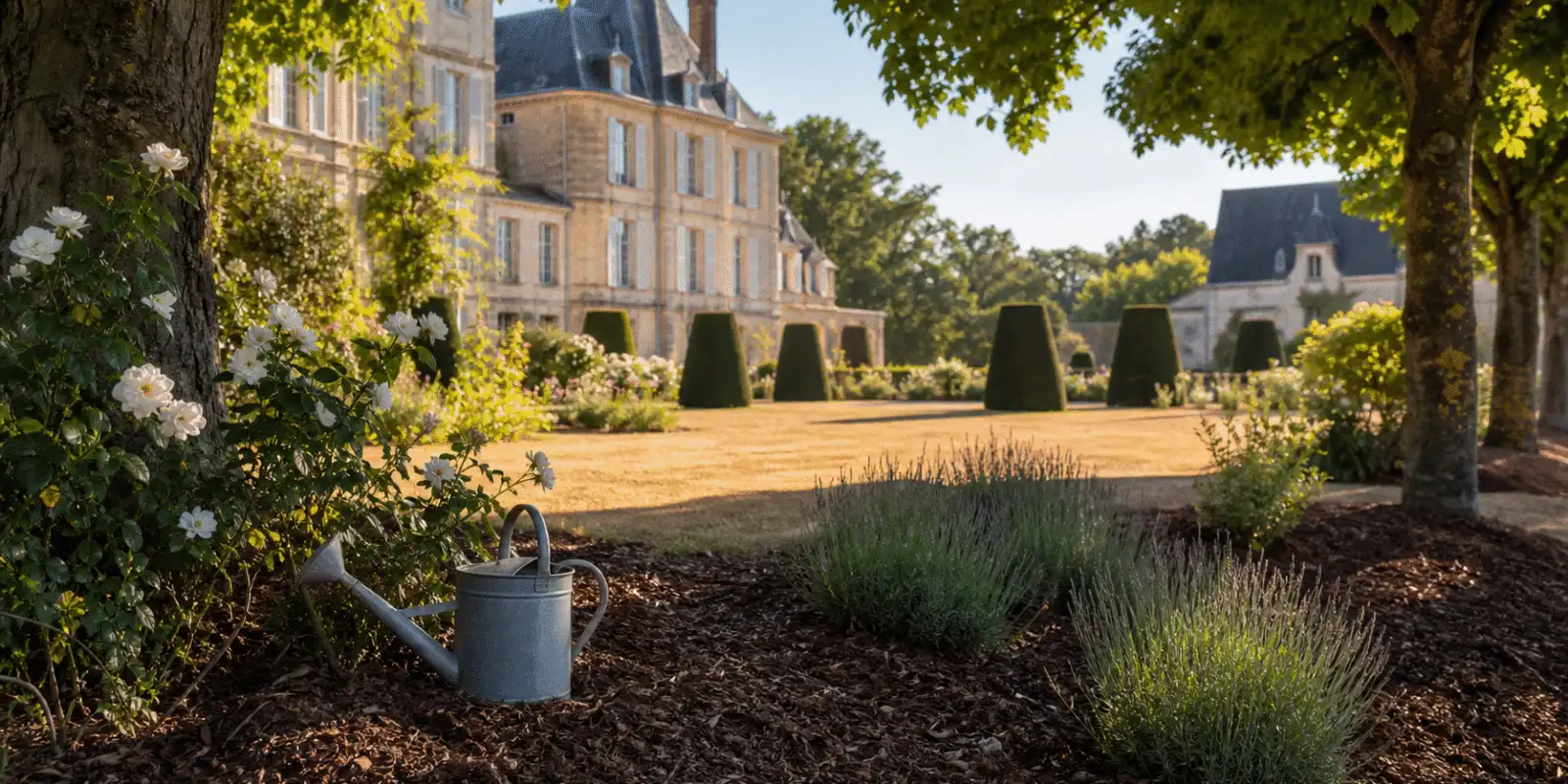
Facing a heatwave, a garden is protected in order: water deeply and early in the morning, mulch the soil 7-10cm deep, shade the most fragile plants, pause mowing and pruning. The right instinct isn’t to water more — it’s to help the soil hold onto the water it already has. This guide gathers the essential moves and points, area by area, to the detailed guides in our Garden Care & Permaculture section.
The Chatelain Method for a heatwave
A well-kept garden doesn’t panic when the mercury climbs: it observes and manages itself. We apply the same four-step framework here as everywhere else on the estate.
- Observe: spot which plants are struggling (leaves drooping at midday, scorching pots, cracked soil) and check the current heat-health alert level.
- Diagnose: tell real water stress (the plant is short of water) apart from simple midday wilting, a defence mechanism that recovers by evening.
- Correct: act on the soil (deep water + mulch) before acting on the plant (shading), always in the cool hours.
- Prevent: prepare the garden for the next heat spell — covered soil, well-adapted planting, water reserves and reusable shading.
The Chatelain note. Bare soil can exceed 50°C at the surface in a heatwave, while mulched soil stays noticeably cooler underneath. Mulch is the one thing that works for you around the clock, without a watering can.
Heatwave: when does it start, and who says so?
In the UK, heat health alerts are issued jointly by the UK Health Security Agency (UKHSA) and the Met Office, graded yellow, amber and red, running through the core alerting season of 1 June to 30 September. A heatwave is defined regionally: three consecutive days at or above a threshold that varies by area — around 28°C across most of southern England and lower further north (25°C in Scotland). The alert level is a useful gauge for how hard to work in the garden.
| Alert | Situation | Garden priority |
|---|---|---|
| Yellow | Short, sharp hot spell | Morning watering, check pots |
| Amber | Heatwave established (≥3 days) | Mulch + shade fragile plants, deep watering |
| Red | Extreme heat | Focus on priorities only (young plants, pots, veg patch, pond) |
Under an amber alert, evaporation rates roughly double compared with a normal June day; a red alert can push surface evaporation from bare soil past 8mm in a single day.
The 5 priority moves, in order
When everything feels urgent, follow this order rather than watering everything at random.
- Secure the soil’s water: one slow, deep watering early in the morning beats several shallow daily top-ups.
- Cover the soil: mulch 7-10cm deep to block evaporation and keep roots cool.
- Shade the fragile ones: young plants, leafy vegetables, hydrangeas, exposed pots.
- Ease off: no mowing, pruning or feeding for the duration.
- Protect water features and pots: a pond heats up and loses oxygen fast; a pot can cook like an oven.
Watering: less often, but deep
The best heatwave watering is infrequent, slow and done in the morning. A generous soak every 2-3 days, aimed at the base, reaches deep and encourages roots to grow downward; light daily overhead watering, by contrast, keeps roots shallow and fragile. In open ground, the best window to water is 4am-7am, when evaporation losses run around 10-15% compared with 50-60% at midday.
An honest clarification. The fear that water droplets « burn » leaves in the sun is, for most plants, a myth. The real reason to avoid midday watering is simpler: evaporation wastes a large share of the water before it ever reaches the roots.
Mulch and shade: keeping things cool
Mulch is the number-one ally in a heatwave. A layer 7-10cm deep (straw, dried grass clippings, ramial chipped wood, dead leaves) limits evaporation, suppresses weeds and buffers temperature swings. Temporary shading saves fragile plants too — stretch a breathable shade cloth over vulnerable beds, never plastic sheeting, which turns the bed into an oven.
Around the garden: protecting each space
A varied garden’s strength is also what makes a heatwave tricky — every space needs a slightly different response.
The vegetable garden
The most exposed space: water-hungry crops, shallow roots, full sun. Mulch thickly, shade during the hottest hours, and water at the base, never over the leaves.
The orchard and citrus
An established tree draws from deep and copes better than you’d think; the real danger is sun-scorched fruit and young trees. Citrus in pots are the weak point — the pot itself heats fast, cooking the roots inside.
Borders and perennials
The best answer is upstream: choose plants that ask for little — lavender, sage, gaura, sedum, ornamental grasses — over ones that need constant watering.
The lawn
A lawn that yellows isn’t a dead lawn: it goes dormant and greens up again with rain. Raise the mowing height and space out cuts rather than watering a dormant lawn back to green.
Ponds and water features
Warm water loses oxygen and turns green fast — fish and plants are the first to suffer. Top up little and often rather than one large cold addition, which shocks the water temperature.
The patio and pots
A hard, mineral surface can radiate serious heat; an exposed pot cooks the roots inside. Group pots in part-shade, mulch their surface, and use light-coloured pots where possible — dark pots in full south sun heat up dramatically.
Mistakes to avoid
A heatwave punishes wasted effort as much as inaction.
- Mowing too short: a short lawn scorches faster. Raise the blade and mow less often.
- Pruning or feeding: this pushes fragile new growth the plant can’t sustain.
- Overhead watering at midday: maximum evaporation, wasted water.
- Covering plants in plastic sheeting: the greenhouse effect finishes what the sun started.
- Insisting on watering a dormant lawn: better to save that water for plants that genuinely depend on it.
During a hosepipe ban, check first what’s still permitted — restrictions vary by water company and can change quickly during a prolonged dry spell.
After the heatwave: getting the garden back on its feet
When cooler weather returns, don’t rush. Let plants recover for a day or two before any feeding. Remove genuinely dead wood and leaves, but be patient with plants that only look tired — many bounce back. It’s also the moment to top up water reserves, refresh the mulch, and note which plants struggled most, so you can replace them come autumn with better-adapted choices.
FAQ
What should I do in the garden when it’s 35°C+?
At the peak of the heat, leave the plants alone and act only in the cool hours. In the morning: a slow, deep watering at the base of priority plants, a pot check, extra mulch. During the day, shade the fragile ones and simply monitor.
Should I water every day during a heatwave?
In open ground, no — a generous soak every 2-3 days beats a daily surface sprinkle. Pots are different and may need watering once or even twice a day at the peak, since their small soil volume dries out fast.
Is it better to water in the morning or the evening?
Morning is preferable: the plant makes use of the water through the day and the foliage dries out, limiting disease. Evening watering is acceptable if morning isn’t possible, but foliage left wet overnight favours fungal problems and slugs.
My plants wilt at midday — are they dying?
Not necessarily. Many plants let their leaves droop in the hottest hours to reduce water loss, then perk back up by evening — a defence, not a sign they’re short of water. If the soil is still cool a little deeper down, don’t water again.