Harvest Rainwater in the Garden: Installation and Uses
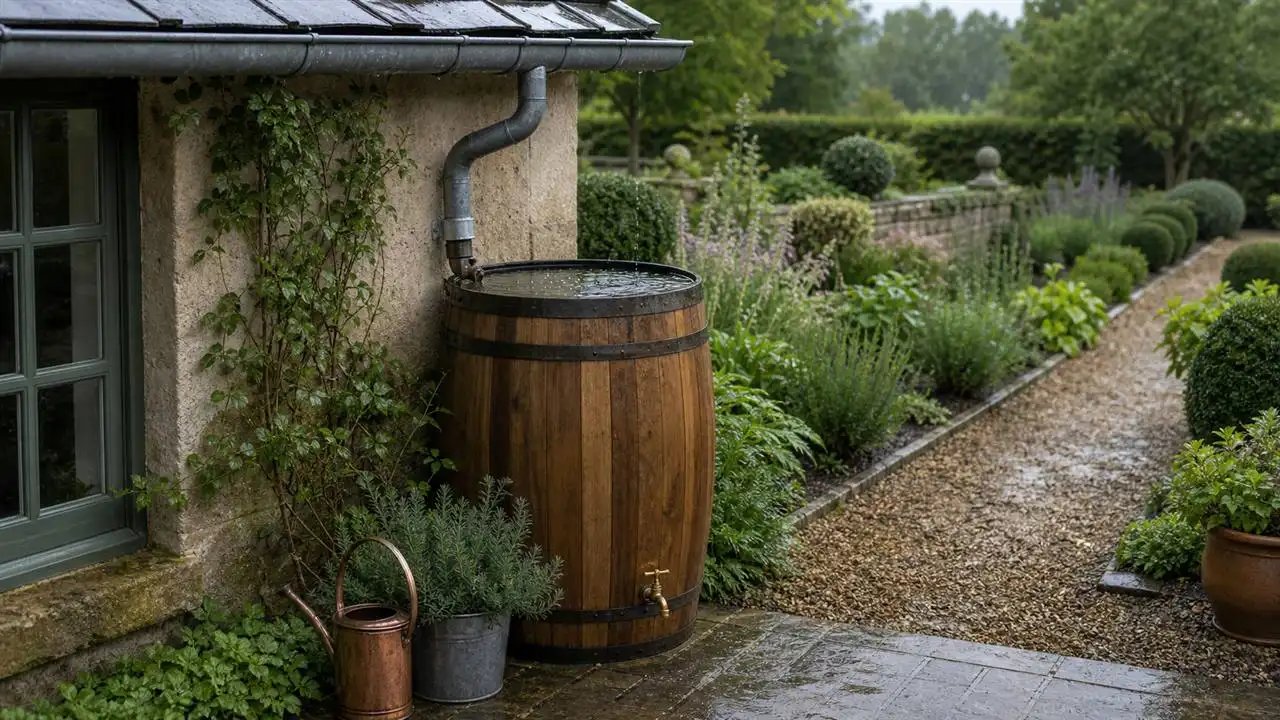
Harvesting rainwater in the garden starts with a diverter fitted to a downpipe, filling a water butt or tank (above or below ground). As a rule of thumb: rainfall (mm) × roof area (m²) = litres collected — free water, soft and lime-free, ideal for citrus and seedlings.
The Chatelain Method for rainwater
You observe your roof area and watering needs; you diagnose the tank size required; you correct with a diverter and overflow; you prevent algae and mosquitoes with an opaque, covered butt.
How much water can you collect?
| Roof area | At 10mm rainfall |
|---|---|
| 50m² | ≈ 500L |
| 100m² | ≈ 1,000L |
| 150m² | ≈ 1,500L |
The Chatelain note. The formula: rainfall (mm) × roof footprint (m²) = litres — use the footprint, not the sloped or ridge measurement. A typical UK home with a 100m² roof can expect to collect in the region of 70,000 to 85,000 litres of usable rainwater a year; for a typical 50-100m² garden, a 1,000-1,500L tank suits consistent summer supply better than a small 200L butt.
Installing and using it
- Diverter fitted to the downpipe (filters leaves, routes the overflow).
- Opaque butt (against algae), covered (against mosquitoes), on a stable stand.
- Tap at the base plus an overflow connected to drainage.
- Use: watering can, gravity hose, or a pump for pressure.
Soft, lime-free rainwater is excellent for citrus, which is sensitive to lime, as well as for young plants and seedlings.
FAQ
How much rainwater can I actually collect?
As a guide, roughly 1 litre per m² of roof per mm of rain. A 100m² roof collects around 1,000 litres for 10mm of rainfall, allowing for some loss depending on roof type.
Is rainwater good for all plants?
Yes, and it’s ideal for lime-sensitive plants (citrus, ericaceous plants) and seedlings.
How do I stop mosquitoes breeding in the butt?
A covered, opaque butt stops them laying eggs and limits algae growth too.