Nettle and Comfrey Feed: Recipe, Dilution and Limits
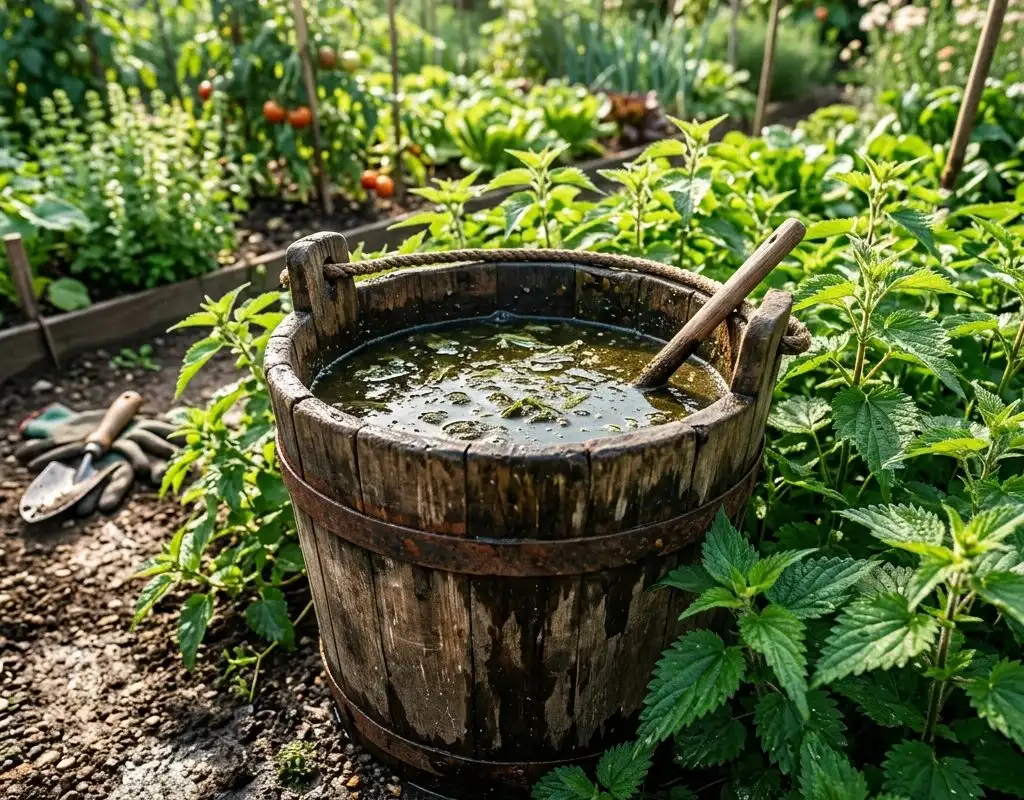
There is no single exact dose for every nettle or comfrey feed. Strength changes with the mass of leaves, water volume, temperature, steeping time and filtration. The first distinction is between a homemade liquid fertiliser and a preparation intended to control a pest or disease: they are not the same recipe or regulatory use.
Dilution follows the way the concentrate was made
| Preparation | Starting guide | Cautious use |
|---|---|---|
| Plant feed made with water | About 1 part feed to 10 parts water | Water onto already moist soil around hungry crops. |
| Waterless plant concentrate | About 1 part to 20 | Greater dilution because the collected liquid is concentrated. |
| Young plant or unfamiliar crop | Dilute further and test a small area | Observe before repeating. |
| Commercial product | Follow its label | A standardised formulation takes priority over a blog recipe. |
These are horticultural starting points, not an NPK assay. RHS guidance also suggests aiming for the colour of weak tea after dilution: imprecise, but more honest than a false laboratory-style number.
Make a water-based comfrey feed
- Wear gloves and cut healthy leaves.
- Pack them into a lidded non-metal container, keep the leaves submerged and add water.
- Leave the container outdoors. RHS guidance gives about three weeks for water-covered comfrey; temperature and particle size alter the time.
- Strain, dilute at roughly 1:10 and use promptly at soil level on moist ground.
Comfrey feed is often reserved for flowering and fruiting crops, but the actual nutrient content varies. It is not a precise correction for a diagnosed deficiency.
Make a water-based nettle feed
The same process can be used for young nettle growth: covered container, submerged leaves, then filtration. For a long water-based feed, 1:10 is a reasonable starting dilution for an established plant; use a weaker solution for seedlings and young plants. Established trees, shrubs and perennials do not usually need routine liquid feeding.
Chatelain marker. If the soil is dry, water it first and apply the diluted feed afterwards. Increasing concentration does not correct drought stress.
Fertiliser is not an improvised pesticide
A plant feed made by decomposition should not be promoted as a universal treatment for aphids, mites or fungal disease. Plant-protection uses are controlled separately. In the United Kingdom, the Health and Safety Executive requires plant-protection products to be authorised or permitted and warns that a homemade remedy is not automatically safe or legal simply because its ingredients are familiar.
For the homemade fertiliser described here, soil application is the prudent route. RHS guidance says not to apply homemade feeds with a sprayer because microbes could be inhaled. Wear gloves, wash hands and keep a clearly labelled container away from children and animals.
When to reduce or stop feeding
- Very dark soft growth, surface deposits or obvious overfeeding.
- Fresh compost or another fertiliser has already been applied.
- The plant is stressed by drought, cold, waterlogged roots or heat: diagnose that problem first.
- The bed borders a pond or watercourse, where nutrient loss can worsen eutrophication.
FAQ
How long should it steep?
A water-based plant feed commonly takes two to four weeks, but temperature and material change the timing. A short plant-protection recipe is a different preparation with separate conditions.
Can nettle and comfrey be mixed?
They can be combined as an empirical feed, but the mixture becomes no more quantifiable. Do not present it as a precise NPK formula or an authorised pesticide.
How often should it be used?
There is no universal calendar. Reserve it for actively growing plants that need feeding, then observe before repeating.