Shade Sails and Shade Structures: Cool Terrace and Borders
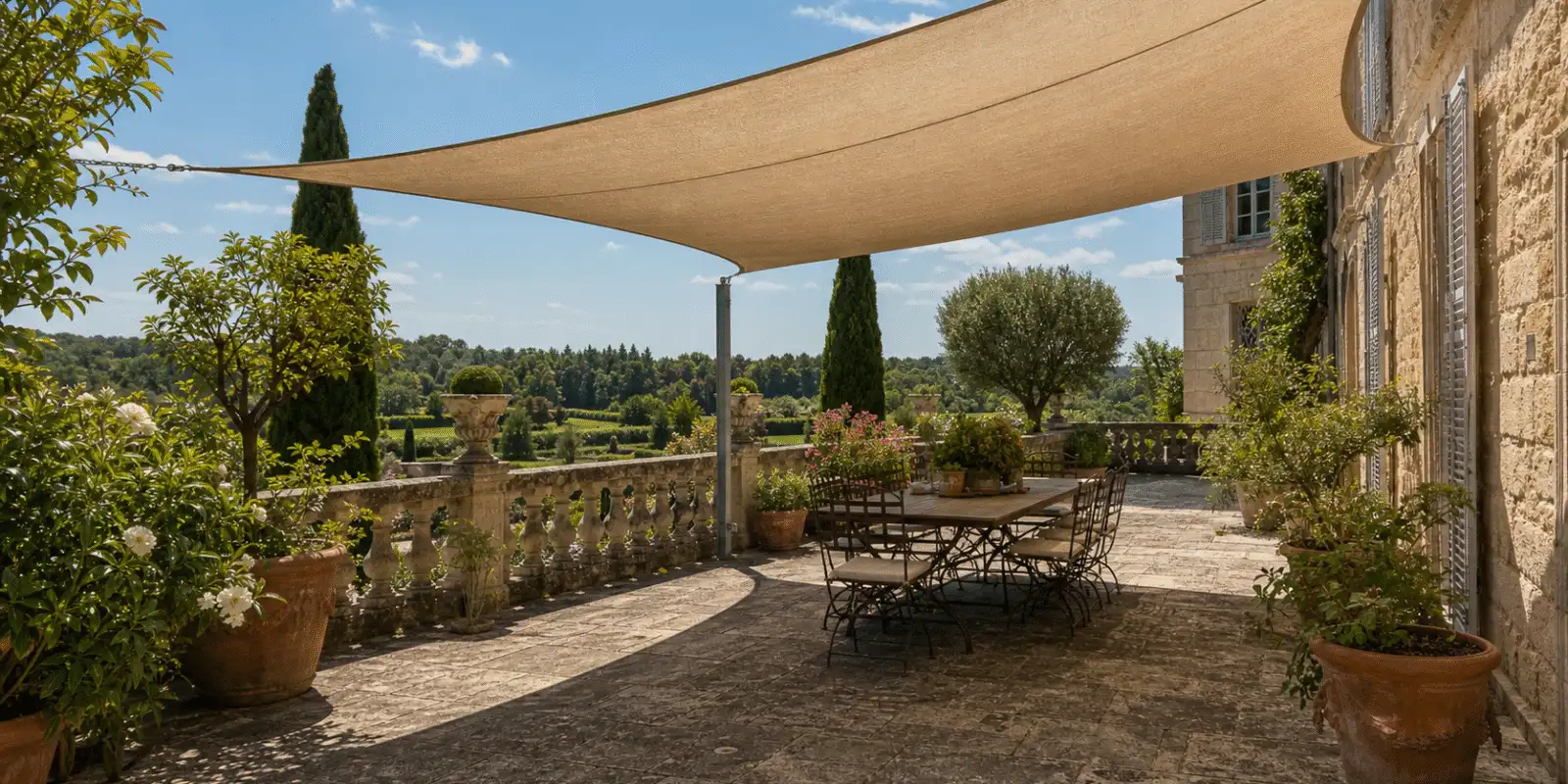
A shade sail is the elegant answer to a heatwave: a stretched fabric that filters the sun, creates a pocket of coolness and cuts watering. The right choice rests on two figures — the shade factor (35 to 95 %) and the fabric weight (150 to 340 GSM for durability). Fit it over the terrace, above fragile borders or the vegetable garden. This guide opens the heatwave chapter of Outdoor Design.
The Chatelain Method for shading
We observe the areas crushed by the afternoon sun; we diagnose the need (comfort, plants, vegetables); we correct with a suitable fabric; we prevent lastingly with a fixed or planted shade structure.
Sail, net or awning: which solution?
| Solution | Use | Strength |
|---|---|---|
| Shade sail | Terrace, dining area, borders | Attractive, large triangular spans |
| Shade net/cloth | Vegetable garden, greenhouse, fragile plants | High shade factor, economical |
| Awning / pergola | Terrace next to the house | Adjustable, built into the structure |
| Planted pergola | Permanent living space | Living, cool shade |
For a structured, lasting solution on the terrace, see our comparison bioclimatic pergola: attached or freestanding.
Choosing your shade sail well
Two figures drive the purchase.
- The shade factor: 35-50 % for a decorative terrace fabric, up to 90-95 % for a net protecting sensitive crops. The higher it is, the denser the shade.
- The fabric weight (GSM): from 150 to 340 GSM. The higher it is, the more the fabric resists wind, UV and wear. Very light fabrics (90-106 GSM) suit occasional use.
Also choose the shape (triangle for design and tension, rectangle to cover a large area), the water behaviour (waterproof or breathable micro-perforated fabric) and a solid tensioning system (post, rings, tensioners). HDPE is the durable material of reference.
The Chatelain’s rule of thumb. A breathable micro-perforated sail lets a thread of air through and avoids the « heat pocket » of a poorly ventilated solid fabric — HDPE mesh sails even create a cooling breeze beneath the canopy. Over a vegetable garden, favour a breathable fabric; on a terrace, a water-repellent one also shelters you from a shower.
Where to fit shading in a heatwave
- Over the terrace and dining area: for the comfort of people and pots.
- Above the vegetable garden: for lettuces, leafy vegetables and young plants (see protecting the vegetable garden from a heatwave).
- Over fragile borders: hydrangeas, ferns, young plantings.
- In the orchard, against fruit sunburn.
- Over part of the pond, to limit heat and algae (see garden pond in a heatwave).
To go further on the comfort of the terrace itself, see cooling a sun-baked terrace.
Fitting a shade sail properly
- Track the sun’s path: cover the area hit in the afternoon (south-west).
- Tension firmly between solid anchor points (façade, set post, sturdy tree).
- Give a slight slope (at least 15°) for water run-off and to avoid pockets.
- Slacken or remove in strong wind, to protect the fabric and fixings.
FAQ
Which shade factor should you choose for a sail?
For a terrace, a 35-50 % fabric is enough for comfort. To protect a vegetable garden or sensitive crops, go up to 50-70 % with a breathable fabric, but avoid 80-90 % over fruiting vegetables, which then lack light.
What is the difference between a shade sail and a shade net?
The shade sail is a decorative stretched fabric, ideal for the terrace. The shade net, more technical and with a high shade factor, mainly protects the vegetable garden, the greenhouse or young plants.
Does a shade sail really protect from the heat?
Yes: by filtering direct radiation, it creates a distinctly cooler area and reduces watering of the sheltered plants. Choose a breathable fabric to avoid any heat-pocket effect.
How do you fix a shade sail securely?
Between sturdy anchor points (façade, set post, solid tree), well tensioned, with a slight slope for water. In strong wind, better to slacken or remove it to protect the fabric.