Bioclimatic Pergola: Attached or Freestanding?
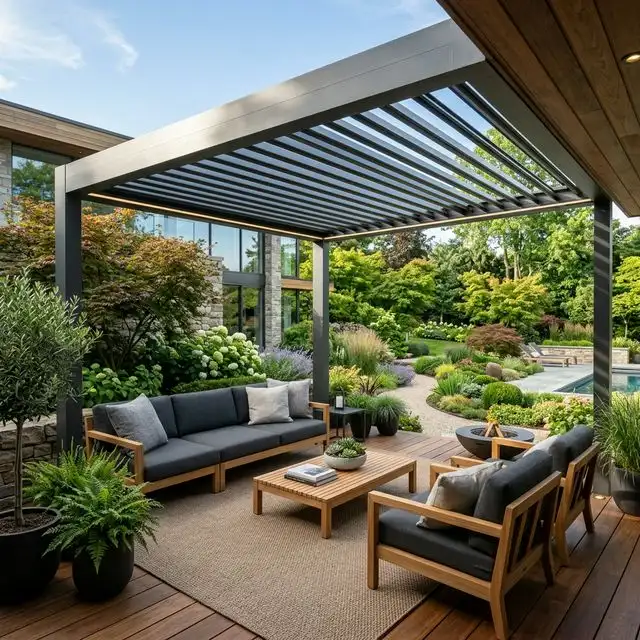
A wall-mounted bioclimatic pergola leans on the house façade: economical and ideal for extending the home outdoors. A freestanding pergola, on four posts, sits anywhere in the garden and creates an independent outdoor room. The choice depends on placement, budget and the effect you want. Here’s the full comparison, criterion by criterion.
The Chatelain Method for choosing a pergola
You observe the location (against the house or out in the garden); you diagnose the constraints (façade, views, wind); you correct with the right structure type; you prevent regrets by planning louvre orientation and water drainage from the design stage.
Wall-mounted vs freestanding: the comparison
| Criterion | Wall-mounted | Freestanding |
|---|---|---|
| Placement | Against the façade | Anywhere in the garden |
| Relative cost | More economical | Higher (4 posts, full structure) |
| Wind stability | Reinforced by the wall | Needs careful anchoring |
| Extends the house | Yes (indoor/outdoor continuity) | No (independent space) |
| Water drainage | Away from the wall | Through the posts |
| Ideal for | Adjoining terrace | Standalone relaxation or dining area |
Bioclimatic or a green arbour?
A bioclimatic pergola (adjustable aluminium louvres) gives total control and minimal upkeep. An arbour or planted pergola (wisteria, vine) gives living, romantic shade, but it’s seasonal and more demanding to maintain. Many gardens combine both, depending on the space.
| Option | Shade control | Maintenance | Feel |
|---|---|---|---|
| Bioclimatic aluminium | Total (louvres) | Minimal | Contemporary, clean |
| Planted arbour | Seasonal | Annual pruning | Natural, romantic |
Permitted development or planning permission?
In England, pergolas are usually covered by permitted development rights, without formal council approval, but height limits still apply: up to 2.5m if within 2m of a boundary, up to 3m (flat/louvred roof) or 4m (dual-pitched) beyond that. Combined with any shed or extension, garden structures must not cover more than 50% of the garden. Rules differ in Scotland, Wales and Northern Ireland, and a listed building or conservation area changes things — always check with your local council before building.
Getting the integration right
Plan the louvre orientation for the sun’s path, allow for integrated lighting, and match tones with the façade and any nearby walls.
FAQ
What’s the difference between a pergola and a bioclimatic pergola?
A classic pergola has a fixed cover; a bioclimatic one has adjustable louvres that control shade, ventilation and rain protection.
Wall-mounted or freestanding: which should I choose?
Wall-mounted to extend a terrace against the house (more economical); freestanding to create an independent space elsewhere in the garden.
Does a bioclimatic pergola keep the rain out?
Yes — with louvres closed, water is channelled to the posts or a gutter. That’s a major advantage over an arbour.
Do I need planning permission for a pergola?
Often not, under permitted development, but height and coverage limits still apply, and this varies across the UK. Check with your local planning authority.