Poolside Plants: How to Reduce Leaves and Debris
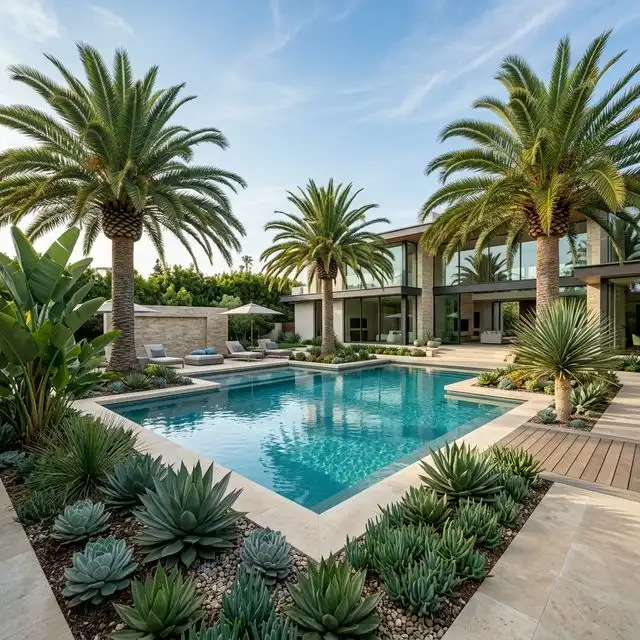
There is no truly leaf-free poolside plant. Evergreens replace foliage, flowers fade and seeds or fruit still fall. A useful planting plan therefore aims to reduce litter and cleaning, not to promise a maintenance-free pool.
Screen every plant against five questions
| Question | What to establish |
|---|---|
| What will fall? | Leaves, petals, seed heads and fruit, including when they fall and whether prevailing winds carry them towards the water. |
| How large will it become? | The mature crown and height in the local climate, rather than the size of the nursery pot. |
| What is below ground? | Pool walls, pipes, paving and available soil volume. Root behaviour and site constraints matter more than one universal setback. |
| Can it cope with the site? | Reflected heat, wind, winter cold and occasional splash. No plant tolerates repeated soaking in chlorinated or saline pool water. |
| Is it safe beside a route? | Thorns, sharp leaves, toxic parts and slippery fruit should not sit beside a narrow circulation path. |
Build the planting in three zones
The immediate pool edge
Use low, compact, non-spiny plants that will not obstruct the cover, coping or maintenance route. In much of the UK, compact hebes, shrubby lavender or restrained evergreen ground cover may be candidates where drainage and hardiness are suitable. They are examples to assess, not a guarantee: each still flowers, sheds and needs periodic care.
The middle planting band
Clump-forming perennials and modest shrubs can provide structure without placing a canopy over the water. Keep irrigation local and prevent compost, fertiliser or muddy runoff entering the pool. Check the dominant wind before positioning anything with fine seed heads.
Trees and screening
Plot the mature crown on a scaled plan. A tree that eventually overhangs the water defeats the purpose of a low-litter scheme. Root characteristics, soil, drainage, underground services and pool construction all affect the safe position, so confirm it with the pool supplier and a locally experienced arborist. Do not transplant a Florida or Arizona distance as a universal UK rule.
The Chatelain Method. Draw the mature plant, not the plant on sale. Combining adult canopy width with the prevailing wind reveals more future litter than a generic list of “clean” species.
A practical nursery checklist
- Record sun, wind, frost exposure, path width and buried services.
- Ask for mature dimensions and hardiness in your location.
- Ask separately about leaves, blossom, seed and fruit drop.
- Reject plants that require spray treatments directed towards the pool.
- Plant a limited first phase and observe a full growing season before filling every gap.
Frequent sources of extra work
- Fruit or a mature crown directly over the water.
- Thorns and rigid, sharp foliage beside a route used barefoot.
- A vigorous hedge kept undersized by constant clipping.
- Containers whose drainage runs across the coping.
- A fashionable plant unsuited to the site’s winter minimum.
FAQ
Are palms automatically safe beside pools?
No. Root form is only one factor; old fronds, flowers, fruit, ultimate height and wind exposure must be checked for the particular palm.
Must ornamental grasses be avoided?
No, but use manageable clumps and account for dry foliage and seed heads. A freely seeding grass upwind of the pool is a poor choice.
What planting distance is correct?
There is no single distance for every plant and pool. The mature crown, documented root behaviour, structure, services and soil determine it.