Pool Enclosure as a Winter Garden: Conditions and Limits
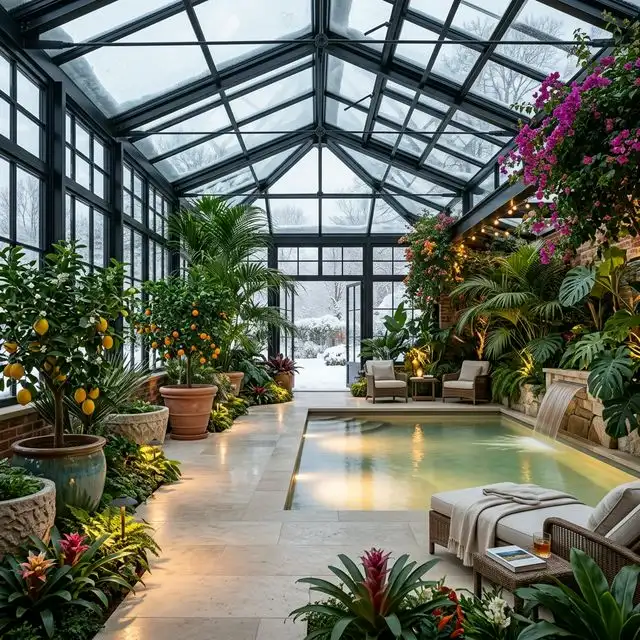
A tall pool enclosure may hold a small collection of container plants, but it is not automatically a frost-free conservatory. Without designed heating, its temperature follows sunlight, cold nights, ventilation and the pool. Measure the microclimate and check the enclosure’s intended use before buying plants.
Run a site test first
- Place a minimum-maximum thermometer and hygrometer at pot height, away from a sun-heated panel.
- Record bright days and several cold nights while operating vents exactly as the manual requires.
- Map condensation, draughts, shade and splash zones.
- Compare the lowest measured temperature with each plant’s stated minimum.
One warm afternoon does not show that the space remains frost-free. The RHS categories for cool and warm conservatories describe plant requirements; they are not a performance certificate for a pool enclosure.
Five conditions for a workable scheme
| Area | Required condition |
|---|---|
| Structure | The manufacturer confirms that the use, floor loading and pot positions are compatible. Do not hang a planter from a frame member without written approval. |
| Safety | Tracks, locks, pool access, exit route and any safety device remain clear and fully operable. |
| Air | The enclosure can be ventilated as designed. Humidity and volatile by-products above chlorinated water should not simply be trapped. |
| Water | Controlled trays or watertight planters prevent compost, fertiliser and drainage entering the pool. |
| Electricity | Any added heat, lighting or ventilation is designed by a competent professional for the electrical zones around a pool. |
Let the readings choose the plants
If temperatures approach freezing, use containers that are genuinely hardy in the local conditions or move them elsewhere during cold weather. Merely avoiding frost does not establish cool-conservatory conditions: the RHS generally specifies a 5°C night minimum for that category. Use those plants only where readings stay above the individual plant minimum and the light is suitable. Warm-house tropical plants only become credible with properly designed heating, ventilation and energy use.
Growth slows in winter. Space plants for air movement, inspect for scale insects and aphids, remove dead material and reduce watering rather than leaving compost wet. Do not leave trays holding stagnant water.
The Chatelain Method. Select a plant from the minimum temperature recorded at its future pot position, not from how warm the enclosure feels on a sunny afternoon.
Keep the layout reversible
- Limit large containers and preserve a continuous route around the pool.
- Use stable stands that neither load nor obstruct the tracks.
- Decide where every pot will move before opening or telescoping the enclosure.
- Keep sensors, handles, fasteners and safety instructions visible.
- Check planning and building-control implications if the structure or use changes.
Compare the structural choices in our flat, low and mid-height pool enclosure guide.
FAQ
Does an enclosure always prevent frost?
No. Cold-night readings and manufacturer data are required; appearance alone proves nothing.
Is there one humidity threshold?
No. Surface temperature, condensation, airflow and plant sensitivity interact. Observe conditions and ventilate as designed rather than relying on an isolated percentage.
Can plants be suspended from the frame?
Only where the manufacturer approves the exact load and fixing point. A moving enclosure is not a greenhouse frame to modify freely.
Sources
- Royal Horticultural Society — Overwintering plants in conservatories
- Royal Horticultural Society — Cool conservatory plants
- World Health Organization — Guidelines for safe recreational water environments
- GOV.UK — Building regulations approval
- Institution of Engineering and Technology — Section 702 and water installations