Natural or Conventional Pool: Budget and Maintenance Compared
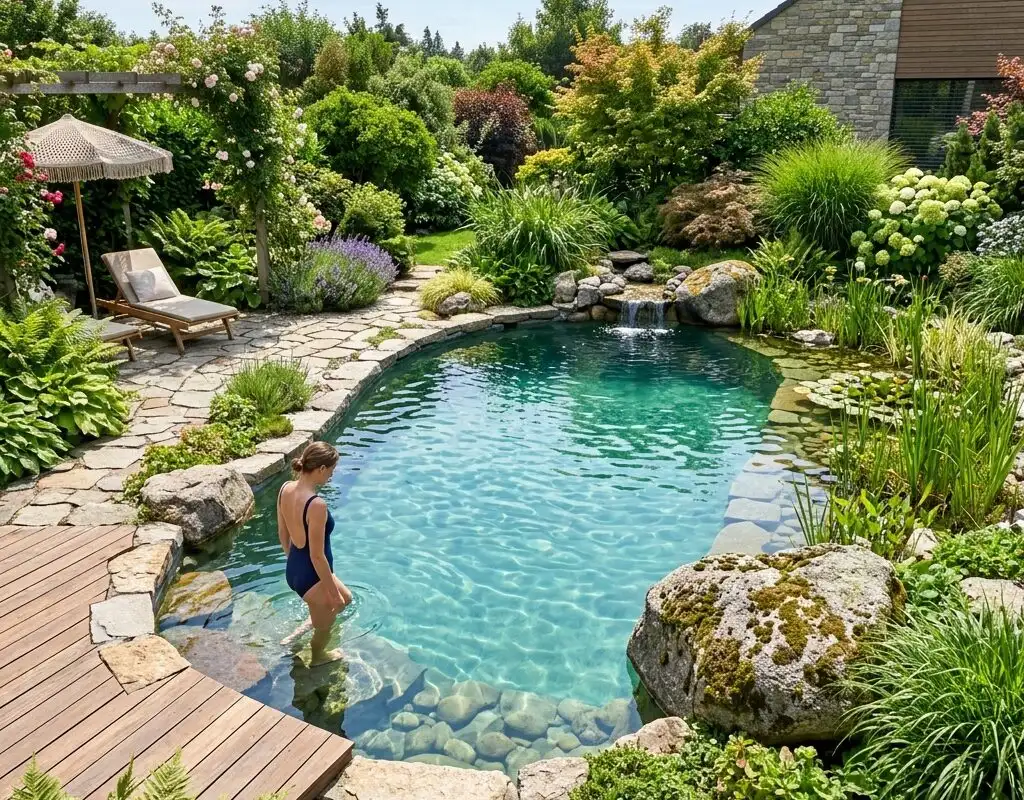
A natural swimming pool and a conventional pool differ in treatment, hydraulics and operating routine, not simply in whether “chlorine” appears on a shopping list. Neither is sterile, self-cleaning, risk-free or maintenance-free. Compare quotations for the same brief over the same costing period.
How the systems differ
| Area | Natural pool | Conventional pool |
|---|---|---|
| Treatment | Designed around biological processes, with physical filtration or other processes according to the system. | Hydraulics and filtration combined with controlled disinfection and water balance. |
| Disinfectant residual | The design does not normally maintain a permanent disinfectant residual in the bathing zone. | The selected process maintains and monitors treatment according to its operating instructions. |
| Space | May require a planted regeneration zone or dedicated biological equipment; there is no universal percentage. | Treatment is concentrated in plant equipment, but that does not make every whole project smaller. |
| Maintenance | Debris, sediment, plants, surfaces, pumps and water quality still require management. | Debris, biofilm, filters, surfaces, water parameters and dosing still require management. |
| Commissioning | The biological system must be started and balanced to the designer’s procedure. | Circulation, filtration and water balance must be established before normal use. |
Build a like-for-like budget
Do not compare a headline square-metre rate with a complete quotation. Give both designers the same swimming area, depth, access constraints and finish, then separate:
- Design and construction: surveys, excavation, spoil removal, structure, waterproofing, hydraulics, electrics, access and reinstatement.
- Treatment: filtration and disinfection for a conventional pool; biological zone or modules, media, hydraulics and planting for a natural pool.
- Safety and permissions: barrier or enclosure, planning, ground information and required inspections.
- Annual operation: pump energy, make-up water, testing, consumables, cleaning, plant care and professional servicing.
- Replacement cycles: pumps, filter media, membrane or finish, test equipment, cover and biological-zone renewal as specified.
A ten-year worksheet is useful when every line states the assumed service life, energy and water price, owner labour and exclusions. It is not a forecast guarantee; it exposes the assumptions behind each offer.
The Chatelain Method. Quotations become comparable only when swimming area, finish, safety, commissioning and replacement items appear in both columns.
Maintenance that does not vanish
In a conventional pool, treatment chemicals do not remove leaves, insects or surface biofilm. Filtration, brushing, debris removal and correct dosing work together. In a natural pool, living processes do not remove the need to manage flow, surfaces, sediment and vegetation. Winter changes the schedule; it does not erase it.
Clear water alone is not microbiological evidence. WHO and PWTAG guidance largely addresses public or operated pools, so its numeric operating values should not be turned into universal domestic limits. It does, however, support the need for an explicit plan covering treatment, circulation, cleaning, testing and, for enclosed pools, ventilation. The natural-pool designer should provide the equivalent operating and monitoring plan for the selected system.
Choose the system, not the slogan
- Natural may suit a project that genuinely wants a living appearance, accepts its space and seasonal management, and has a competent specialist designer.
- Conventional may suit a compact, controllable pool where the owner accepts regular testing and the specified treatment routine.
- Pause the project where a quotation does not explain hydraulics, target water quality, maintenance, consumption and replacement planning.
FAQ
Is a natural pool chemical-free?
It is designed without a permanent disinfectant residual in the bathing zone, but materials, adjustments and interventions depend on the system. “Zero chemicals” is too broad a promise.
Is either system healthier?
No general health superiority can be claimed. Design, operation, monitoring and swimmer behaviour determine risk.
Which costs less?
The site and matched quotations decide. Excavation, space, finish, energy, consumables, labour and replacement cycles can reverse a headline comparison.