Holidays in a Heatwave: Keep the Garden Alive Without Manual Watering
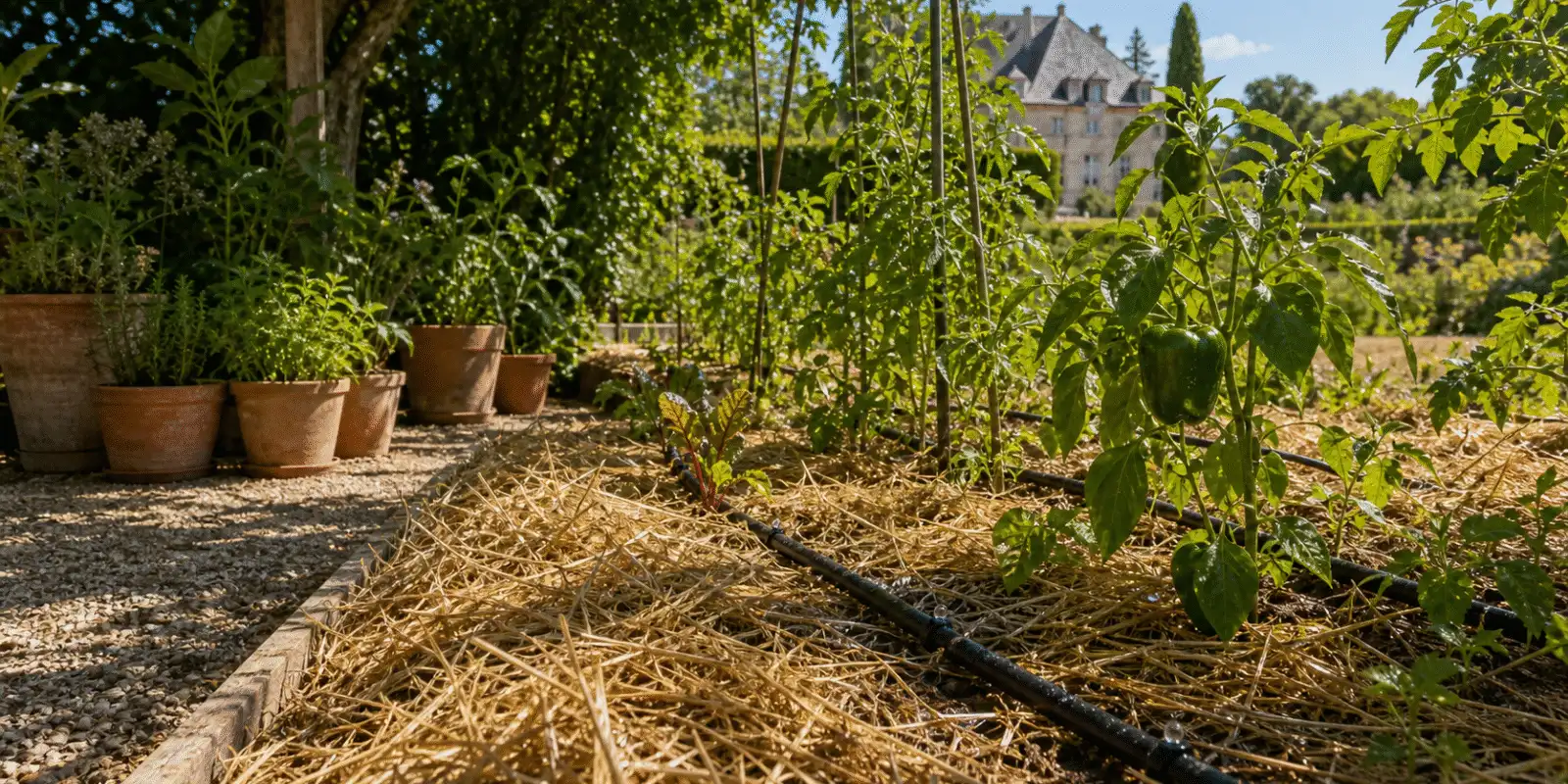
Going away in the middle of a heatwave without letting the garden die is entirely possible: you automate the watering (drip lines + timer for the vegetable garden and borders), install ollas and ceramic spikes for the pots, and group the containers in the shade under mulch. Golden rule: start the system at least a week before you leave, to fine-tune it. This guide closes the heatwave cluster of Outdoor Design.
The Chatelain Method before you leave
We observe what really depends on watering (pots, vegetable garden, young plants); we diagnose the length of the absence and the autonomy needed; we correct with the right system; we prevent the nasty surprise by testing everything before departure.
The comparison of solutions
| Solution | For what | Autonomy | Strength |
|---|---|---|---|
| Drip line + timer | Vegetable garden, borders, planters | The whole absence (on a tap) | The most reliable and regular |
| Terracotta ollas | Vegetable garden, large pots | 3 to 20 days | Thrifty (up to 75 % water), passive |
| Ceramic spike + bottle | Pots, isolated plants | Up to several weeks | Very cheap, simple |
| Solar kit (pump on a butt) | Pots, no tap | Depending on the reserve | Self-contained, no electricity |
| Globes / water reserve | Ornamental pots | A few days | Decorative, short-term fix |
For the vegetable garden and borders: automate
A drip line connected to a timer on the tap is the reference solution: it delivers gentle, regular water straight to the base, even in strong heat, at the hours you choose (early morning). Complete it with terracotta ollas, which provide a self-contained buried reserve. If you have no outdoor tap, a solar kit pumps water from a butt (see harvesting rainwater in the garden). For setting the quantities, see watering in a heatwave.
The Chatelain’s rule of thumb. A ceramic spike screwed onto a bottle can water a potted plant for several weeks; an olla, several days before it needs refilling. But no autonomy is guaranteed without a full-scale test at least a week before: it is the only way to adjust the flow before it’s too late.
For the pots: multiply the small reserves
Pots are the most vulnerable: little soil, fast drying. Combine:
- Ollas and ceramic spikes for slow, continuous diffusion.
- A wick system (capillarity from a water reservoir).
- Self-watering planters for new plantings.
- Grouping in partial shade: close together and sheltered, pots evaporate less and shade each other.
What to do before you leave
- Mulch the surface of pots and beds to limit evaporation (see protecting the vegetable garden from a heatwave).
- Group the pots in shade or partial shade, away from scorching surfaces.
- Harvest the vegetables and fruit already ripe.
- Raise the mowing height and let the lawn go dormant (see a lawn scorched by the heatwave).
- Test the system a week before and, if possible, ask a neighbour to keep an eye on it.
Mistakes to avoid
- Leaving without testing the automatic watering: a badly set flow ruins everything.
- Leaving pots in full sun: they dry out despite the reserves.
- Relying on one big watering the day before: not enough for an absence in a heatwave.
- Forgetting to mulch: the water reserves evaporate faster.
FAQ
How do you water your garden while on holiday in a heatwave?
You automate: a drip line connected to a timer for the vegetable garden and borders, ollas and ceramic spikes for the pots, and grouping the containers in the shade under mulch. Test the system at least a week before leaving.
Which watering system should you choose for a long absence?
A drip line on a timer is the most reliable for a long absence. Without a tap, a solar kit on a butt takes over. For a few pots, ceramic spikes on a bottle offer several weeks of autonomy.
How long do an olla or a spike last without intervention?
An olla provides 3 to 20 days depending on its size; a ceramic spike screwed onto a large bottle can diffuse for several weeks. The real duration depends on the heat and the plant’s needs.
What to do with the pots before leaving in a heatwave?
Mulch their surface, group them in partial shade away from scorching surfaces, and set up a water reserve (olla, spike, wick). In full sun, they would dry out regardless.