Ollas: Buried Clay-Pot Irrigation That Saves the Vegetable Garden
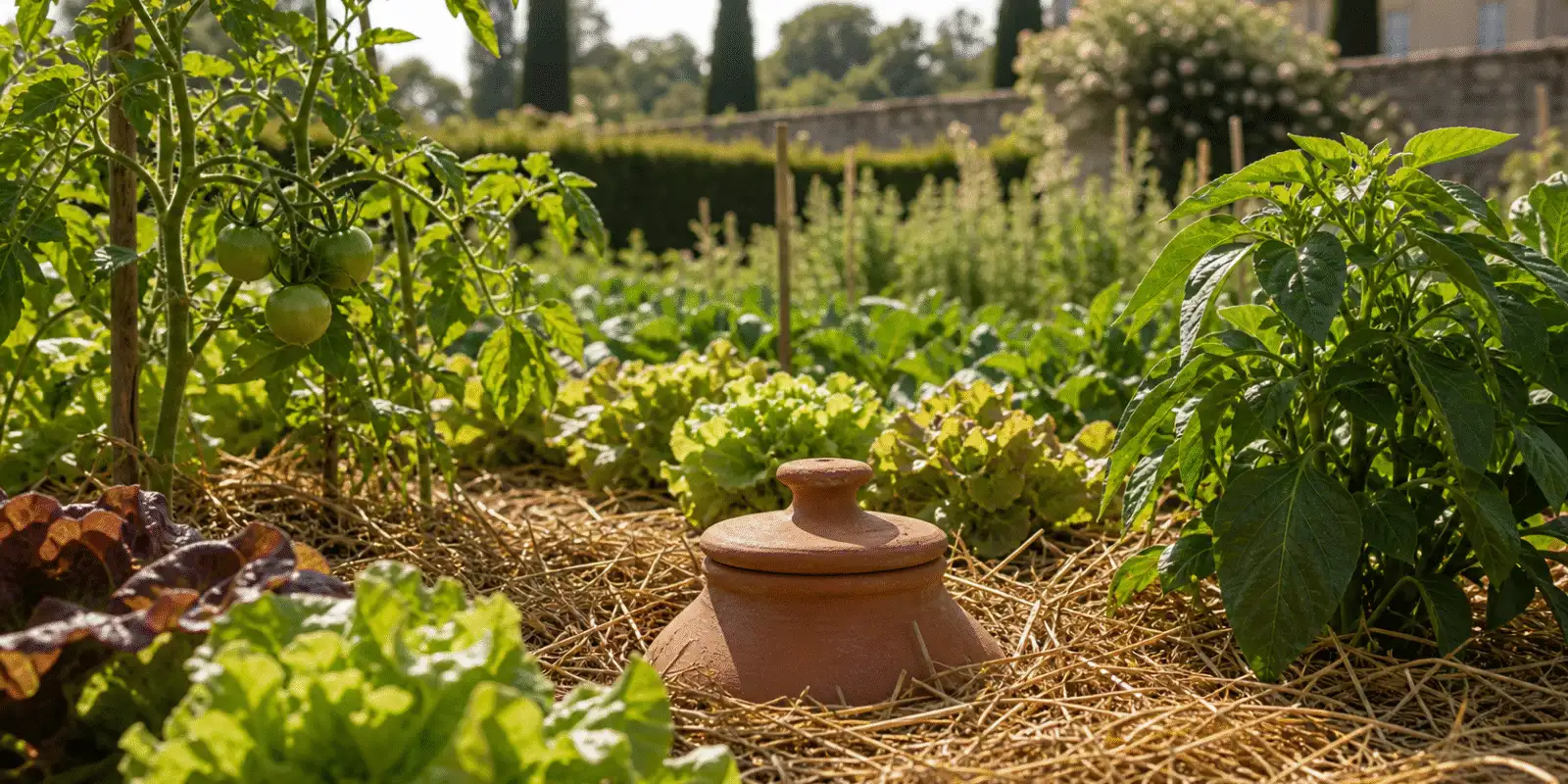
An olla is a microporous terracotta pot buried among the crops and filled with water: it diffuses slowly by capillarity, straight to the roots and on demand from the plant. The result: up to 75 % water savings and an autonomy of 3 to 20 days depending on size. It is the ideal ally of the vegetable garden in a heatwave, a companion to the garden and heatwave guide.
The Chatelain Method and the olla
We observe the water needs of each bed; we diagnose the olla size suited to the area; we correct waste with targeted diffusion; we prevent water stress with a permanent buried reserve.
How an olla works
Porous terracotta lets water through according to soil moisture: when the soil is dry, water migrates through the wall; when it is moist, diffusion slows. The plant « helps itself » at its own pace, without excess or lack. This self-regulation explains both the water savings and the absence of water stress — the opposite of surface watering, which alternates between drowning and drought.
The Chatelain’s rule of thumb. A buried olla feeds the roots deep down, without a drop lost to evaporation — unlike a watering can, part of which evaporates at the surface in a heatwave. That is why savings reach up to 75 % compared with conventional watering; research even puts subsurface olla watering at up to ten times more efficient.
Which olla size for which area
Correct sizing is everything. Here are the common benchmarks.
| Olla volume | Area covered | Typical use |
|---|---|---|
| 0.3 L | radius ~15 cm | plug, small plant, seedling |
| 1.5 L | diameter ~40-60 cm | tomato plant, potted plant |
| 5 L | up to ~1 m² | vegetable bed, shrub |
| 10 L and up | several m² | border, large bed |
Autonomy ranges from 3 to 20 days depending on size; in practice, refill every 4 to 9 days, more often in a heatwave or for thirsty crops. It is also a precious solution to water while you are away.
Installing your ollas
- Bury the olla between the plants, ideally at transplanting time, leaving the neck above the soil.
- Fill with water and fit the lid (it limits evaporation and stops mosquitoes laying eggs).
- Space the ollas according to their reach to cover the whole bed.
- Mulch around them to reinforce the effect (see protecting the vegetable garden from a heatwave).
Maintaining and storing your ollas
- Descale from time to time: limescale eventually clogs the pores (white vinegar, brushing).
- Check the level regularly in a heatwave, as the olla can empty faster.
- Overwinter away from frost: an olla full of water can crack as it freezes. Empty it and bring it in for winter.
Making your own olla
No need to invest straight away: two unglazed terracotta pots, glued rim to rim (food-safe sealant), the bottom hole plugged and the top hole used for filling, make a cheap homemade olla. The terracotta must stay porous (unglazed) for capillarity to work.
FAQ
How does an olla work?
It is a porous terracotta pot, buried and filled with water. The water passes through the wall by capillarity according to soil moisture: the plant helps itself on demand, straight to the roots, with no evaporation or waste.
How much water does an olla save?
Up to 75 % compared with conventional watering, because the water goes straight to the roots without evaporating at the surface. It is one of the most water-efficient irrigation systems.
Which olla size should you choose for a vegetable garden?
For a bed of about 1 m², a 5 L olla is suitable; for a tomato plant or a planter, 1.5 L is enough. Multiply the ollas according to the area to cover and their reach.
Should you bring ollas in for winter?
Yes, in regions where it freezes: an olla full of water can crack as it freezes. Empty it and store it away from frost until spring.