Scorched Lawn in a Heatwave: Should You Water and How to Save It
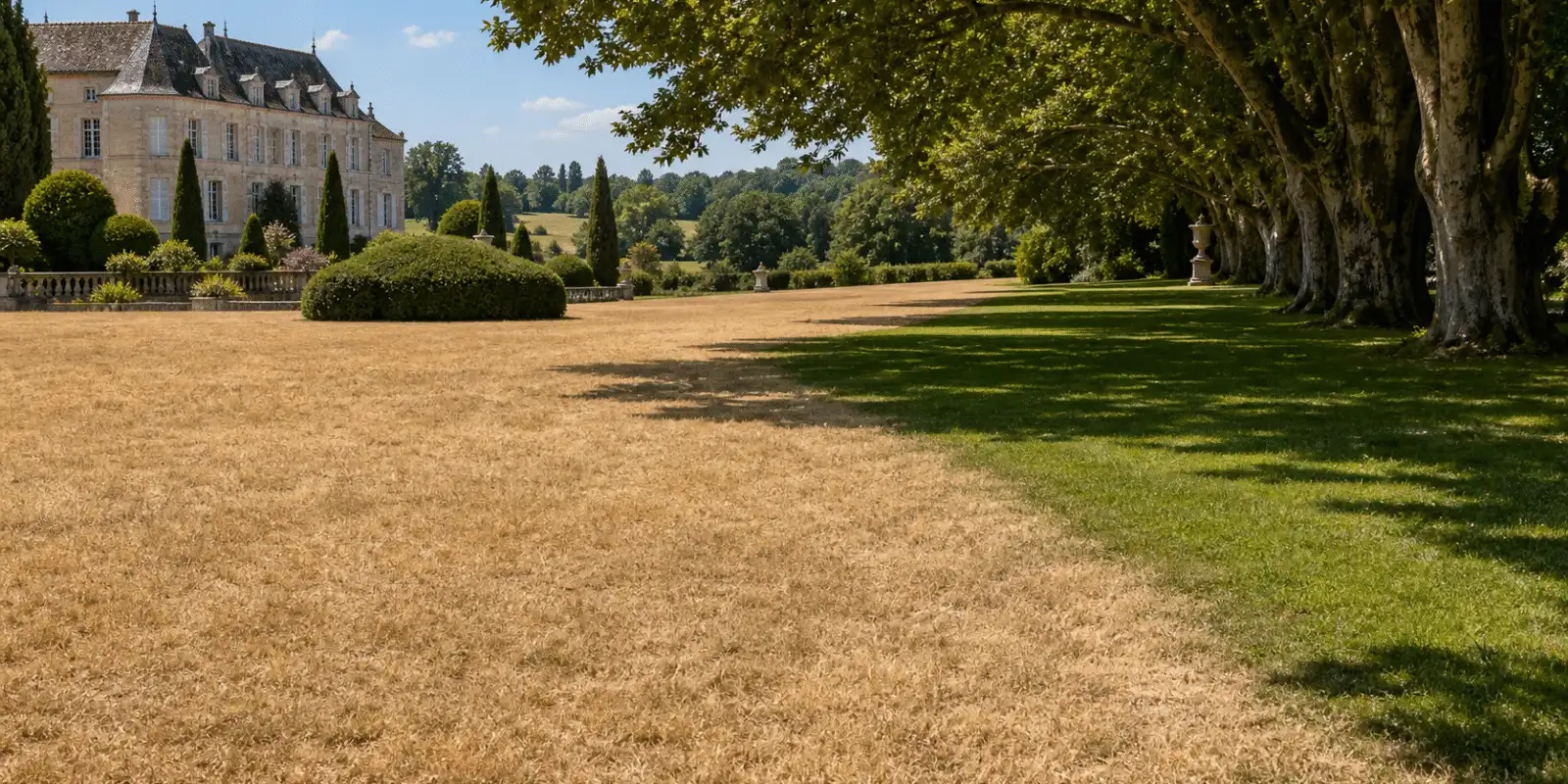
Reassurance first: a lawn that turns yellow in a heatwave is not dead, it is asleep. Above 30 °C and without water, grass enters summer dormancy — it stops growing, turns brown, but greens up again with the first autumn rains. So you can let it sleep (and save hundreds of litres) or keep it green at the cost of deep watering. The only exception: a lawn sown less than a year ago. This guide complements Outdoor Design.
The Chatelain Method for the lawn
We observe the age of the lawn and its state; we diagnose dormancy (reversible) or true dieback; we correct with the right watering call; we prevent with high mowing and suitable species.
Why the lawn turns yellow in a heatwave
Yellowing is a defence mechanism: to survive dry spells, grasses stop growing and put their above-ground part to sleep, keeping their reserves in the roots and crown. It is dormancy, not death. With rain and cooler weather, the lawn starts again and greens up.
The Chatelain’s rule of thumb. Letting an established lawn go dormant saves several hundred litres of water a week and removes mowing for 4 to 6 weeks, without lasting damage. Trying to keep it green at all costs in a heatwave means a lot of water for a fragile result.
Should you water? The right call
| Situation | Decision | How |
|---|---|---|
| Established lawn (> 1 year) | Let it sleep (recommended) | No watering; it will green up in autumn |
| You insist on a green lawn | Deep, spaced watering | ~20-25 L/m², once a week, soaking 15-20 cm |
| Lawn sown < 1 year ago | Never let it sleep | Water generously at least once a week |
The mistake would be the in-between: small daily waterings that don’t soak in, waste water and keep fragile roots. Either let it sleep or water thoroughly, never half-way. For the technique, see watering in a heatwave.
Mowing in hot weather
- Raise the height to 8-9 cm: tall grass shades its own soil, keeps it cool and limits evaporation.
- Leave the clippings in place (mulching): they form a natural mulch that cuts evaporation by around 20 to 30 %.
- Mow early in the morning or in the evening, never in full heat, to avoid stressing the blades.
- Don’t mow at all when the lawn is dormant: growth has stopped, mowing is pointless and harmful.
Towards a more thrifty lawn
If the heatwave returns every summer, you can rethink the space: shrink the grassed area, overseed with more resistant species (fescues), or replace part of the lawn with dry borders and ground covers that need no water — see drought-resistant plants. Outside heat spells, the foundation of care is scarifying the lawn.
FAQ
Is a lawn scorched by a heatwave dead?
No, in the vast majority of cases it is only dormant: it turned yellow to survive the dry spell and will green up with the first autumn rains. An established lawn copes very well with this phase.
Should you water your lawn during a heatwave?
For an established lawn, it is not necessary: you can let it sleep. If you insist on keeping it green, water deeply once a week (20-25 L/m²). A lawn sown less than a year ago, though, must be watered to survive.
At what height should you mow in strong heat?
Raise the cut to 8-9 cm: tall grass shades the soil and limits evaporation. During dormancy, don’t mow, since growth has stopped.
Should you collect the clippings in summer?
No, better to leave them in place: they form a natural mulch that cuts evaporation by 20 to 30 % and feeds the soil. That is the principle of mulching.