When to harvest olives: the fruit decides, not the calendar
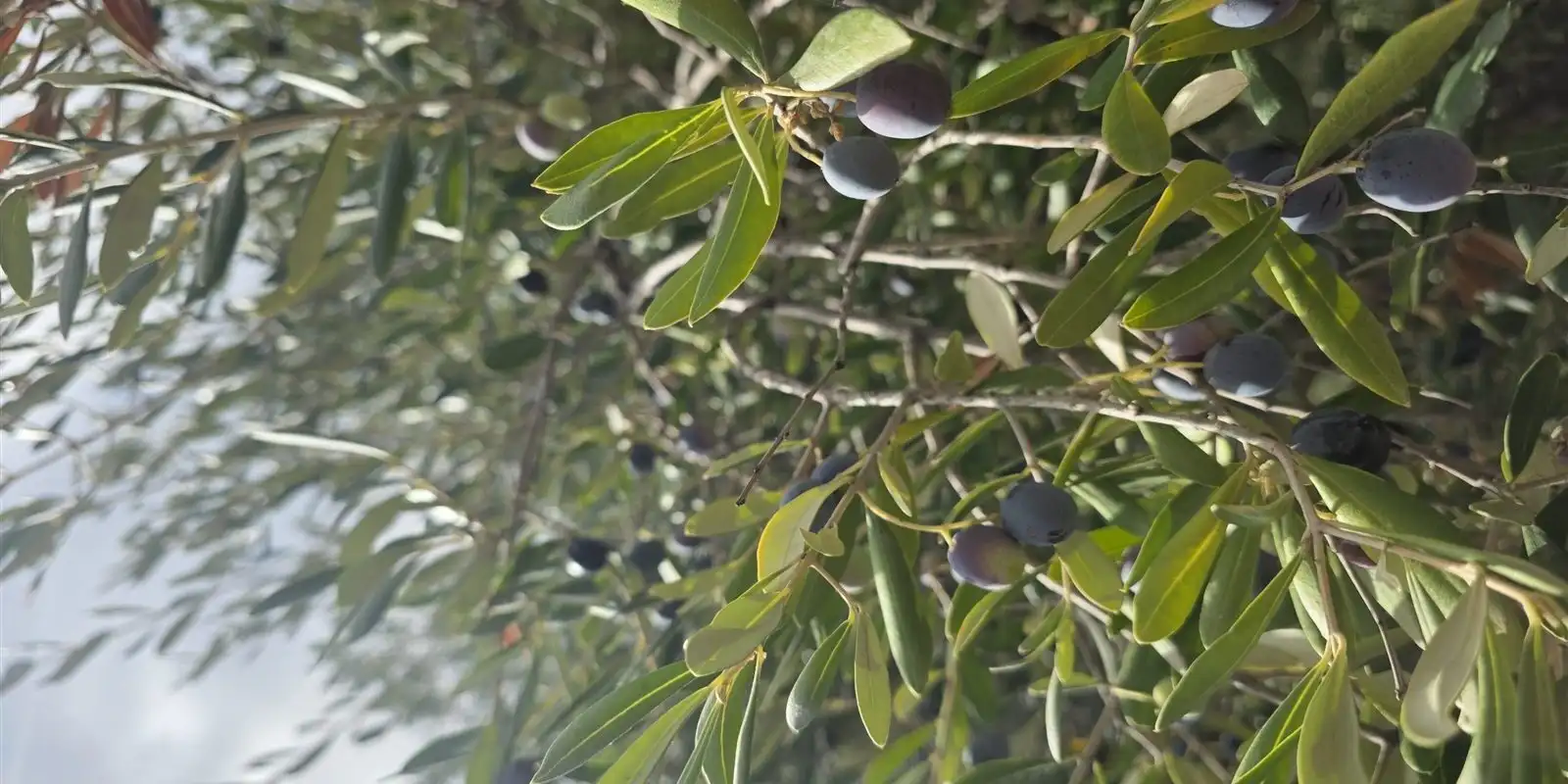
There is no harvest date for olives. There is a stage of the fruit, an intended use and a health
status, and those three rarely line up on the same day two years running. The professional answer is
a count rather than a calendar: the maturity index, read on a scale of 0 to 7 across a hundred
fruits.
In Britain there is a prior question, and it is the honest place to start. Olive trees rarely fruit
here. The RHS is blunt about it: olives are usually grown for their shape and foliage, they fruit
reliably only in southern England after a hot summer, and fruiting becomes rare further north. If
your tree has set a real crop this year, that is already the unusual part.
First, the British reality check
A tree that carries a handful of fruit is not a tree you harvest, it is a tree you taste. Picking
twenty olives is worth doing for the experience, but the preparation that follows takes weeks
whatever the quantity, so it is worth knowing in advance whether you have enough to bother with a
jar.
Two things limit fruiting in the UK. Olives need a cool period to initiate flower buds, and they need
warmth afterwards to ripen the crop, which is why a container tree wheeled into a frost-free
conservatory all winter often flowers poorly. Most olives tolerate roughly −5 to −10 °C, but
container-grown plants are more exposed and are usually moved to a sheltered, frost-free spot for the
winter. Ripening then runs late: where fruit does colour up, it tends to do so in November, with the
weather closing in.
That gives British growers a different first question from Mediterranean ones. It is not have the
olives reached the ideal stage, it is will they reach any usable stage before the weather ends the
season. If fruit is still hard and grass-green in late autumn, picking it green for the table is
usually a better outcome than waiting for a colour change that will not arrive.
Reading the fruit, and on how many olives
Ripening shows in the skin. Fruit goes from green to yellow-green, then takes on red and purple
tones, and finally darkens. The trade reads that progression as a number: the maturity index,
scored on a 0 to 7 colour scale across 100 fruits taken at random from around the tree.
That sampling rule matters more than the scale itself. On a single branch the fruit is never all at
the same stage: fully black olives sit next to part-coloured ones and next to green ones. Whichever
olive you happen to taste tells you nothing about the tree. Take fruit from all four sides, at hand
height and higher, in sun and in shade, and cut a few open.
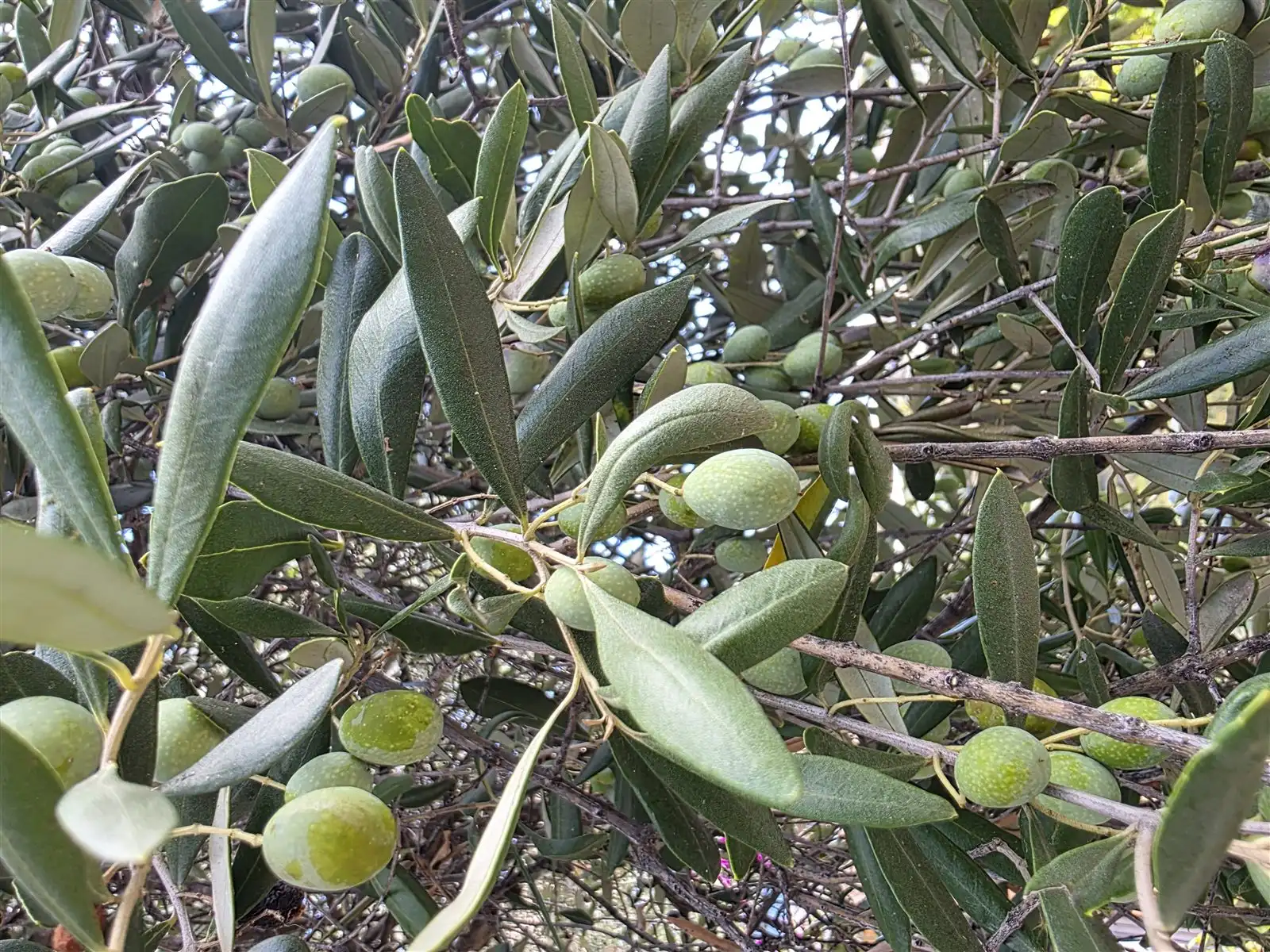
For green table olives, the fruit should have reached full size while the skin is still green to
yellow-green. Two checks beat colour alone: the stone should come away from the flesh fairly easily
or turn within it, and the juice pressed from the fruit should be milky rather than green. Frankly
green juice means the olive is still immature and will cure hard and grassy.
For black table olives, wait until the skin is properly black, with the flesh still firm and
parting cleanly from the stone. A soft olive is not a riper olive, it is one that has started to go
over.
For oil, black skin does not automatically mean the best moment has arrived, because oil
accumulates before the fruit finishes darkening. Early picking gives greener, more bitter and more
pungent oil at a lower yield; later picking raises the yield, softens the profile and costs
stability.
When pest damage decides before ripeness does
In the Mediterranean, the olive fruit fly (Bactrocera oleae) usually sets the date, not the colour.
French trade guidance is explicit: do not harvest trees where more than 10 % of the fruit shows fly
exit holes, and bring the harvest forward rather than wait, timing it at the latest three weeks
after exit holes first appear. Early picking costs oil yield and saves the batch.
British growers can usually set this aside, since the fly is a pest of olive-growing regions rather
than of a pot on a Surrey terrace. It matters if you harvest a tree abroad, or if you buy fruit to
cure. Check a sample for pinprick holes before committing to a jar.
On our own ground near Nice, this is what moves the date more often than colour does, because we
apply no plant protection products at all and rely solely on beneficial insects. That choice has a
cost worth stating plainly: it means accepting a non-zero level of damage and thinking in terms of
population balance rather than eradication. With no treatment available, the harvest date is our main
lever.
The frost question
The idea that olives should be left until the first frost to sweeten them is widespread and worth
dismantling, because it confuses two different things.
On genuinely frozen fruit, the research is unflattering. Morelló and co-authors, writing in Food
Chemistry in 2003 on the Arbequina variety, recorded a marked fall in secoiridoid compounds, lower
oil stability and a flattened sensory profile, with bitterness gone and pungency reduced. Oil that
turns sweet after a frost is not mellowed oil, it is oil missing part of its antioxidants.
Then there is the example always quoted, the French appellation whose black olives are picked finely
wrinkled after the first cold spells of December and January. It is real, and it proves the opposite
of what it is used to prove: that specification requires at least 60 % wrinkled olives in the batches
sold, while tolerating no more than 2 % frosted, maggot-damaged or hail-damaged fruit among its
defects. The appellation built on cold-wrinkled olives is precisely the one that refuses frozen ones.
Wrinkling is water loss; freezing is cell damage.
Worth separating too: the hardiness figures you find for olives describe the tree, not the fruit.
A tree that shrugs off a cold night says nothing about what that night did to a crop still hanging on
it.
Picking without bruising
Olives mark easily, and a bruised fruit keeps badly. That single fact explains most of the
professional advice: spread clean nets, pick by hand or with a hand comb, work the accessible wood
without forcing it, empty the nets regularly and avoid treading on fruit. Mechanical combs and
shakers exist to speed the work, not to improve it.
Our own sequence, for what it is worth as one grower’s organisation rather than a rule: nets down
first, then the year’s pruning, carried out during the harvest rather than in another season,
then the olives are picked off the cut branches before the wood is cleared, and only then is the
opened-up tree worked with an electric comb.
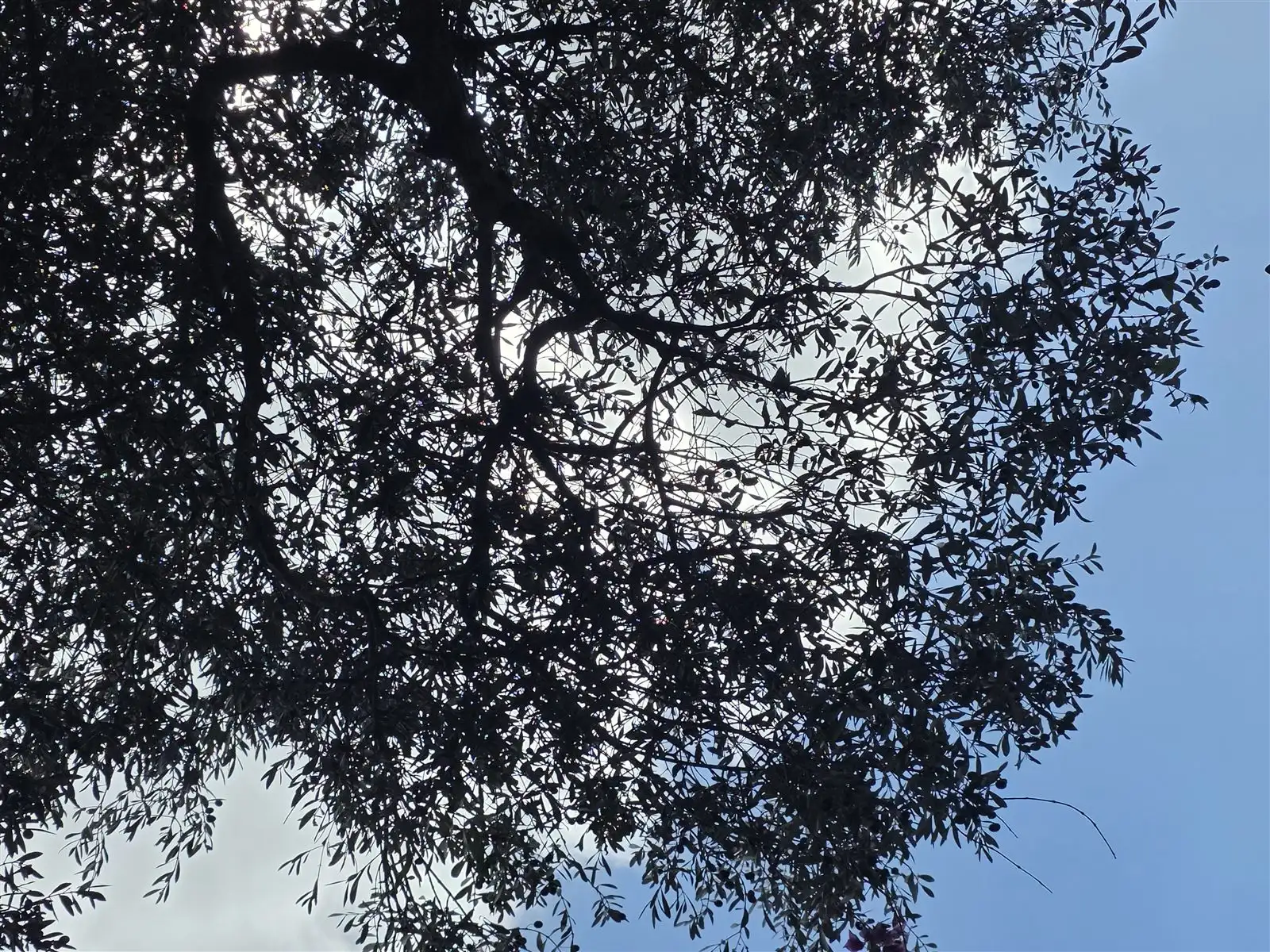
Traditional beating with a pole works, and we fall back on it when branches are too tangled for the
comb, but it is best avoided because it is exhausting. The detail says the important part: if the
pole becomes necessary, the problem is not the tool, it is the tree. Hence the pruning rule we apply,
more useful than a height in metres: everything must be reachable from the ground, without a
ladder. The moment you have to climb, the tree is too tall.
A tree pruned for harvest gives us 80 to 100 kg. One left to grow exceeds that, sometimes by a
lot, and the gain is partly illusory, because what it produces extra is lost in what can no longer be
reached. Three trees picked clean beat two picked halfway. Reckon on two to four hours per tree for
one person, in a single pass.
| Figure | Value | Nature |
|---|---|---|
| Picking time | 2 to 4 h per tree, one person | observation, our ground |
| Number of passes | 1 | our practice |
| Crop from a tree pruned for harvest | 80 to 100 kg | observation, our ground |
| Nets laid | 2 weeks before picking | our practice |
| Share going to oil | 90 % | our practice |
For the arithmetic of how many trees it takes before a mill will press your batch, the full
calculation is in
how many olive trees you need for your own oil.
Fallen fruit
The trade rule is unambiguous: do not gather olives that have fallen on the ground, because of
the risk of earthy taints and moulds. Washing does not rehabilitate fruit that has already spoiled.
Appellation rules go further still, excluding even fruit that has dropped naturally onto permanent
nets, which must be emptied before protected picking begins.
Our practice departs from that, and it is better said than dressed up. Because the nets go down a
fortnight early, olives that drop on their own land on clean fabric rather than on soil, and we try
to recover them. Those go to oil, never to the table. We claim no appellation, which is what
leaves us that latitude. The rule to take away is still the professional one: fruit that has touched
the ground stays out of the batch, and an olive picked up off a net is not worth the same as one
taken from the tree that day.
The hours after picking
This is the most neglected stage and the one that quietly spoils most crops. The sequence is always
the same: sort out leaves and twigs, put the fruit into clean, perforated plastic crates,
avoid contact with metal or non-food-grade plastic, keep it away from fuel and running engines, do
not let it ferment, and get it to the mill as quickly as possible. Olives should arrive sound, whole
and uncrushed, which rules out sacks and deep heaps where the mass heats up for want of air. As a
guide to container size, the strictest specifications cap slatted crates at 20 kg.
Research has put a number on « quickly ». Beltrán and co-authors, writing in the Journal of the
Science of Food and Agriculture in 2021, concluded that olive storage should be avoided or kept to
under twelve hours, and that fruit should not be washed before storage, since washing encourages
sensory losses and the formation of ethanol.
We do not manage it, and the gap is worth exposing. A slot is booked at the mill before picking even
starts, but our transport capacity is 500 kg per trip and delivery spreads over seven days.
That is not best practice, it is the constraint of a holding that moves its own crop. It does produce
a useful rule: since transport sets the pace, book the slot before you fill the crates, not after.
Cleaning gets shared, for reasons of cost rather than capability. Our mill does the full clean,
leaves included, so we could deliver the fruit as it comes. We still take out the bulk in the grove,
because what arrives clean costs less to press. Ask your mill what it cleans and what it charges;
the answer decides how much effort is worth making before you load. And never dry olives destined for
oil: waiting is not a preparation stage, it is a loss.
Curing olives at home, safely
Fresh olives are intensely bitter, black ones included, because of oleuropein. Curing is not a
flavouring step, it is what makes the fruit edible. The reference text in English is the University
of California’s Olives: Safe Methods for Home Pickling, which sets out the water, brine, dry-salt
and lye methods along with the safety and storage points that matter.
Sort first and discard damaged fruit, separate sizes if you can so that a batch cures evenly, rinse
in drinking water, and start promptly rather than leaving picked fruit sitting in a warm kitchen.
Water curing is the simplest approach: cover the olives with fresh water in a clean container and
change it daily. No fixed number of days applies to every batch, since ripeness and size both move
it. Tasting is the only reliable test, and you continue while the bitterness is still unpleasant.
Brining suits black fruit, which takes no lye: wash, then cover with brine and leave it for
months rather than weeks before the fruit becomes pleasant. Keep the olives fully submerged.
Dry salting is a distinct method for ripe black fruit rather than a step you can tack onto any
batch, and lye curing is the fast industrial-style route that demands a precise protocol,
chemical-resistant gloves and eye protection. The order rule never bends: lye goes into water,
never water onto concentrated lye.
Store jars cool, dark and fully covered with their liquid. Throw a batch out without debating it if
there is a frankly off or putrid smell, significant mould, marked softening, an abnormally swollen
jar or a large loss of brine. When in doubt, do not eat it.
Frequently asked questions
My olive tree has never fruited. Am I doing something wrong?
Probably not. Fruiting is rare in much of the UK, reliable only in the warm south after a hot summer.
A tree kept frost-free all winter may also miss the cool spell that triggers flower buds.
Should I wait for the first frost?
No. Frozen fruit loses phenolic compounds and stability, and the appellation famous for cold-wrinkled
olives tolerates only 2 % frosted fruit in its batches. Wrinkled is not frozen.
Are green and black olives different varieties?
No, they are two stages of the same fruit. The same tree gives both; what changes is when you pick
and how you cure.
Can I pick over several weekends?
On a few trees, yes, though each pass means judging ripeness and fruit health again. We pick in a
single pass and accept that not every fruit is at the exact stage, because batch consistency matters
more than each olive’s theoretical optimum.
Sources and further reading
- RHS, how to grow olives — fruiting in the UK,
hardiness and container growing. - RHS, growing olives — siting,
overwintering and what to expect from a potted tree. - University of California ANR, Olives: Safe Methods for Home Pickling
— water, brine, dry-salt and lye curing, with safety and storage guidance. - France Olive, Cahier de l’oléiculteur 2026
— harvesting and transport rules, and the fly exit-hole threshold (French, cited as the primary
source for Mediterranean practice). - Morelló et al., 2003, « Effect of freeze injuries in olive fruit on virgin olive oil composition »,
Food Chemistry 81, pp. 547-553 — what frost does to the fruit. - Beltrán et al., 2021, « How olive washing and storage affect fruit ethanol and virgin olive oil
ethanol, ethyl esters and composition », Journal of the Science of Food and Agriculture 101,
pp. 3714-3722 — washing and storage before pressing.
Elsewhere in this section:
Orchard and citrus · How many olive trees for your own oil · Olive tree in a heatwave · Watering citrus: what your soil decides