Olive Tree in a Heatwave: How Much Water to Save It?
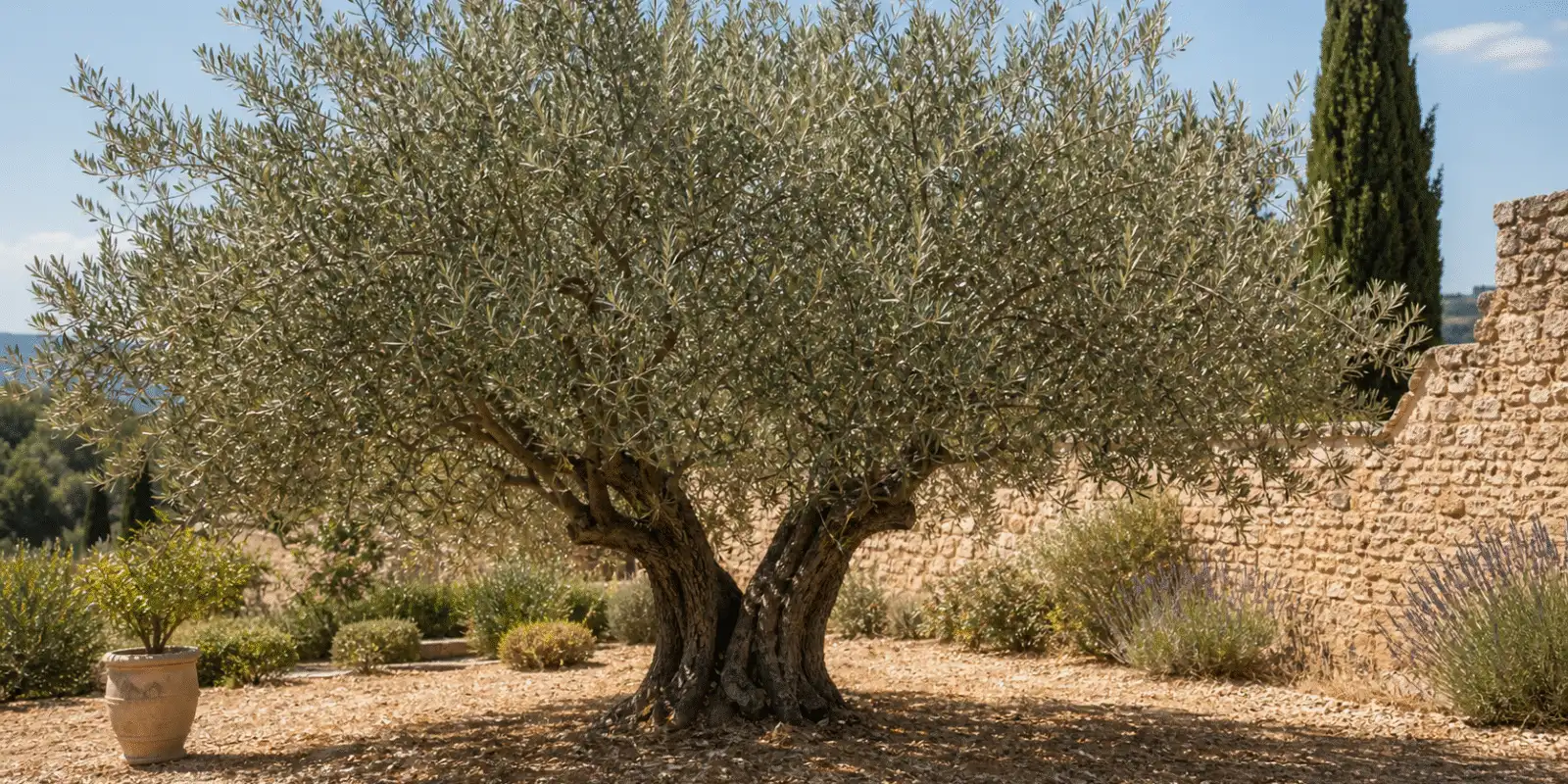
If an olive tree planted in open ground is under heatwave stress and the soil is dry about 20 cm down, give it 20 L that evening as the first rescue dose. Use 40–60 L for a medium tree and up to 100 L for a very large specimen with a broad, dense canopy. Apply the water slowly in two or three passes over the root zone beneath the branches, not as one pool against the trunk. These are practical emergency starting amounts, not a fixed watering schedule, and they do not apply to potted olives.
How much water should you give an olive tree tonight?
The first decision is not whether the air feels hot, but whether the useful root zone is dry. Make a narrow hole with a trowel or spade at two or three points beneath the canopy. If the soil is still cool and moist at about 20 cm, wait. If it is dry at that depth and the tree is showing lasting heat stress, use the following rescue scale.
| In-ground olive | First evening rescue dose | How to apply it |
|---|---|---|
| Small or modest tree | 20 L | Two slow passes across the root zone beneath the branches. |
| Medium established tree | 40–60 L | Two or three passes, moving around the canopy so one patch is not flooded. |
| Very large tree with a broad, dense canopy | Up to 100 L | Three slow passes over the wider root zone; pause whenever water stops infiltrating. |
France Olive’s establishment guidance records a 20 L watering for a newly planted olive when necessary. That supports the order of magnitude of the first band; it does not make 20 L a universal prescription for every mature tree.
This is the practical rescue scale used in this guide, not an official universal prescription. The France Olive 2026 technical handbook advises checking the root zone with a hole about 20 cm deep and stresses that water demand changes with heat, wind, tree dimensions, soil reserves and the irrigation method. Those variables matter more than a calendar.
The immediate rule. Dry at 20 cm: begin with the size-adjusted dose that evening. Moist at 20 cm: do not add water merely because the day was hot.
Put the water under the canopy, not against the trunk
An olive does not drink through the bark at the base of its trunk. Spread the dose over the soil explored by its active roots, broadly beneath the spread of the branches. Keep the first few centimetres around the trunk free of a permanent puddle and keep the foliage dry.
The Royal Horticultural Society’s watering guidance recommends slow, thorough watering that reaches the root zone. Watering after the direct heat has eased is acceptable; early morning is another efficient window. During a rescue in the evening, the important point is to wet the soil rather than the leaves.
- Deliver roughly one third to one half of the dose.
- Wait for it to infiltrate, then move around the tree before the next pass.
- Stop if water remains on the surface or runs away from the root zone.
- After the final pass, do not schedule the next watering automatically; inspect the soil again.
Very dry or compacted soil may initially repel water. Two or three passes give it time to accept the dose. In heavy clay, use smaller passes and longer pauses. A nominal 100 L is not a target to force into soil that is already saturated or unable to drain.
Why a large canopy can justify up to 100 L
Tree size is not decorative information: it changes water use. Leaves release water through transpiration, while sunlight, temperature, humidity and wind influence evaporation. Forest Research’s explanation of tree water use describes this root-to-leaf transpiration stream. The France Olive handbook likewise notes that olive-water demand varies with the dimensions of the tree.
A very large olive with an extensive crown therefore cannot sensibly receive the same rescue amount as a modest young specimen. The 20 L dose is the starting point; the 40–60 L and 100 L bands scale the intervention to the crown and root zone. Soil still decides whether that water is needed and whether it can be accepted safely.
The Chatelain Method: save the tree, then protect the crop
Observe → Diagnose → Correct → Prevent. First inspect the root zone and the canopy. Diagnose genuine dryness rather than reacting to temperature alone. Correct it with one deep, measured rescue. Then conserve the replenished reserve with mulch and repeat only when the soil diagnosis calls for it.
Observe the right signs
Early-morning drooping that does not recover in the cool period, dull or curling foliage and dry soil at depth support a drought diagnosis. Yellow leaves alone do not. Yellowing can also accompany saturated soil, damaged roots or disease, so the spade check is more reliable than leaf colour on its own.
Correct the shortage without creating another problem
After watering, the aim is soil that is moist at depth but still aerated. Persistent standing water or saturated soil points away from thirst. Do not repeat a large dose until drainage and the condition of the root zone have been reassessed.
Prevent the next rapid loss
Once the water has infiltrated, an organic mulch can reduce evaporation and competition from weeds; keep it clear of the trunk. For a wider plan covering borders and orchard plants, use our guide to watering a garden during a heatwave.
Saving the tree is not the same as saving its olives
An established olive may remain alive through drought while sacrificing shoot growth, flowers, fruit retention and fruit size. That is why a silver-green canopy is not proof that the current water supply is enough for a worthwhile harvest.
France Olive’s technical evidence links water stress during flower and early fruit development with poorer fruit set and smaller final fruit. Stress during pulp growth can also produce smaller olives with a lower pulp-to-stone ratio. The RHS olive guide makes the same practical distinction for British growers: olives are drought tolerant, but moisture during active growth matters when a crop is wanted.
A one-off 100 L rescue can still be below the water needed to sustain production. In the France Olive 2026 handbook, indicative July–August requirements for adult productive trees without rain range from 180 to 300 L per tree per week, depending on the irrigation system. Those are Mediterranean orchard figures, not a domestic UK schedule. They show why “the tree survived” and “the crop was protected” are different outcomes.
In a British garden, summer warmth and flowering conditions also limit cropping. Water cannot create olives where those conditions are absent. When fruit is already present, however, allowing the root zone to remain severely dry can needlessly reduce what the tree is capable of carrying to harvest.
How to tell whether the rescue watering worked
Do not judge success by a wet surface. Once the dose has had time to infiltrate, inspect the soil again at about 20 cm within the watered root zone. It should feel evenly moist, not sticky and saturated. There should be no lasting puddle and no stream of water escaping beyond the canopy.
- Successful infiltration: moisture has reached depth and the soil still contains air.
- Too little or badly distributed: one patch is wet but the wider root zone remains dry.
- Too much or poor drainage: water persists on the surface, the soil smells stagnant or the root zone remains saturated.
- Wrong diagnosis: the soil is moist but decline continues; investigate roots, disease and previous damage rather than adding more water.
Recheck as the weather, wind and soil change. Do not turn the rescue dose into a daily or weekly ritual. A sandy soil may dry again far sooner than a deep loam; heavy clay can retain the same intervention much longer.
This 20–100 L scale does not apply to olive trees in pots
Do not pour these full-ground quantities into a container. Pot volume, compost, drainage holes, material and exposure control the safe dose. For a potted olive, moisten the whole root ball slowly, let surplus water drain completely and never leave the pot standing in water. The table above is exclusively for olive trees planted in open ground.
Check a live hosepipe ban before applying the dose
In England and Wales, Ofwat explains that a Temporary Use Ban can prohibit watering a garden with a hosepipe, while a watering can or bucket may remain available under the published conditions. Always check the current notice from your water company. Our dedicated guide summarises hosepipe bans and what you can still water; the live local notice takes precedence.
FAQ
How much water should I give an olive tree during a heatwave?
For an olive in open ground with soil dry about 20 cm down, start with 20 L that evening. Use 40–60 L for a medium tree and up to 100 L for a very large, broad-canopied tree. Apply it slowly in two or three passes beneath the canopy.
Should I pour the water at the base of the trunk?
No. Distribute it across the root zone under the spread of the branches. Avoid creating a deep puddle against the trunk, and stop if the soil no longer absorbs the water.
Is 100 L too much for a large olive tree?
Not necessarily for a very large in-ground tree in genuinely dry soil, provided it is applied slowly over a wide root zone. It can be unsafe in wet, compacted or poorly drained soil. Check at depth first and use ponding as a stop signal.
Will this watering save the olive crop as well as the tree?
It can relieve immediate water stress, but one rescue dose does not guarantee a crop. Ongoing soil moisture, heat, flowering, pollination and cultivar all matter. A large productive tree may need more water over time than the single rescue amount.
Sources and further reading
- Royal Horticultural Society — watering plants wisely
- Royal Horticultural Society — how to grow olives in Britain
- Forest Research — Water Use by Trees
- France Olive / Centre Technique de l’Olivier — Cahier de l’Oléiculteur 2026
- France Olive — care after planting
- France Olive — the olive tree and water
- Ofwat — hosepipe bans and non-essential use bans
- Back to Orchard and Citrus