Watering citrus: what your soil decides for you
The most common question about citrus is how often to water, and it is precisely the question with no universal answer. Two plants given the same amount of water on the same day can end up one thriving and one struggling. The variable that decides is not the calendar but the growing medium: its texture in the ground, its composition in a pot.
In Britain this matters even more than in the Mediterranean, because almost all citrus here live in containers rather than in open ground. A pot holds a small, finite volume of compost with no deep reserve to draw on, so it crosses the limits described below far faster than a garden bed ever will.
Why dry compost stops the plant drinking
This is the point that changes how you think about watering. Dry soil is not empty of water. It still holds some, but it holds it so tightly that roots can no longer pull it free. The water is present and measurable, yet unavailable.
Soil scientists call that limit the permanent wilting point: below it, the remaining water is bound to soil particles more strongly than roots can overcome. At the opposite end, field capacity is the most a soil can hold against gravity once free drainage has stopped. The gap between the two is the available water, and it is the only water the plant can actually use.
Good watering keeps the medium inside that band. Water too sparingly and the plant sits in front of moisture it cannot take up. Water too generously and the surplus drains below the roots, doing nothing except costing you water. In both cases the plant goes short, and the difference is invisible from the surface.
The container problem in a British garden
The RHS guidance on growing citrus sets out what our climate imposes: citrus are grown in pots, moved under cover before the first frosts, and kept in a bright, frost-free place through winter. Three consequences follow for watering.
Compost choice governs drainage. A citrus or ericaceous compost in the pH 5.5 to 6.5 range, opened up with perlite, drains freely and resists the compaction that turns a pot into a sump.
Rainwater is preferable to tap water, particularly in hard-water areas, because repeated watering with limey water pushes the compost pH upward and away from the range citrus need.
Winter overwatering is the single most frequent failure. The plant is cool, barely growing and losing very little through its leaves, so the compost stays wet far longer than in July. Applying a summer rhythm in January drowns the roots. The RHS notes on citrus problems make the same point: when in doubt in winter, err on the dry side.
If you grow in the ground, start with texture
For beds and borders the starting point is different. Sand, silt and clay hold water in very different ways, and the proportions in your soil set your own limits. The RHS guide to soil types offers a simple hand test, and a laboratory particle-size analysis gives the exact figures. It is a one-off expense: texture does not change from season to season.
What we measure on our own holding
Our own ground is near Nice, on the French Mediterranean coast, and it is not comparable to a British garden. We give our figures because the method transfers even though the numbers do not.
Laboratory analysis identified our soil as a sandy loam. From that texture we work to two thresholds: below roughly 12 percent moisture the plant can no longer draw water, and above roughly 25 percent the soil stops holding it and the surplus drains beyond the roots.
These are our numbers, for our soil, and for no other. A clay soil holds far more and shows markedly higher thresholds. A pure sand empties almost at once. Copying our figures onto a different plot would be meaningless. What does transfer is the sequence: analyse, identify the texture, derive your own limits.
The Chatelain Method applied to water
Observe. The soil analysis sets the framework, the instrument gives today’s reading. Together they replace an impression with a measurement.
Diagnose. Dull foliage can signal shortage or excess. The question is never « did I water recently » but « where is the medium within its band ». The symptoms converge, the causes are opposite. Our guide to a lemon tree losing its leaves works through that separation.
Correct. Adjust distribution before adjusting volume. Water delivered unevenly overshoots in one place while another stays below the threshold.
Prevent. Size the system against the water you actually have, not against the plant’s theoretical demand.
How we know where we stand
Part of the holding carries a tensiometer, which is not merely a display: it suspends irrigation for as long as the soil remains moist. The instrument makes the decision, and it makes it better than we would, because it reads where the roots are.
Elsewhere we work from calculation. Knowing what our emitters deliver per square metre, we know how long it takes to bring the soil into its band and when we risk leaving it through the top. The instrumented zone acts as a reference and calibrates the reasoning applied to the rest.
The reason for that split is ordinary: tensiometers are expensive, and fitting an entire holding with them is an investment we have not made. It is a compromise rather than an ideal, and it works only because at least one zone is genuinely measured.
Closely spaced emitters rather than a heavy flow
Our lines deliver 1.6 litres per hour every 20 centimetres. That is a soil physics decision rather than an equipment preference. Close spacing produces a continuous moist strip instead of isolated bulbs separated by dry ground, and a low flow gives the soil time to absorb as it goes. Together they let us rise into the useful band and stay there instead of shooting through it.
For the same reason we ruled out under-canopy sprinklers. The technique works elsewhere, but it delivers a great deal of water in a short time. On our sandy loam that means crossing the upper threshold and pushing part of what we have just applied below the root zone.
Mulching, and one thing to avoid
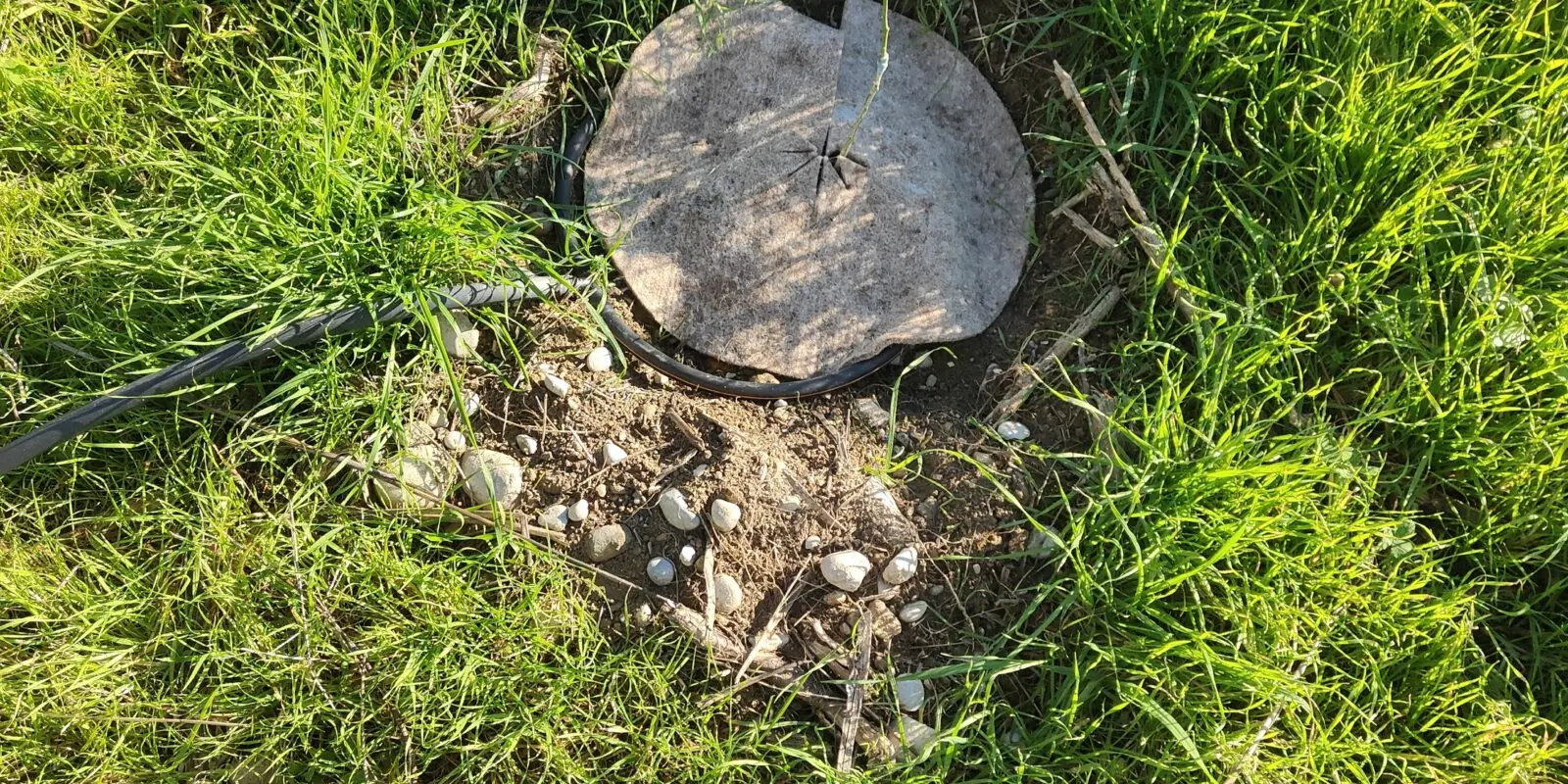
Mulch is the most effective lever for limiting evaporation, and our own practice is more mixed than the advice usually suggests. We gave up sheep wool mulch because it attracted wild boar onto an unfenced plot. Across most of the holding we now use no mulch at all and hoe by hand. On dense plantings and herb beds, where repeated hoeing damages the plants themselves, we use a woven ground cover renewed every five years. We try to limit plastic, and we have not managed to remove it.
Wood chip and hay remain excellent materials, on one condition that is too rarely stated: they belong on the surface and must never be dug in. Incorporated, they create waterlogging and cause nitrogen drawdown, because the micro-organisms breaking them down take up the available nitrogen at the crop’s expense.
The mistakes that cost most
- Watering to a calendar rather than to the state of the medium.
- Judging moisture on the top two centimetres, far from the working roots.
- Carrying a summer rhythm into winter on a plant that has almost stopped growing.
- Mistaking excess for shortage, since the leaf symptoms resemble each other.
- Leaving a pot standing in a saucer of water.
- Borrowing thresholds from another garden, ours included, without knowing your own texture.
Frequently asked questions
How often should I water a potted citrus in summer? Often enough that the compost stays just moist and never dries out completely, which in hot weather can mean checking daily. Frequency follows pot size, compost and weather rather than a fixed rule.
Does yellowing foliage mean the plant is thirsty? Not necessarily. Waterlogging suffocates roots and produces similar symptoms. Establish where the compost sits before adding water, or you may worsen an excess while believing you are correcting a shortage.
Is rainwater really worth collecting? In a hard-water area, yes. It avoids pushing the compost pH out of the range citrus prefer. It is worth adding that a reservoir does not make you self-sufficient: ours holds 70 cubic metres and still covers the year only outside the June to October period.
Sources and further reading
Elsewhere in this section: Orchard and citrus · Growing a potted lemon tree in a cold climate · Olive tree in a heatwave