How many olive trees does it take to make your own oil?
Olive trees have become one of the most planted ornamentals in British gardens, and sooner or later the same question arrives: could this tree give me my own oil? The honest answer requires an obstacle that almost no article mentions. A mill will not press any quantity you bring it. Below a certain tonnage your harvest simply cannot become your oil.
Our own mill in southern France requires 250 kg minimum. On our holding a tree pruned for harvesting yields 80 to 100 kg of olives, and we obtain one litre of oil for every 4 to 6 kg, depending on the year. It therefore takes about three pruned trees to clear the threshold. Those figures are the yardstick this article uses, and applying them to a British garden gives a clear answer.
Will a UK olive tree actually fruit?
Sometimes, rarely, and seldom well. The RHS rates Olea europaea as hardy across much of the United Kingdom, so the tree itself survives without difficulty in most gardens, particularly in a large container that can be moved somewhere sheltered or against a south-facing wall.
Fruiting is another matter. It happens in southern England after a genuinely hot summer, becomes uncommon further north, and rarely reaches culinary quality. The tree needs a long warm season to ripen fruit, and British summers deliver that only occasionally. Self-fertile varieties such as Arbequina, compact at three to four metres in UK conditions, are the most reliable choice if fruit matters to you.
So a British olive tree can produce a handful of olives in a good year. It will not produce a harvest in the agricultural sense, and the arithmetic below shows the size of the gap rather than dismissing the ambition.
The mill minimum, the invisible gate
Mills work in batches. Pressing a small quantity on its own ties up the line, the cleaning cycle and an operator’s time for a volume that does not justify it. Hence a minimum, which varies from one mill to another, below which your olives are refused or blended with someone else’s.
If you ever grow olives seriously, this is the first call to make, before planting anything. Ask your nearest mill for its minimum in kilos. That thirty-second question decides whether a project makes sense in its current form.
What a tree really yields
The spread between two olive trees is enormous, which makes published averages misleading. A young tree may give ten kilos. A mature traditional tree gives far more. On our holding a tree pruned for harvesting gives 80 to 100 kg.
A tree left to grow exceeds that figure, sometimes by a wide margin, but the surplus is paid for at picking time and part of it never reaches the crates. Yield also depends on age, variety, training, exposure and the season. Olives alternate naturally, a generous year following a modest one.
A British container tree operates in a different order of magnitude entirely. Counting its fruit individually is realistic; weighing the crop in kilos generally is not.
How many kilos for a litre?
Between 4 and 12 kg of olives per litre is the range usually quoted, with most harvests landing around 6 to 7 kg. Oil content rises with ripeness, so later picking increases volume while changing the character of the oil and exposing the fruit longer to pests.
We sit between 4 and 6 kg per litre, which is a good conversion. The weather of a given year moves us within that range more than any technique does.
The arithmetic, separating what is measured from what is calculated
| Element | Value | Nature |
|---|---|---|
| Minimum at our mill | 250 kg | observed constraint |
| A tree pruned for harvesting on our holding | 80 to 100 kg | our observation |
| Our extraction rate | 1 litre per 4 to 6 kg | our observation |
| Trees needed to reach the threshold | about 3 pruned trees | derived calculation |
| Oil from 250 kg | roughly 40 to 60 litres | derived calculation |
The last two rows are divisions, not measurements. We separate them because a reader who reuses a number should know whether it is an observation or a deduction.
Set your own tree beside that table. A container olive in a British garden producing a bowl of fruit in a good summer is around three orders of magnitude away from the first row. That is not a criticism of the tree, it is a reason to enjoy it for what it does well.
What a British olive tree is genuinely good for
Evergreen silver foliage through winter, a sculptural trunk, real drought tolerance once established, and a Mediterranean note in a courtyard or on a terrace. Those are substantial qualities and none of them depend on fruit.
If you do harvest a few olives, curing them for the table is far more realistic than pressing them. Raw olives are inedible and require weeks of brining or dry-salting, which needs no specialist equipment and no minimum quantity.
The larger the tree, the harder the harvest
A point worth knowing before wishing for a giant. A tree left to grow carries more fruit than a pruned one, and that is precisely the trap: the time spent harvesting degrades faster than the tonnage improves. The tree grows too tall, branches end up crossing, the pole no longer passes through, ladders or a platform become necessary, and part of the crop stays out of reach. The gain exists on paper; some of it is lost in what you cannot bring down.
Hence the pruning rule we apply, which fits in one sentence: everything must be reachable with a pole from the ground, without a ladder. The moment you have to climb, the tree is already too tall. That is what brings a tree back to 80-100 kg instead of the higher tonnage it would reach unchecked, and it is a trade-off we accept: three trees picked completely beat two picked halfway.
On a grove intended for oil, several trees of manageable size often out-produce a handful of giants in practice, simply because everything gets picked. The shape you give a tree is first of all a decision about labour.
What actually ruins a season
Our main problem is the olive fruit fly (Bactrocera oleae), which stings the fruit and compromises both the harvest and the quality of the oil. We control it with beneficial insects alone and no treatment products, which means accepting a non-zero level of damage rather than aiming at eradication.
This year the heatwave brought down a great many fruits before ripening. Excessive heat causes physiological drop that nothing recovers afterwards, which is why our recent harvests have been poor. We mention it because a page describing only good years would be a brochure.
Before counting on your own oil
- Ask your nearest mill its minimum in kilos, before anything else.
- Weigh one real harvest rather than estimating it.
- Check you can actually pick the whole tree within the harvest window.
- Find out whether local growers pool a batch if you fall just short.
- Assess fruit fly pressure locally, which can cut an expected crop sharply.
Frequently asked questions
Can I press a very small quantity? Rarely on its own. Growers usually combine harvests to make up a batch, which means knowing others nearby who press at the same time.
Does my olive tree need a partner to fruit? Many varieties crop better with a second tree nearby, though self-fertile varieties exist and are the sensible choice in a garden with room for only one.
Should I wait until the olives turn black? Riper fruit yields more oil but a different flavour profile, and stays exposed to pests longer. The trade-off is decided in the grove rather than by the calendar.
Sources and further reading
Elsewhere in this section: Orchard and citrus · Olive tree in a heatwave · Watering citrus: what your soil decides
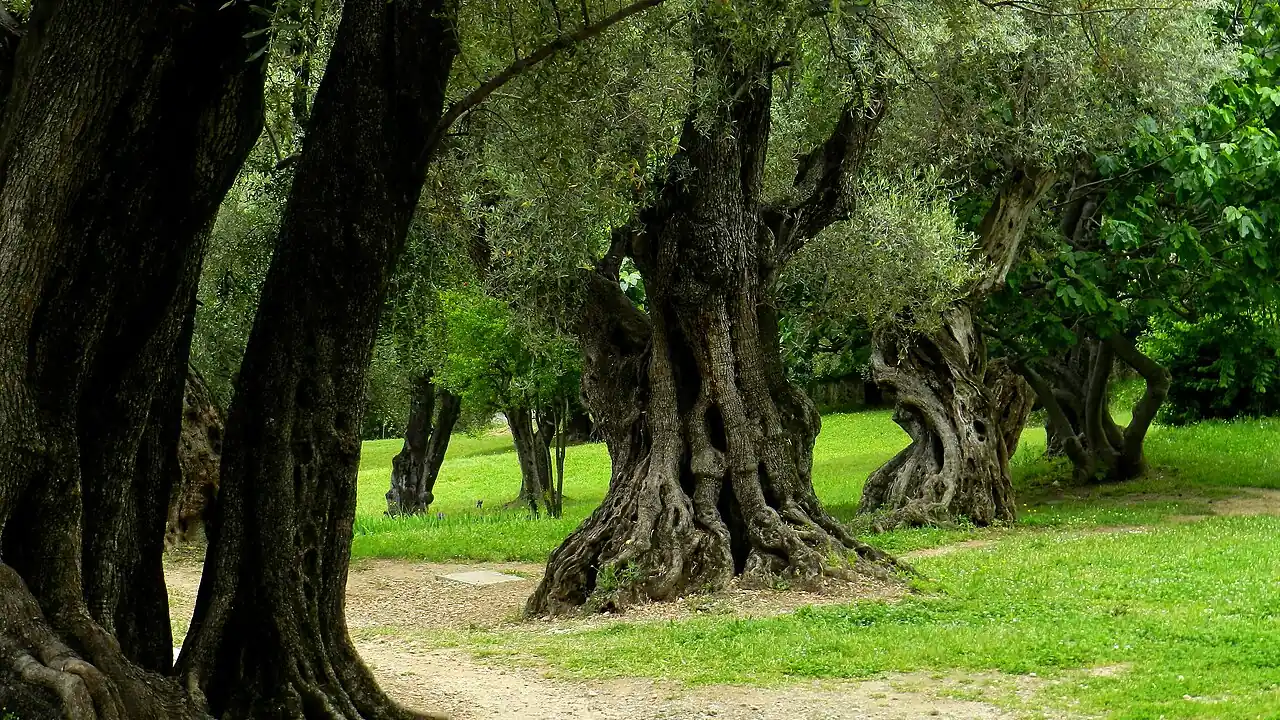
Opening photograph: the old olive trees of the Domaine des Collettes at Cagnes-sur-Mer, by Guerinf, 17 mai 2019, under CC BY-SA 4.0. Image cropped to 16:9, resized to 1,280 × 720 px and converted to WebP; the derivative remains under the same licence. This dated view documents the site, not its condition in 2026.
