Tarocco blood orange tree
Citrus × sinensis ‘Tarocco’ — the Sicilian blood orange, represented by many clones
A finely balanced blood orange, sweet yet bright, with red-streaked flesh. Its colour is not guaranteed by the label: exposureThe amount of sunlight a spot in the garden receives (full sun, part shade, shade). to low temperatures while the fruit ripens helps it develop.
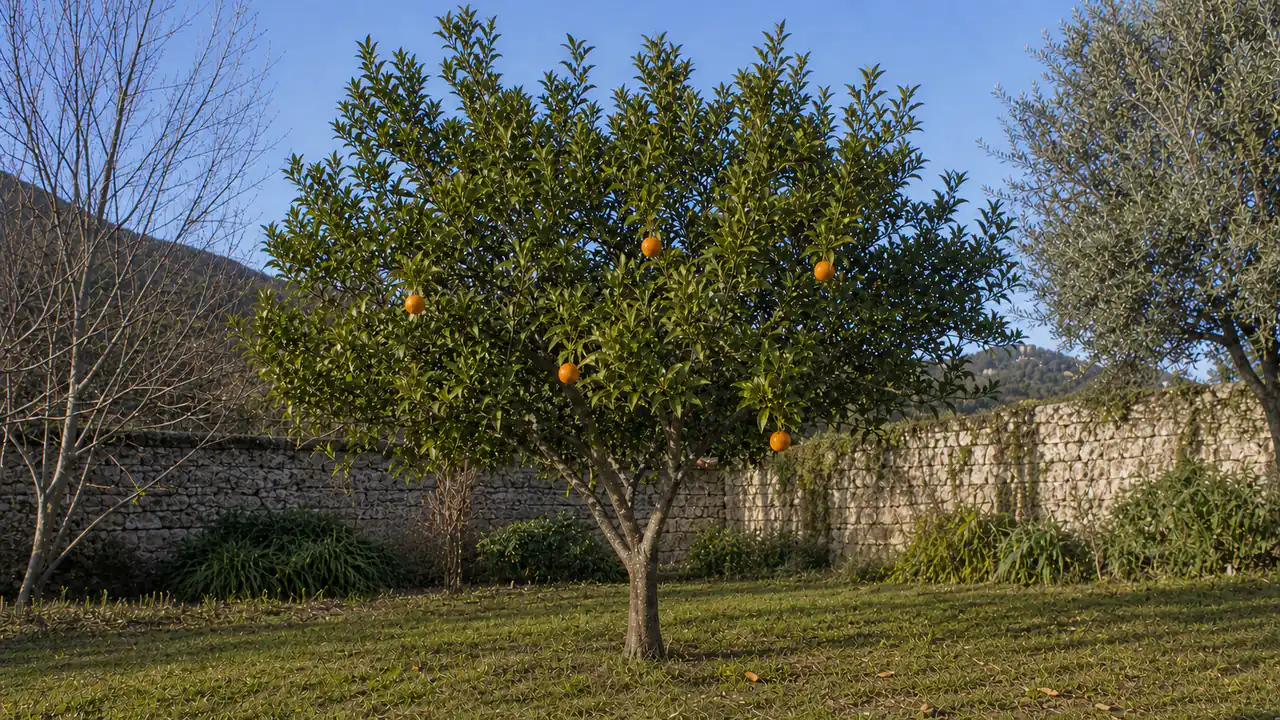
Tarocco is prized for its balance: sweet-sharp flesh, few pips and a refined flavour. Planting a named Tarocco, however, does not guarantee crimson flesh. Its anthocyanins respond to exposure to low temperatures during ripening, while intensity also varies with the clone, harvest timing and the cultivarA variety produced through selection or cultivation, distinct from the wild original plant.-rootstockThe root and base onto which a variety is grafted to give it vigour or resistance. combination. Research does not support one universal night-temperature threshold or a simple day-night amplitude rule. In a mild climate or a heated winter shelter, fruit may remain only lightly streaked.
Do not confuse it with Cara Cara, whose pink lycopene pigmentation does not depend on cold exposure. Compare the darker Moro and blond oranges such as Washington Navel and Valencia Late.
Reliable checks before you buy
Red colour develops through cold exposure
Tarocco makes the central blood-orange lesson unusually clear. Its red anthocyanins build as ripening fruit receives sufficient exposure to low temperatures. A warm site or heated overwintering can therefore leave the flesh orange with only faint streaks. The response is not governed by one transferable threshold, and research on Tarocco Ippolito found cold accumulation more informative than day-night thermal amplitude or solar radiation for the onset of pigmentation. Clone and harvest date matter too. Rootstock trials also show a cultivar-by-rootstock interaction affecting sugars, colour and compounds, so any ranking must retain its clone, site and dated harvest context.
The honest consequence is simple: choose a documented clone, keep the fruit on the tree until flavour confirms maturity, and provide cool but frost-free winter conditions. A permanently warm container may produce good oranges without the deep red promised by a catalogue photograph.
| Your objective | What to verify | Why — and the trade-off |
|---|---|---|
| Named, grafted Tarocco | Clone and rootstock on the label or nursery record | Tarocco is a cultivar group, so traceability matters. ⚠️ A plant passport does not prove the eventual flesh colour. |
| Hard water, high pH or poor drainage | Why the nursery selected that rootstock | Root-zone fit affects chlorosisYellowing of the foliage caused by poor iron uptake, often linked to chalky soil. risk and vigour. ⚠️ No one rootstock suits every British container. |
| Container and limited winter space | Expected vigour of the graft combination | Rootstock affects growth and fruit traits. ⚠️ It does not make the scion frost-hardy. |
| Remember | Cultivar × rootstock × harvest date | Colour and sugars depend on the combination and dated conditions; avoid undated rankings. |
Tarocco through the year: open ground or container
Citrus is not reliably hardy outdoors in Britain, even in the warmest areas. A mobile container with a bright, cool, frost-free winter position is the dependable baseline; open ground is reserved for an exceptionally mild, sheltered site and still needs protection.
| Jan | Feb | Mar | Apr | May | Jun | Jul | Aug | Sep | Oct | Nov | Dec | |
|---|---|---|---|---|---|---|---|---|---|---|---|---|
| Plant outdoors (exceptionally mild, sheltered site) | ||||||||||||
| Protect from cold (container under cover / outdoor fleece) | ||||||||||||
| Move container outdoors | ||||||||||||
| Flowering (spring, fragrant) | ||||||||||||
| Harvest (colour varies with timing) | ||||||||||||
| Feed with citrus fertiliser |
How to obtain genuinely pigmented Tarocco fruit
Your winter temperatures
Note how much low-temperature exposure the ripening fruit actually receives; avoid reducing a continuous response to one supposed night threshold.
Clone, date and roots
If colour disappoints, check the named clone, an early pick and the rootstock-site match before blaming Tarocco itself.
Wait for flavour as well as colour
Leave sound fruit to mature and taste it before harvesting; rind or flesh colour alone is not a complete ripeness test.
Protect without overheating
Keep the tree frost-free, but favour a bright, cool shelter rather than a centrally heated room that is warm and dry.
Read the symptom, trace the cause, correct and prevent
Tarocco shares the usual orange-tree problems. Pale flesh is different: it is normally a pigmentation response to conditions, clone and timing, not a disease.
| Observed symptom | Likely cause | Correct | Prevent |
|---|---|---|---|
| Flesh is pale or only lightly streaked | Limited cold exposure, clone or early harvest — not a disease | Let sound fruit mature; avoid an overheated winter position | Choose a documented clone and cool, frost-free winter conditions |
| Yellow leaves with green veins | Iron chlorosis from high pH, lime or poor root aeration | Correct watering; confirm pH before using chelated iron | Free-draining compost, suitable water and rootstock |
| Cottony masses or shell-like bumps on stems and leaf undersides | Mealybugs or scale insects | Isolate the plant, remove accessible pests and use only a currently authorised product if intervention is needed | Inspect before bringing the plant under cover; keep air moving |
| Sticky black coating on foliage | Sooty mould growing on honeydew from scale insects or aphids | Control the honeydew-producing insect first | Check early for aphids, mealybugs and scale insects |
| Unfamiliar winding mines or distorted young leaves | A leaf-mining insect; the species needs confirmation | Isolate a recent arrival and seek a diagnosis before treatment | Inspect traceable plants before placing them beside the collection |
Keep treatments proportionate and follow the product label. For online purchases, check that plants for planting carry the required UK plant passport; report a suspected regulated pest through current APHA guidance.
A particularly versatile blood orange
Tarocco works well fresh, where its sweet-sharp balance is clearest, and as vividly coloured juice. Its aromatic rind also suits zest, marmalade and candied peel. It is generally gentler than Moro, but only fruit given suitable ripening conditions will out-colour a blond orange.
What the commercial standard actually says
Tarocco falls within the blood orange category of Great Britain’s commercial marketing standard for fresh citrus fruit.
- Commercial minima for blood oranges: diameter ≥ 53 mm, juice content ≥ 30% and sugar-to-acid ratio ≥ 6.5:1.
- Red flesh: these grade figures do not guarantee pigmentation, which still varies with temperature exposure, clone and harvest timing.
No generic tree yield is published here: rootstock, soil, tree age, crop load and climate all alter it. Record the output of your own tree.
What growers ask most often
Why is my Tarocco not red inside?
Anthocyanin development responds to exposure to low temperatures while the fruit ripens. A mild site or warm winter shelter can leave it lightly streaked; clone and harvest timing also matter. There is no single universal night-temperature threshold.
How is Tarocco different from Cara Cara?
Cara Cara is pink from lycopene and does not need cold exposure for that pigment. Tarocco is a true blood orange coloured by anthocyanins, usually brighter in flavour and more variable in colour.
Can I grow it in a container in Britain?
Yes. A mobile container is normally the soundest choice: summer it outdoors, then overwinter it in a bright, cool, frost-free place. A heated living room is often too warm and dry.
When should I pick Tarocco?
Its traditional season runs from winter into early spring, but a British container has no guaranteed calendar date. Taste a fruit and judge the sugar-acid balance rather than relying on colour alone.
Sources and verification
Scientific and regulatory check completed on 3 August 2026. Rootstock and fruit measurements retain their clone, site and harvest-date limits.
- Journal of Agriculture and Food Research — Tarocco Ippolito pigmentation and cold exposure: research on Tarocco Ippolito (Citrus × sinensis), cold accumulation and the limits of a simple thermal-amplitude explanation.
- UK Government — Marketing standard for citrus fruit: commercial minima for blood oranges in Great Britain.