Washington Navel orange tree
Citrus × sinensis ‘Washington Navel’ — also called Bahia
The classic dessert orange: large, sweet, characteristically seedless and marked by a navel. It is excellent eaten fresh, while juice intended for later is better made from another cultivarA variety produced through selection or cultivation, distinct from the wild original plant..
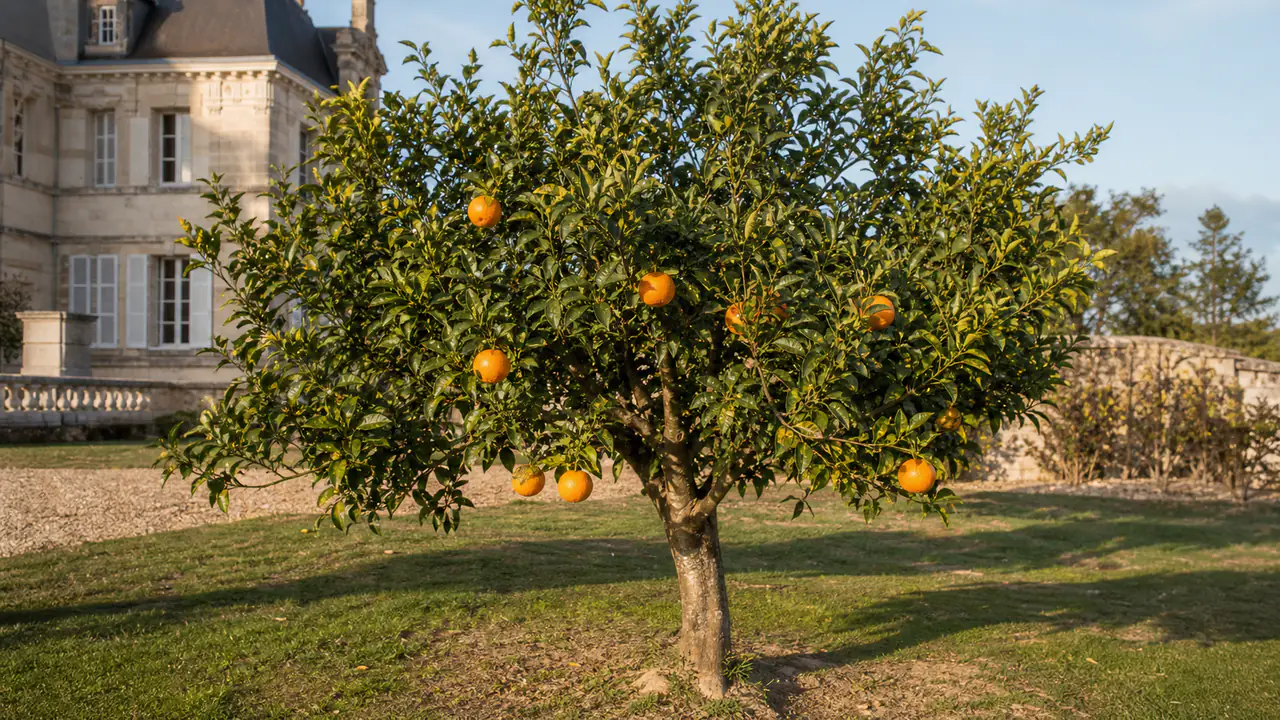
Washington Navel is the classic dessert orange: a large fruit with sweet, juicy flesh, characteristically seedless, peel that comes away readily and a navel opposite the stalk — actually a small secondary fruit enclosed within the main one. It is at its best eaten fresh. One practical detail matters: after extraction, non-bitter precursors in Navel-orange juice can form bitter limonin while the juice stands or is heated. It is lovely when freshly squeezed; for juice prepared ahead, Valencia Late is the more suitable choice.
Distinguish it from the classic juice orange, Valencia Late, and from blood oranges such as Tarocco and Moro. “Navel” describes the fruit’s characteristic secondary fruit, not a trade mark.
Reliable points to check before buying
Eat it fresh — do not squeeze it for later
Washington Navel is an outstanding dessert orange: sweet, juicy, characteristically seedless and easy to peel. After extraction, however, non-bitter compounds in Navel-orange juice can give rise to limonin, so bitterness may increase while the juice stands or is heated. The useful rule is simple: squeeze it just before drinking, or choose an orange bred for juice, such as Valencia Late, when the juice must stand.
Below ground, choose for the actual soil, water and growing system; there is no universal ranking.
| Your priority | Rootstock option(s) | Why — and the trade-off |
|---|---|---|
| Production and quality in suitable media | C35, Carrizo | Common options to discuss for compatible soils. ⚠️ Ask the nursery to confirm the graft combination, vigour and risk of lime-induced chlorosisYellowing of the foliage caused by poor iron uptake, often linked to chalky soil.. |
| Lime-rich conditions or saline water | Forner-Alcaide 5 (FA5) | An option to assess where chlorosis or salinity is a concern. ⚠️ Suitability still depends on water, soil and the exact scion–rootstock combination. |
| Cool conditions or restrained size; freely drained soil | Trifoliate orange, Swingle citrumelo | Options whose root characteristics may suit some sites. ⚠️ Avoid wet or poorly drained clay; confirm active-lime tolerance and vigour with the supplier. |
| Needs verification | Sour orange (historic) | A traditional option, but some scion–rootstock combinations are vulnerable to CTV. Use only with certified stock and local plant-health advice. |
A container-first calendar for Britain
Citrus is not reliably hardy outdoors in Britain. Keep Washington Navel in a container with bright, frost-free winter quarters; harvest timing remains dependent on accumulated warmth and light.
| Jan | Feb | Mar | Apr | May | Jun | Jul | Aug | Sep | Oct | Nov | Dec | |
|---|---|---|---|---|---|---|---|---|---|---|---|---|
| Repot or renew the surface compost | ||||||||||||
| Keep in bright, frost-free winter quarters | ||||||||||||
| Move the container outdoors gradually | ||||||||||||
| Flowering (spring, fragrant) | ||||||||||||
| Potential harvest window | ||||||||||||
| Feed container-grown citrus |
A fine dessert orange
The intended use
Decide whether you want a dessert orange, where Navel excels, or juice that will stand, where Valencia is the better fit. This prevents the “bitter juice” surprise.
Winter conditions and pH
Assess the winter quarters, available light and growing-medium pH. These factors govern tree health and whether the fruit can ripen well.
The right root and shelter
Match the rootstock to the medium and water, give bright winter shelter, then water by checking the compost rather than following a fixed timetable.
Squeeze at the last moment
If you juice a Navel, do it immediately before drinking. That is the practical way to avoid delayed bitterness.
Read the sign, trace the cause, correct, prevent
Washington Navel shares the usual citrus problems. In a container, waterlogging, lime-induced chlorosis and pests in winter quarters deserve the first checks.
| Sign | Likely cause | Correct | Prevent |
|---|---|---|---|
| Young leaves yellow while veins stay green | Iron chlorosis linked to high pH, hard water or impaired roots | Check drainage and root health; use an appropriate iron chelate if the diagnosis is confirmed | Match rootstock and compost to water chemistry; never leave the pot standing in water |
| Cottony masses or brown scales on stems and leaf undersides | Mealybugs or scale insects | Isolate the plant and remove light infestations; use only a product authorised for the crop and follow its label | Inspect before moving indoors and keep winter quarters airy |
| Sticky black coating on leaves | Sooty mould growing on honeydew from sap-feeding insects | Identify and control the honeydew-producing insect first | Check early for scale insects, mealybugs and aphids |
| Silvery winding mines in young leaves | Citrus leaf miner | Remove only badly damaged young growth where practical | Avoid forcing repeated soft flushes and encourage natural enemies |
| Flowers or young fruit drop suddenly | Normal thinning made worse by erratic watering or a temperature shock | Restore steady moisture without waterlogging and stabilise conditions | Check compost before watering and acclimatise the plant when moving it |
Keep treatment proportionate: begin with identification, hygiene and growing conditions. If a regulated pest is suspected, follow the current official plant-health guidance for your part of the UK.
The fruit-bowl orange
Washington Navel is best eaten fresh: characteristically seedless, easy to peel and sweet. Its zest provides fragrant oils, while the peel’s pith and structure suit candied peel and marmalade. For juice, the instruction is short: drink it immediately.
What the marketing standard actually says
Washington Navel belongs to the Navel orange group in the citrus Specific Marketing Standard used in England and Wales.
- Commercial minima for Navels: 53 mm diameter, 33% juice and a sugar-to-acid ratio of 6.5:1.
- Garden ripeness: judge fruit by taste and balance; peel colour alone is not enough.
Those figures grade fruit offered for sale; they are not a promise about a home-grown cultivar. Do not quote a generic yield without the rootstock, tree age, site and growing system.
What growers most often ask
Why does my Navel orange juice become bitter?
After extraction, non-bitter precursors can form bitter limonin while Navel-orange juice stands or is heated. Drink it freshly squeezed, or choose Valencia Late when juice needs to stand.
Why does the fruit have a “navel”?
The navel is a small secondary fruit enclosed at the blossom end of the main fruit. It is a normal cultivar character, not a defect.
Does Washington Navel contain pips?
It is characteristically seedless: viable pollen and ovules are lacking, and fruit develops without a polliniser. Occasional exceptions should not be turned into an absolute guarantee.
Can I grow it in a container in Britain?
Yes. A large container and bright, frost-free winter quarters are the realistic pattern; move it outdoors gradually to a sunny, sheltered position for summer.
Sources and checks
Last scientific and local horticultural check: 2026-08-01. Harvest timing and rootstock performance remain site-dependent.
- UC Riverside Citrus Variety Collection — Parent Washington navel CRC 1241B: primary accession history and characters of Citrus × sinensis ‘Washington Navel’.
- GOV.UK — citrus Specific Marketing Standard: the commercial 53 mm, 33% juice and 6.5:1 minima. Delayed bitterness and limonin formation were checked against Maier & Beverly (1968), DOI 10.1111/j.1365-2621.1968.tb03661.x; UK container practice against the RHS citrus guide; rootstock trade-offs against UC ANR and IVIA documentation.