Menton Lemon PGI
A Protected Geographical Indication product — Citrus × limon, cultivars authorised by the specification in force
The Menton Lemon is not a variety you plant anywhere: it is a territory product, born of a maritime climate, terraced restanque gardens and a specification. You buy and understand it as a terroir, not as a catalogue plant.
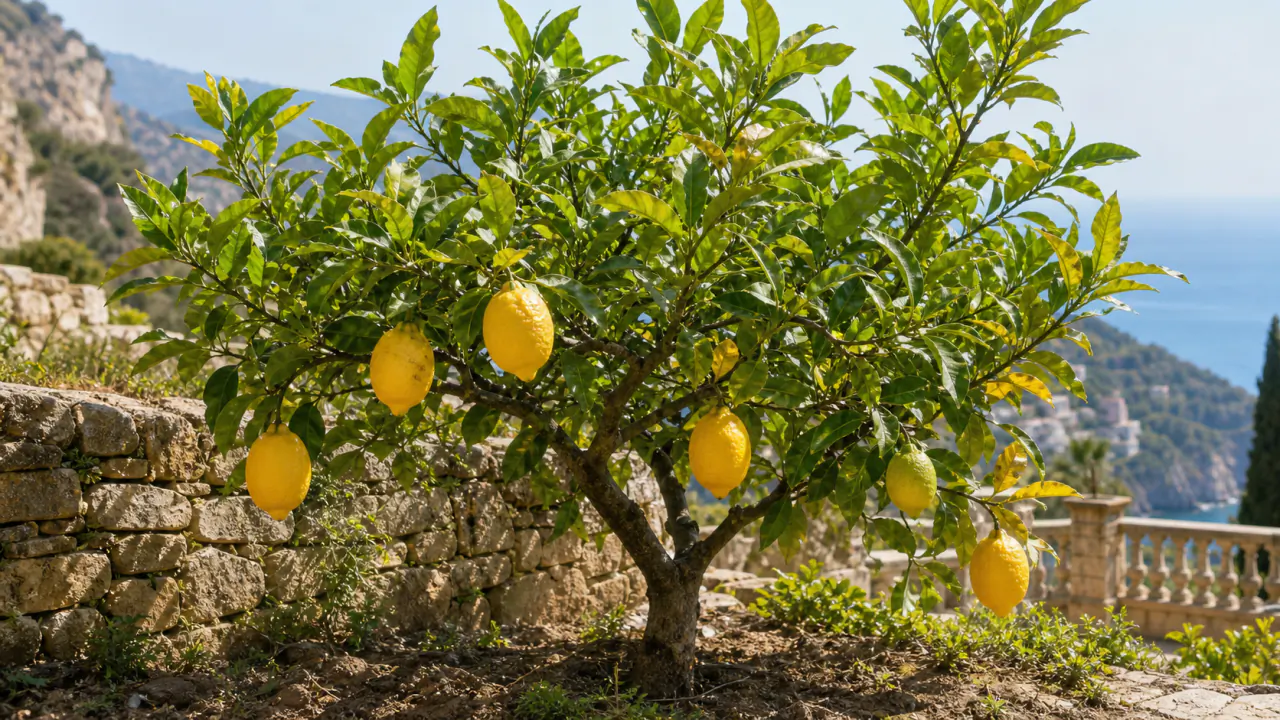
Unlike the Eureka or the Fino, the « Menton Lemon » does not first designate a variety, but a territory product protected by a Protected Geographical Indication (PGI), attached to the communes of the Menton area. Its reputation — a fragrant, juicy lemon, with a generous peel and a tart flavour without marked bitterness, presented untreated after harvest and unwaxed — owes as much to the place, the mild maritime microclimate and terraced restanque cultivation as to the cultivarA variety produced through selection or cultivation, distinct from the wild original plant.. It is therefore a terroir rather than a cultivar: what defines it comes from a specification, not from genetics alone.
For the botanical and cultural side of the lemon tree, see the Eureka, the Fino and the Meyer. Here, the subject is the product and its territory. See also the Citrus & Orchard section.
The terroir markers
The place makes the fruit
What sets the Menton Lemon apart is not a varietal feat but a meeting of a cultivar, a rootstockThe root and base onto which a variety is grafted to give it vigour or resistance., a terraced restanque plot and a maritime microclimate. The mildness of Riviera winters, the exposureThe amount of sunlight a spot in the garden receives (full sun, part shade, shade). of the terraces and a traditional way of growing give a fruit with a thick, highly fragrant peel, presented under current practice untreated after harvest and unwaxed — which makes it a lemon whose peel is happily used. It is this place-and-know-how coherence that the PGI protects, and that no plant sold elsewhere can guarantee on its own.
The consequence is honest and important: buying « a Menton lemon tree » from a nursery outside the area does not give a « Menton Lemon PGI ». You can grow the same type of lemon tree; the protected product itself remains attached to its territory and its specification.
The specification — to be checked at source
A PGI lives by its specification: it sets the area, the authorised cultivars, the practices and the periods. A key methodological point: this specification has been under a modification procedure since 29 April 2026. No fixed figure-based rule is repeated here (exact list of cultivars, dates, yields): for any regulatory data, refer to the specification in force on the day of consultation, published by INAO. It is the only authoritative source, and it prevails over any older reproduction.
Understand — and respect — a terroir
The place before the variety
Faced with a « Menton lemon », look first at the origin and the PGI mention: it is the territory, not the cultivar alone, that defines the product.
Reproducible terroir or not?
At home, the question is not « which variety » but « does my microclimate resemble it? ». Outside a mild zone, the terroir’s peel and fragrance are not reproduced identically.
Choose a real growing lemon
To grow, turn to a lemon tree suited to your climate (Meyer in a pot, Fino/Eureka in a mild zone), without claiming to reproduce the PGI.
Cite the official source
For any regulatory statement, refer to the specification in force: it is the guarantee of not circulating an out-of-date rule.
The lemon whose peel you love
The strength of the Menton Lemon is its peel: thick, fragrant and unwaxed, it lends itself admirably to zest, marmalade and candied peel — three uses where the peel is queen. Its juice sharpens with finesse, without the marked bitterness sometimes feared. It is the lemon where the whole fruit is used, from zest to pulp.
What people most often ask
Is the « Menton Lemon » a variety?
No. It is a terroir product protected by a PGI, attached to the Menton area. Several lemon cultivars, specified by the specification, can take part in it.
Can I grow a Menton Lemon PGI at home?
You can grow a lemon tree; but the PGI product remains attached to its territory and its specification. Outside the area, it will not be a « Menton Lemon PGI ».
Why don’t you give the exact list of cultivars and dates?
Because the specification has been under modification since April 2026. We refer to the official version in force rather than fixing a rule that could change.
Why is its peel so used?
The fruit is presented untreated after harvest and unwaxed, with a thick fragrant peel: it is therefore particularly suited to zest, marmalade and candied peel.
Sources and control
Last check: 2026-07-18. Regulatory data to be confirmed against the specification in force (modification under way since 29 April 2026).
- INAO — Institut national de l’origine et de la qualité: PGI status and specification in force of the Menton Lemon.
- Menton lemon — Wikipedia (EN): context of the product and its territory.