Eureka Lemon
Citrus × limon ‘Eureka’ — the everyday supermarket lemon (clones include Frost Eureka)
The most productive and most « everbearing » lemon in cultivation, yet not a universal choice. Success has little to do with the name on the label: it turns on three things — the clone, the rootstockThe root and base onto which a variety is grafted to give it vigour or resistance. and your climate.
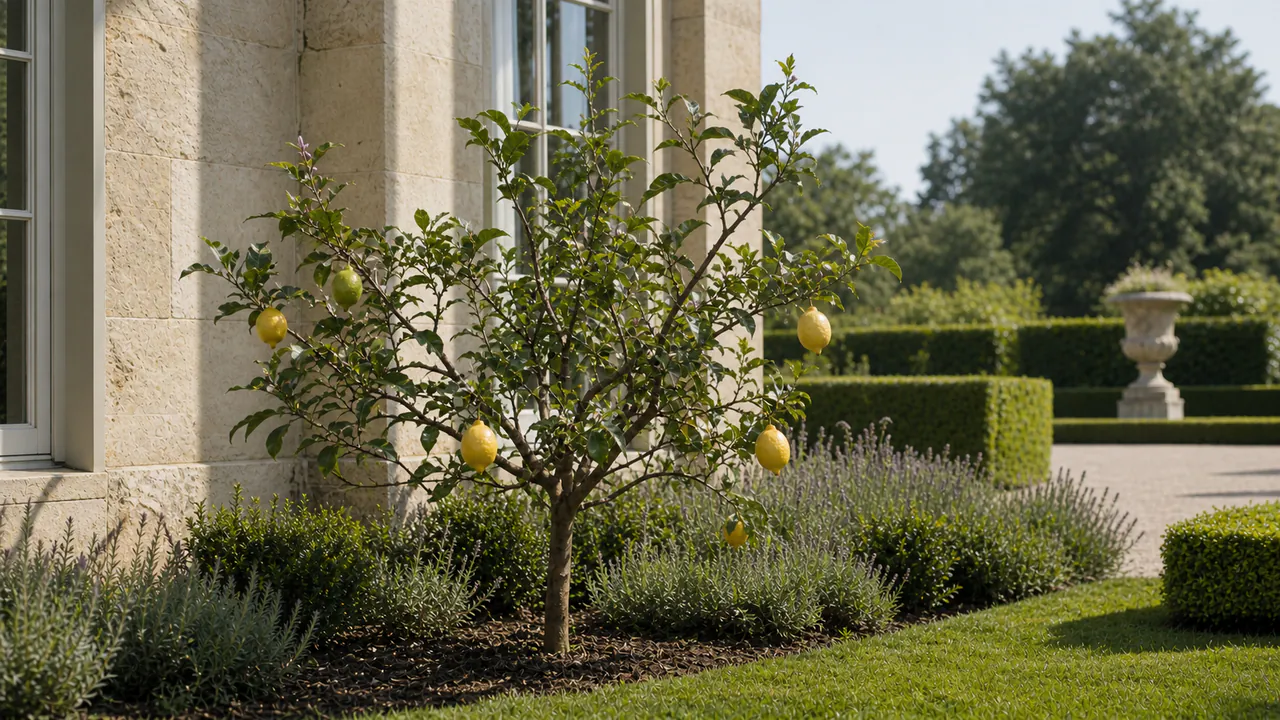
The Eureka is the lemon most often recommended, and rightly so: an open, nearly thornless habit, several flushes of fruit through the year, and a sharply acidic juice. It is the classic market lemon of California and coastal Australia. But its label hides two traps. The word « everbearing » suggests a twelve-months-a-year crop — untrue in a cool-temperate climate. And the same « Eureka » covers several clones (standard, nucellar Frost, Taylor) grafted onto very different rootstocks, which change everything: vigour, lime tolerance, longevity. Choosing a Eureka means, first of all, choosing a scion–root combination suited to your soil and your winter.
Not to be confused with the vague « four seasons lemon » label — see the Lunario lemon. For general container culture, see the Citrus & Orchard section.
The reliable facts before you buy
The tree and the fruit
The Eureka is known by its open, spreading, nearly thornless habit — far friendlier than the more vigorous, thorny Lisbon. The young shoots and flower buds are tinged with purple, a useful clue when buying. Fruit is carried mainly at the edge of the canopy, which makes picking easy but leaves it more exposed to cold and scorching sun.
The fruit is a medium to smallish, elliptical lemon, sometimes lightly ribbed, with a moderately thick rind. The flesh is very acidic and juicy, and the tree is usually few-seeded, though seed count depends on the clone and on pollination, so it varies from tree to tree. Flowers are generally self-fertile: a single tree will set fruit.
The Eureka’s rhythm: open ground or container
In mild areas (frost-free coastal gardens, warm city microclimates) the Eureka can go in the ground and be protected on cold nights. Everywhere else it is grown in a large container, moved into a bright, frost-free space (cool greenhouse or conservatory) for winter. Cropping is spread out, with a strong flush from late winter to early summer.
| Jan | Feb | Mar | Apr | May | Jun | Jul | Aug | Sep | Oct | Nov | Dec | |
|---|---|---|---|---|---|---|---|---|---|---|---|---|
| Plant (open ground, mild area) | ||||||||||||
| Protect from cold (pot brought in / fleece outdoors) | ||||||||||||
| Move the pot back outdoors | ||||||||||||
| Flowering (flushes) | ||||||||||||
| Harvest | ||||||||||||
| Feed (citrus fertiliser) |
The rootstock matters more than the clone
This is the point garden-centre buying almost always skips: under any Eureka there is a grafted root that decides its soil tolerance and its lifespan. There is no absolute « best » rootstock — only a trade-off to match to your situation:
- Warm area, seeking vigour and yield: Volkameriana or Citrus macrophylla, depending on the soil.
- High-pH (calcareous) soil: compare FA5 and other lime-tolerant rootstocks — FA5 is neither universal nor « fully resistant »; choose it case by case.
- Non-calcareous soil, priority on quality and controlled size: citrange or trifoliate only where the combination is genuinely proven.
Two honest cautions, often mis-reported: do not treat the Eureka as « incompatible with sour orange » in an absolute way — it depends on the case. On the other hand, delayed incompatibilities are documented between Eureka and certain citranges, notably Troyer: they appear after several years. The safe rule is to ask the nursery for a scion–rootstock combination already proven in a comparable region, rather than an assembly that only looks good on paper.
| For your goal | Rootstock(s) | Why — and the trade-off |
|---|---|---|
| Quality, contained size, pot | Trifoliate (Citrus trifoliata), Flying Dragon (dwarf) | Concentrated fruit, compact tree, good root hardiness. ⚠️ very lime-sensitive, slow-growing, thorny. |
| Productivity, warm soil | Volkameriana, Citrus macrophylla | Vigour, early bearing, big productive trees in mild areas. ⚠️ cold-tender, variable quality; proven combination required. |
| Calcareous or saline (high-pH) soil | Forner-Alcaide 5 (FA5), compared with C35 | Documented tolerance to lime-induced chlorosis and salinity. ⚠️ not « universal » nor « fully resistant »; response varies with soil and scion. |
| Cold / small space | Trifoliate, Flying Dragon | Better cold tolerance, useful dwarfing in a pot. ⚠️ slow, lime-sensitive. |
| Avoid / verify | Some citranges (Troyer); sour orange | Delayed Eureka × Troyer incompatibility; sour orange = tristeza (CTV) risk → health check + safe combination. Always insist on a proven nursery combination. |
Growing a Eureka without kidding yourself
The space and the root
Measure the real room for an open habit, and ask for the rootstock name. These two facts weigh more than the label’s « everbearing » promise.
Cold and chlorosis
Assess your winter (class F2: tender) and the pH of your water and soil. Cold and iron chlorosis are the two most common causes of failure.
Shelter and the right medium
Free-draining pot and a bright, frost-free space in winter; a proper citrus compost; a rootstock matched to the soil. Correct the cause, not just the symptom.
Steady watering, watch for suckers
Avoid the dry/waterlogged swings that drop flowers and fruit, and remove suckers below the graft union, which exhaust the tree.
Read the sign, trace the cause, correct, prevent
On citrus, most trouble shows first on the leaves. The same method — observe, diagnose, correct, prevent — applies to the commonest problems, the Eureka being watched above all for cold, chlorosis and overwintering scale.
| Sign observed | Likely cause | Correct | Prevent |
|---|---|---|---|
| Yellow leaves with veins staying green | Iron chlorosis (high pH, lime, overwatering) | Iron chelate; review watering; in time, a lime-tolerant rootstock | Free-draining medium, low-lime water, suitable rootstock |
| Cottony masses or small shells on stems and leaf undersides | Scale insects (mealybugs or armoured scale) | Clean off, white oil or soft soap, isolate the plant | Ventilate overwintering, inspect when bringing indoors |
| Sticky black coating on the foliage | Sooty mould, on the honeydew of scale or aphids | Treat the honeydew-producing insect first | Watch for scale and aphids early |
| Silvery winding tunnels in young leaves | Citrus leaf miner | Remove badly affected shoots | Limit soft flushes, favour natural predators |
| Fine webbing, leaves stippled yellow, dry air | Red spider mites | Mist the foliage, raise humidity | Avoid hot, dry air in winter quarters |
| Drop of flowers and young fruit | Watering swings or a cold snap | Even out watering, protect from cold | Steady watering, early winter protection |
Keep treatments minimal: clean foliage, airy overwintering and balanced feeding prevent most problems. Where a notifiable citrus disease is suspected, follow the official guidance in force.
What a very acidic lemon does best
No need to list dishes: the Eureka’s value lies in functions. Its abundant, very acidic juice is above all there to sharpen — to lift a sauce, a drink, a marinade. Its fragrant zest flavours without adding acidity. Its rind takes well to salting: these are the lemons that are preserved in salt, a base of many cuisines. It is not a sweet lemon to eat out of hand; its strength is acidity and juice, not fresh eating.
What the standards say — and what they don’t
The Eureka belongs to the lemons class of the EU/UK citrus marketing standard. Size is set by the fruit’s equatorial diameter, never by variety alone: never infer a size from the name.
- Commercial minimum (lemons class): diameter ≥ 45 mm, juice content ≥ 20%.
- Size codes: 0 (79–90 mm), 1 (72–83), 2 (68–78), 3 (63–72), 4 (58–67), 5 (53–62), 6 (48–57), 7 (45–52 mm).
No « per-variety » yield makes sense out of context: it depends on rootstock, soil, climate, age and management. As a research benchmark — not a promise for a garden — the IVIA trial at Elche (Spain) measures lemon trees on Forner-Alcaide rootstocks in very calcareous soil (17% active lime, pH 8.5, ~417 trees/ha), cumulative harvests 2007–2015. Those figures do not apply to a container tree: always measure your own crop.
What people most often ask
Does the Eureka really fruit all year round?
No. It is « everbearing », meaning it gives several flushes of fruit, but not twelve months a year in a cool-temperate climate. The main flush runs from late winter to early summer.
Which rootstock should I choose?
The one that matches your soil: Volkameriana or macrophylla in a warm area, a lime-tolerant rootstock (compare, including FA5) on high-pH soil. Always ask for a combination proven in a comparable region.
Can I grow it in the open ground?
Only in a mild, sheltered microclimate (frost-free coastal gardens). Elsewhere, a large container overwintered frost-free in a bright space is the reliable route.
Why does my Eureka drop its flowers and young fruit?
Most often because of watering swings (dry then waterlogged) or a cold snap. Steady watering and early winter protection greatly reduce this drop.
Sources and checking
Last scientific check: 2026-07-18.
- UC Riverside — Citrus Variety Collection: primary reference on Eureka clones (including nucellar Frost).
- RHS — Growing citrus: container culture and overwintering for cool-temperate gardens.