Fino / Primofiori Lemon
Citrus × limon, ‘Fino’ group — Primofiori, Fino 49, Fino 95, Fino Elche
The great early Spanish lemon, very juicy, opening the season from autumn. But « Fino » is not a single variety: it is a group of clones, and it is the rootstockThe root and base onto which a variety is grafted to give it vigour or resistance., more than the name, that decides juice and yield.
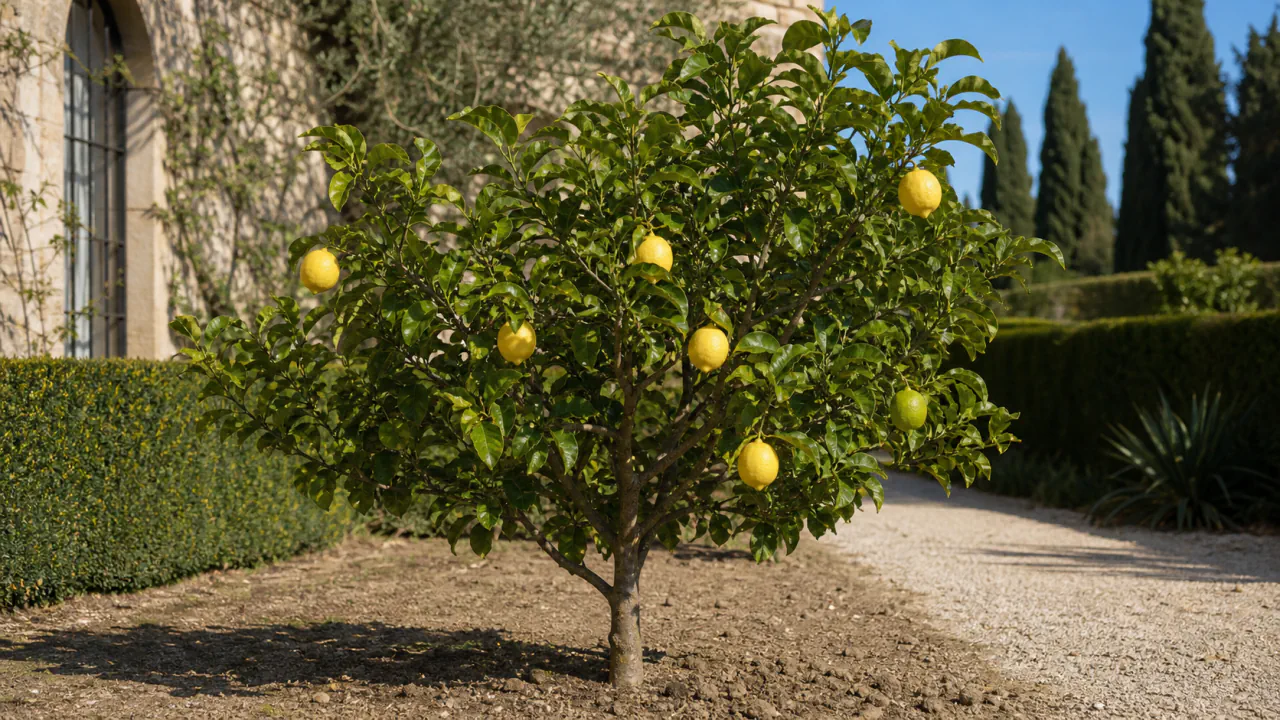
Under the names « Fino » and « Primofiori » hides the Spanish export lemon par excellence: early, harvested from autumn, with thin skin and a high juice percentage, smaller and juicier than the late Verna. But two realities should guide both the purchase and any technical fact-sheet. First, « Fino » is a group of clones — Fino 49, Fino 95, Fino Elche — that must be told apart, because their performances differ. Second, on this lemon more than others, the rootstock governs juice and yield: the same clone gives very different results depending on the root and the soil.
Compare with the Eureka and the Meyer, and above all the Verna, its late counterpart. For growing, see the Citrus & Orchard section.
The reliable facts before you buy
The tree and the fruit
The Fino gives an export-quality lemon: fruit rather small to medium, thin to medium skin, very juicy, with high acidity — a lemon that « yields », made for juice. The tree’s vigour and alternate bearing depend clearly on the clone (Fino 49, 95, Elche) and the rootstock: which is why a serious technical base measures each clone separately rather than speaking of a generic « Fino ». The flower is self-compatible: a single tree sets fruit.
The rootstock governs juice and yield
On the Fino, the root decides not only vigour: it directly affects yield and juice content. Spanish trials showed this by comparing Forner-Alcaide selections. The rule: choose according to your soil and your goal, and never transpose a trial result outside its conditions.
| Depending on your goal | Rootstock(s) | Why — and the trade-off |
|---|---|---|
| Quality, contained size, pot | Trifoliate (Citrus trifoliata), Flying Dragon (dwarf) | Concentrated fruit, compact tree, good cold tolerance. ⚠️ very sensitive to active lime, slow. |
| Productivity, warm soil | Volkameriana, Citrus macrophylla (control) | Vigour and yield in a Mediterranean zone. ⚠️ low cold tolerance, variable quality. |
| Calcareous or saline soil | Forner-Alcaide 5 (FA5), FA2324, FA418 | Series evaluated at Elche on very calcareous soil; tolerance to chlorosisYellowing of the foliage caused by poor iron uptake, often linked to chalky soil. and salinity. ⚠️ different responses by Fino clone. |
| To avoid / verify | Extrapolation beyond the trial | No ban to publish without a source for the Fino; do not transpose figures from one trial to another soil. Insist on a proven combination. |
The Fino’s rhythm: in the ground or in a pot
An early lemon, the Fino is harvested from autumn to late winter. In a mild zone it is planted in the ground with protection; elsewhere, in a large tub brought in frost-free.
| Jan | Feb | Mar | Apr | May | Jun | Jul | Aug | Sep | Oct | Nov | Dec | |
|---|---|---|---|---|---|---|---|---|---|---|---|---|
| Plant (in the ground, mild zone) | ||||||||||||
| Protect from cold (pot in / fleece in ground) | ||||||||||||
| Move the pot outside | ||||||||||||
| Flowering | ||||||||||||
| Harvest (early) | ||||||||||||
| Feed (citrus) |
Getting the best juice from a Fino
The clone and the root
Note the clone (Fino 49, 95, Elche) and the rootstock: on this lemon, that pair weighs more than anything on yield and juice.
Soil and alternation
Assess your soil’s pH and salinity, and watch alternate bearing: a heavy-crop year followed by a light one signals an unbalanced tree.
Suitable root, regulated crop
Choose the root to suit the soil (FA5/FA2324 on lime, macrophylla in a warm zone) and regulate the crop to limit alternation.
Steady water and nutrition
A « juice » lemon feeds itself: regular watering and citrus feeding in season sustain the juice percentage and consistency.
Read the sign, trace the cause, correct, prevent
Like all lemon trees, the Fino is watched at the foliage. On calcareous soil, chlorosis is the first point of vigilance; in overwintering, the usual pests.
| Sign observed | Probable cause | Correct | Prevent |
|---|---|---|---|
| Yellow leaves with veins staying green | Iron chlorosis (high pH, lime, waterlogging) | Iron chelate; review watering; lime-tolerant rootstock (FA5/FA2324) | Free-draining compost, low-lime water, suitable root |
| Cottony masses or shells on stems and undersides | Scale insects (mealybugs or armoured scale) | Clean off, white oil or soft soap, isolate | Ventilate overwintering, inspect when bringing in |
| Sticky black deposit on the foliage | Sooty mould, on the honeydew of scale or aphids | Treat the honeydew-producing insect first | Watch scale and aphids early |
| Silvery galleries in the young leaves | Citrus leaf miner | Remove badly affected shoots | Limit soft flushes, encourage beneficials |
| Heavy crop one year, light the next | Alternate bearing | Thin/regulate the crop, steady nutrition | Balance the crop every year |
Stay sparing with treatments: clean foliage, bright frost-free overwintering, balanced nutrition. If a notifiable citrus disease is suspected, follow the official instructions in force.
The « juice » lemon by definition
The Fino is made to sharpen: its high juice percentage makes it the pressed lemon par excellence, for drinks, sauces and marinades. Its fine zest flavours, and its skin lends itself to salting. It is not a lemon to eat as it is: its strength is juice yield, clean and acidic, available early in the season when other lemons are still lacking.
What the standards say — and what they do not
The Fino belongs to the lemon group of the European standard. The equatorial diameter is measured, never the variety alone.
- Commercial minimum (lemon group): diameter ≥ 45 mm, juice content ≥ 20 %.
- Size codes: 0 (79–90 mm) to 7 (45–52 mm).
A reference trial — IVIA at Elche, Spain (clay-loam soil, pH 8.5, active lime 17 %, ~417 trees/ha, nine harvests 2007-2015) — compared Fino 49, Fino Elche and Verna 50 on the rootstocks FA5, FA2324 and FA418: the clones there responded differently. These figures are research benchmarks, to be kept with their soil, density and tree age; they do not hold for a tubbed plant. Always measure your own crop.
What people most often ask
Are Fino and Primofiori the same thing?
Yes: « Primofiori » is the common trade name for the Fino group. Under that name sit several clones (Fino 49, Fino 95, Fino Elche) with slightly different performances.
What is the difference with the Verna?
The Fino is early (autumn-winter harvest), smaller and juicier; the Verna is late (spring-early summer), larger. The two complement each other to spread the season.
Which rootstock for good juice?
On calcareous soil, the Forner-Alcaide selections (FA5, FA2324); in a warm non-calcareous zone, macrophylla stays productive. The best depends on your soil: do not transpose a trial result.
Can it be grown in a pot?
Yes, like the other lemon trees, in a large tub brought in frost-free in winter; a dwarfing rootstock helps contain the vigour.
Sources and control
Last scientific check: 2026-07-18. Detailed IVIA trial figures to be extracted before publishing any weight, diameter or juice value.
- IVIA — Instituto Valenciano de Investigaciones Agrarias: rootstock × lemon trials (Elche).
- Lemon — Wikipedia (EN): botanical framework of Citrus × limon.