Meyer Lemon
Citrus × limon ‘Meyer’ — choose virus-tested « Improved Meyer » clones
The patio lemon par excellence: compact, with a sweeter fruit and slightly better cold tolerance. But beware the misunderstanding — the Meyer is not « a sweeter Eureka », it is a hybrid in its own right, with its own rules.
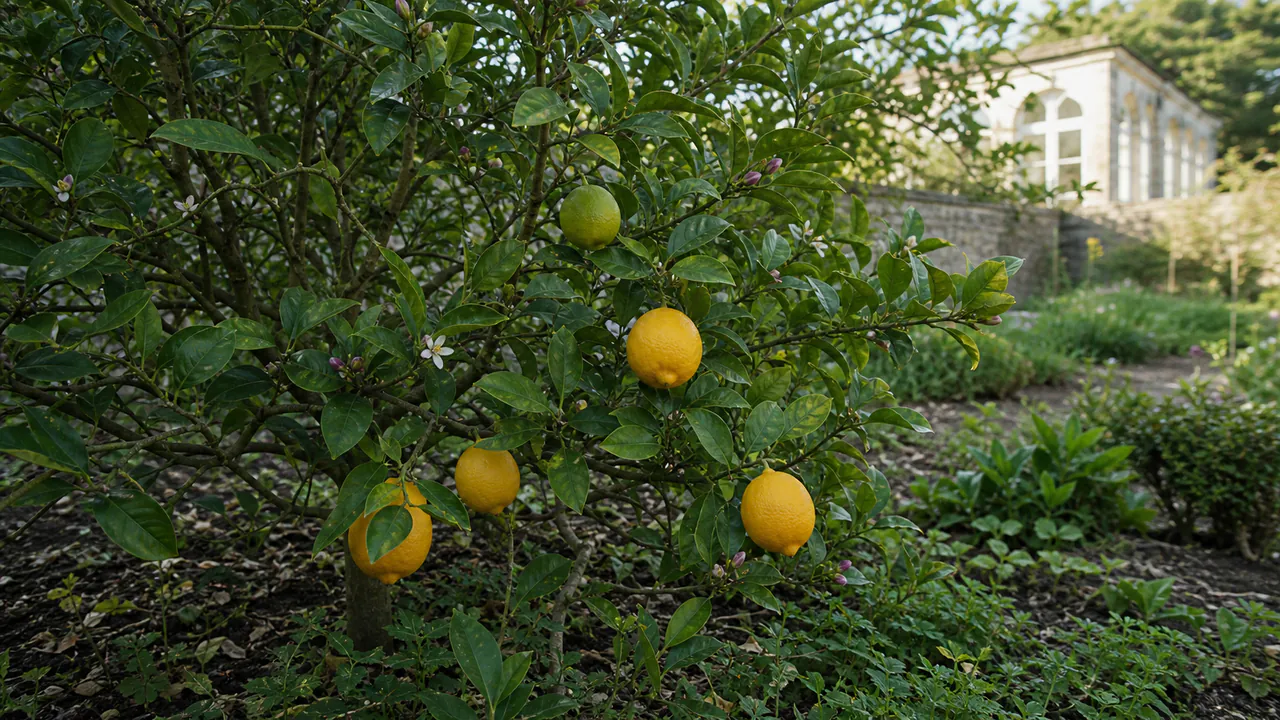
The Meyer is not a true lemon: it is a hybrid with lemon and orange or mandarin ancestry, brought from China to the United States in 1908. That origin gives it its three assets for the gardener: a compact habit ideal in a pot, a less aggressively acidic fruit with thin yellow-orange skin and a distinctive fragrance, and slightly better cold tolerance than the Eureka. Three cautions too: choose an « Improved » clone (virus-tested — the old Meyer carried viruses), do not expect the hardinessA plant's ability to survive winter cold without protection. of a mandarin, and be wary of certain rootstocks.
Compare with the Eureka (larger, more acidic, open habit) and the Lunario « four seasons ». For container growing, see the Citrus & Orchard section.
The reliable facts before you buy
The tree and the fruit
The Meyer is known by its compact bushy habit, far more contained than a true lemon tree, and by its intermittent flowering with a spring peak. The fruit is short and elliptical, thin-skinned, smooth, yellow-orange when ripe — a warmer colour than the classic lemon. The flesh is juicy, acidic but rounder, less biting, often with a few seeds. It is that relative sweetness that makes it pleasant in desserts and drinks, where a Eureka would overpower everything.
The rootstock — and caution with some roots
Like every grafted citrus, the Meyer is chosen first by its root. Its particularity: some combinations behave badly. C35 has shown incompatibilities with the Meyer in some cases — do not take it by default. Ask the nursery for a known, proven combination.
| Depending on your goal | Rootstock(s) | Why — and the trade-off |
|---|---|---|
| Quality, contained size, pot | Trifoliate (Citrus trifoliata), Flying Dragon (dwarf) | Reinforce the Meyer’s natural compactness, better cold tolerance. ⚠️ sensitive to active lime, slow. |
| Productivity, warm soil | Volkameriana, Citrus macrophylla | Vigour and yield in a mild zone; macrophylla has been used with the Meyer. ⚠️ low cold tolerance. |
| Calcareous or saline soil | Forner-Alcaide 5 (FA5) | Documented tolerance to lime-induced chlorosisYellowing of the foliage caused by poor iron uptake, often linked to chalky soil.. ⚠️ not « universal »; variable responses. |
| To avoid / verify | C35; hardiness promises | Observed C35 × Meyer incompatibilities in some cases → not by default. Do not promise mandarin-level hardiness. Insist on a proven combination. |
The Meyer’s rhythm: in the ground or in a pot
A little more cold-tolerant, the Meyer can be tried in the ground in mild zones with protection for young plants; elsewhere it excels in a pot brought in frost-free. Its harvest is mainly in winter.
| Jan | Feb | Mar | Apr | May | Jun | Jul | Aug | Sep | Oct | Nov | Dec | |
|---|---|---|---|---|---|---|---|---|---|---|---|---|
| Plant (in the ground, mild zone) | ||||||||||||
| Protect from cold (pot in / fleece in ground) | ||||||||||||
| Move the pot outside | ||||||||||||
| Flowering (spring peak) | ||||||||||||
| Harvest (mainly winter) | ||||||||||||
| Feed (citrus) |
Getting a Meyer right in a pot
A clean clone, a good root
Buy an « Improved Meyer » and note the rootstock. A virus-tested clone and a proven combination head off the Meyer’s two biggest risks from the start.
Cold and light
More tolerant does not mean hardy: gauge your winter and plan a bright indoor spot. A lack of winter light is still the first cause of yellow leaves and drop.
Free-draining pot, light pruning
A free-draining container, citrus compost, and light pruning to keep a neat compact shape. You do not cut a Meyer back the way you coppice a shrub.
Regular water, watchfulness
Steady watering without excess, and an inspection when bringing it in: the Meyer, often near windows, quickly attracts scale insects and red spider mites.
Read the sign, trace the cause, correct, prevent
Compact and often grown near glass, the Meyer is especially watched by overwintering pests. The same method applies.
| Sign observed | Probable cause | Correct | Prevent |
|---|---|---|---|
| Yellow leaves with veins staying green | Iron chlorosis (high pH, lime, waterlogging) | Iron chelate; review watering; lime-tolerant rootstock | Free-draining compost, low-lime water, suitable rootstock |
| Cottony masses or shells on stems and undersides | Scale insects (mealybugs or armoured scale) | Clean off, white oil or soft soap, isolate | Ventilate overwintering, inspect when bringing in |
| Sticky black deposit on the foliage | Sooty mould, on the honeydew of scale or aphids | Treat the honeydew-producing insect first | Watch scale and aphids early |
| Fine webbing, leaves stippled yellow, dry air | Red spider mites (mites) | Mist the foliage, humidify the air | Avoid hot dry air in the overwintering space |
| Yellow leaves dropping in winter | Lack of light and/or overwatering in the cold | Brighter spot, cut back winter watering | Bright, cool overwintering, not overheated |
Stay sparing with treatments: clean foliage, an airy and bright overwintering space, balanced nutrition. If a notifiable citrus disease is suspected, follow the official instructions in force.
What the Meyer’s sweetness changes
Where the Eureka brings only acidity, the Meyer is rounder and more fragrant: its juice sharpens gently and suits desserts and drinks where a true lemon would dominate. Its fine zest flavours delicately. Unlike hard lemons, it is sometimes pleasant almost as it is, in fine slices. It is the lemon of the sweet as much as the savoury.
What the standards say
The Meyer belongs to the lemon group of the European standard. The equatorial diameter is measured, never the variety alone.
- Commercial minimum (lemon group): diameter ≥ 45 mm, juice content ≥ 20 %.
- Size codes: 0 (79–90 mm) to 7 (45–52 mm).
No universal figure for yield: the UCR collection describes a moderately vigorous, compact, relatively cold-tolerant tree, with medium thin-skinned fruit and a mainly winter harvest — a qualitative description, not a production promise. Measure your own crop.
What people most often ask
Is the Meyer really hardier?
A little more cold-tolerant than the Eureka (class F3), yes, but it is not a hardy citrus: protect it below -3 to -4 °C. Do not expect it to behave like a mandarin.
Should I choose an « Improved Meyer »?
Yes. The old Meyer carried viruses; « Improved » clones are virus-tested. That is the first criterion when buying.
Can any rootstock be used?
No: C35 has shown incompatibilities with the Meyer in some cases. Ask the nursery for a known, proven combination.
What is the difference with the Eureka?
The Meyer is more compact, sweeter, a little more cold-tolerant, with thin yellow-orange skin. The Eureka is larger, more acidic, with an open habit. They are not the same plant nor the same use.
Sources and control
Last scientific check: 2026-07-18.
- UC Riverside — Citrus Variety Collection: description of the Improved Meyer and its behaviour.
- Meyer lemon — Wikipedia (EN): hybrid origin and cultivarA variety produced through selection or cultivation, distinct from the wild original plant. characters.