Maltaise demi-sanguine blood orange tree
Citrus × sinensis Maltaise Group — a heritage orange with partial blood pigmentation
Choose it for fragrant, balanced juice rather than a promise of crimson flesh. “Demi-sanguine” describes partial colour; the exact accession, rootstockThe root and base onto which a variety is grafted to give it vigour or resistance. and growing site explain the rest.
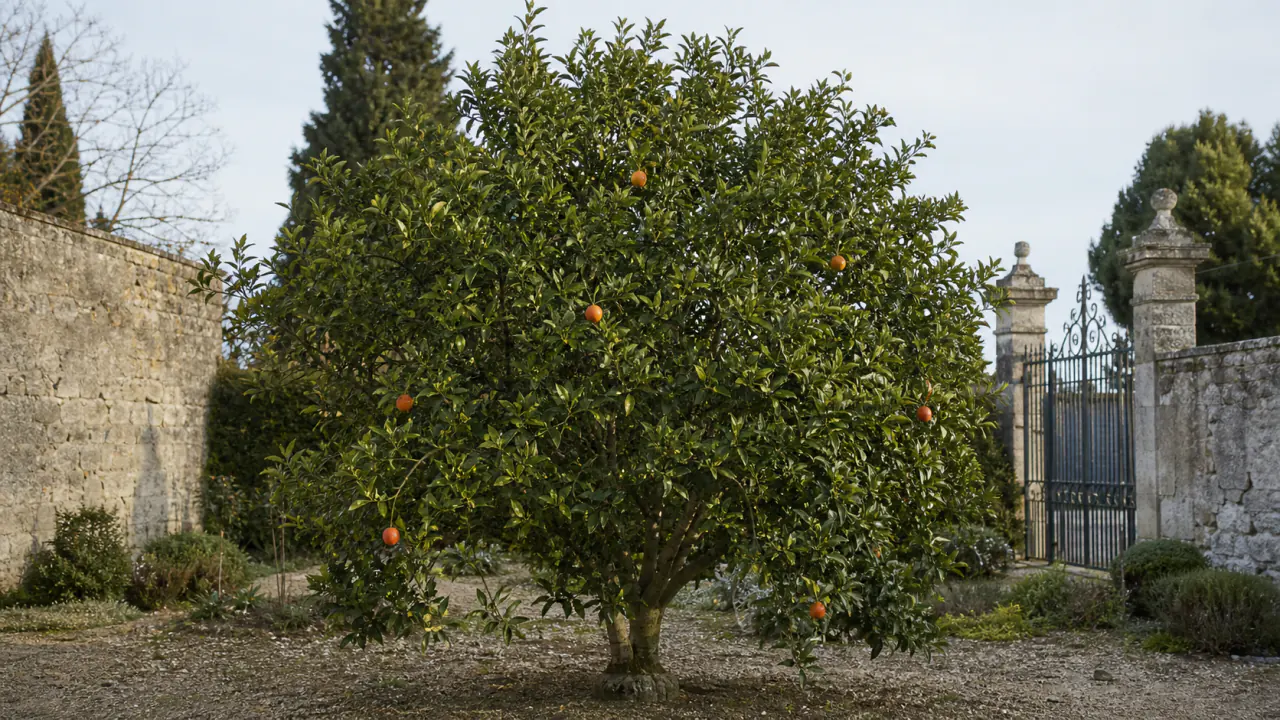
Maltaise demi-sanguine is a heritage sweet-orange group, a historic Mediterranean selection closely associated with Tunisia and Cap Bon. The name signals the limit: it is partly blood-pigmented, with partial and variable flesh colour, not a reliably deep-red orange. Its recognised character lies in finesse: medium, often slightly oval fruit with a sweet-sharp balance and fragrant, juicy flesh. Treat Maltaise as a cultivarA variety produced through selection or cultivation, distinct from the wild original plant. group rather than one uniform clone; documented accessions and variants mean the nursery identity needs checking. Understand it through accession, site and rootstock, not one fixed description.
Compare its partial pigmentation with the blood oranges Tarocco, Moro and Sanguinello. Maltaise is valued for finesse rather than maximum colour and sits closer in use to a fragrant blonde orange such as Salustiana.
Reliable checks at cultivar-group level
Flavour before colour — and traceability before promises
Choose Maltaise for its flavour, not for a colour display. Exact-accession descriptions emphasise tender, juicy flesh with a balanced sweet-sharp taste. Expecting every fruit to turn crimson would be a mistake: pigmentation is partial and site-dependent, exactly what demi-sanguine signals.
Because this is a historical group, the sound buying question is about nursery traceability: ask for the accession or clone name, the rootstock and graft union, and the source of the material. The exact graft combination must be justified for your soil, water or container; a Tunisian field trial cannot choose a universal British rootstock.
| Your objective | What to verify | Why — and the trade-off |
|---|---|---|
| Traceable plant | Accession or clone, rootstock, graft union and plant passport | Historical names can cover different material. ⚠️ A label alone does not prove identity. |
| Hard water, high pH or heavy soil | Nursery reason for the chosen rootstock | Rootstock affects adaptation and fruit response. ⚠️ One site trial is not a UK ranking. |
| Container and limited winter space | Expected vigour, drainage and water quality | A movable tree is easier to shelter. ⚠️ Restricted roots require closer care. |
| Remember | Accession × rootstock × site × harvest stage | Colour and quality belong to a documented combination, not to the name alone. |
Maltaise through the year: container or exceptional open ground
A mobile container with a bright, cool, frost-free winter position is the dependable British baseline. Open ground is for an exceptionally mild, sheltered site. Fruit checks are observational, not a copied Tunisian harvest calendar.
| Jan | Feb | Mar | Apr | May | Jun | Jul | Aug | Sep | Oct | Nov | Dec | |
|---|---|---|---|---|---|---|---|---|---|---|---|---|
| Plant outdoors (exceptionally mild, sheltered site) | ||||||||||||
| Protect from frost (under cover / fleece) | ||||||||||||
| Move container outdoors after frost risk | ||||||||||||
| Flowering (main spring flush; conditions may shift it) | ||||||||||||
| Inspect ripening fruit (quality check, not a fixed harvest period) | ||||||||||||
| Feed with citrus fertiliser |
Keep the Maltaise true to its documented character
Plant identity and fruit record
Record the accession, rootstock, source, shelter and internal appearance of dated fruit. The group name alone is not a complete identity.
Pale or patchy flesh
Limited red colour is not automatically a defect: this is a partially pigmented orange, and material, maturity and site all matter.
Judge a sound sample
Cut and taste one fruit, then assess aroma and sugar-acid balance. Do not leave the crop exposed merely to chase darker colour.
Protect and document
Provide bright, cool and frost-free winter shelter and keep the nursery record; both preserve the plant’s practical and heritage value.
Read the symptom, trace the cause, correct and prevent
Maltaise shares common sweet-orange problems. Partial flesh pigmentation is a cultivar-group character, not a disease symptom.
| Observed symptom | Likely cause | Correct | Prevent |
|---|---|---|---|
| Flesh is pale or only partly streaked | Partial pigmentation, accession, maturity or site — not automatically a defect | Verify the plant and taste a sound sample instead of chasing red colour | Buy traceable grafted stock and keep dated records |
| Yellow leaves with green veins | Iron chlorosisYellowing of the foliage caused by poor iron uptake, often linked to chalky soil. linked to high pH, lime or poor root aeration | Correct watering and confirm pH before using chelated iron | Free-draining compost, suitable water and rootstock |
| Cottony masses or shell-like bumps on stems and leaf undersides | Mealybugs or scale insects | Isolate, remove accessible pests and use only a currently authorised product if needed | Inspect before winter shelter and keep air moving |
| Sticky black coating on leaves | Sooty mould growing on honeydew from scale insects or aphids | Control the honeydew-producing insect first | Check new growth and leaf undersides early |
| Silvery winding mines in young leaves | Citrus leafminer | Remove only badly damaged soft growth; preserve natural enemies | Avoid excess nitrogen that drives repeated soft flushes |
Keep treatment proportionate. Before using any product, check the current HSE authorisation and exact label. Report a suspected regulated pest through the plant-health authority for your UK nation rather than treating blindly.
Fragrant juice before dramatic red colour
Maltaise is best approached through its fragrant juice, with a tender texture and a balanced sweet-sharp taste. Eat sound fruit fresh, press it for juice, or use aromatic zest in marmalade and candied peel. Partial pigmentation provides a variable blush, not the consistently dark flesh expected from some blood oranges. Its heritage character lies in provenance and flavour.
What the commercial standard actually says
The applicable category depends on how the marketed fruit is classified; “demi-sanguine” in a plant name does not settle the legal grade by itself.
- Commercial blood-orange minima: diameter ≥ 53 mm, juice content ≥ 30% and sugar-to-acid ratio ≥ 6.5:1 when the lot is marketed in that category; these figures are not a home-ripeness test.
- Pigmentation: partial and variable; colour alone proves neither identity nor eating quality.
No generic tree yield is published here. Accession, rootstock, soil, tree age, crop load, shelter and season all alter it; record the crop from your own tree.
What growers ask most often
Why is it called “demi-sanguine”?
Because red pigmentation is partial and variable rather than uniformly deep. Choose Maltaise for fragrance and balance, not a guarantee of crimson flesh.
Where does Maltaise come from?
It is an old Mediterranean orange strongly associated with Tunisia, especially Cap Bon. The ultimate origin is not securely established, so an accession’s later provenance must not be presented as the origin of the whole group.
Is Maltaise one cultivar?
Treat it as a cultivar group: historical sources and collections distinguish accessions and variants. Ask the nursery for the exact material and rootstock.
Is it good for juice?
Yes. Tender, juicy flesh with a fragrant sweet-sharp balance is central to its reputation, although every fruit should still be judged when sound and mature.
Sources and verification
Scientific, horticultural and regulatory check completed on 3 August 2026. Accession, rootstock and site observations retain their documented limits.
- UC Riverside — Maltaise demi sanguine, CRC 4224: identity as Citrus sinensis, accession history, fruit traits and the existence of other Maltaise accessions and variants.
- Royal Horticultural Society — grow your own citrus: British container culture, summer acclimatisation and bright, frost-free winter shelter.