Buddha’s Hand
Citrus medica ‘Sarcodactylis’ — fingered citron, Fo-shou, Bushukan
The most astonishing citrus: a hand-shaped fruit with yellow fingers, almost without pulp or juice. All its interest lies in the peel and the fragrance — an aromatic and ornamental object as much as a fruit.
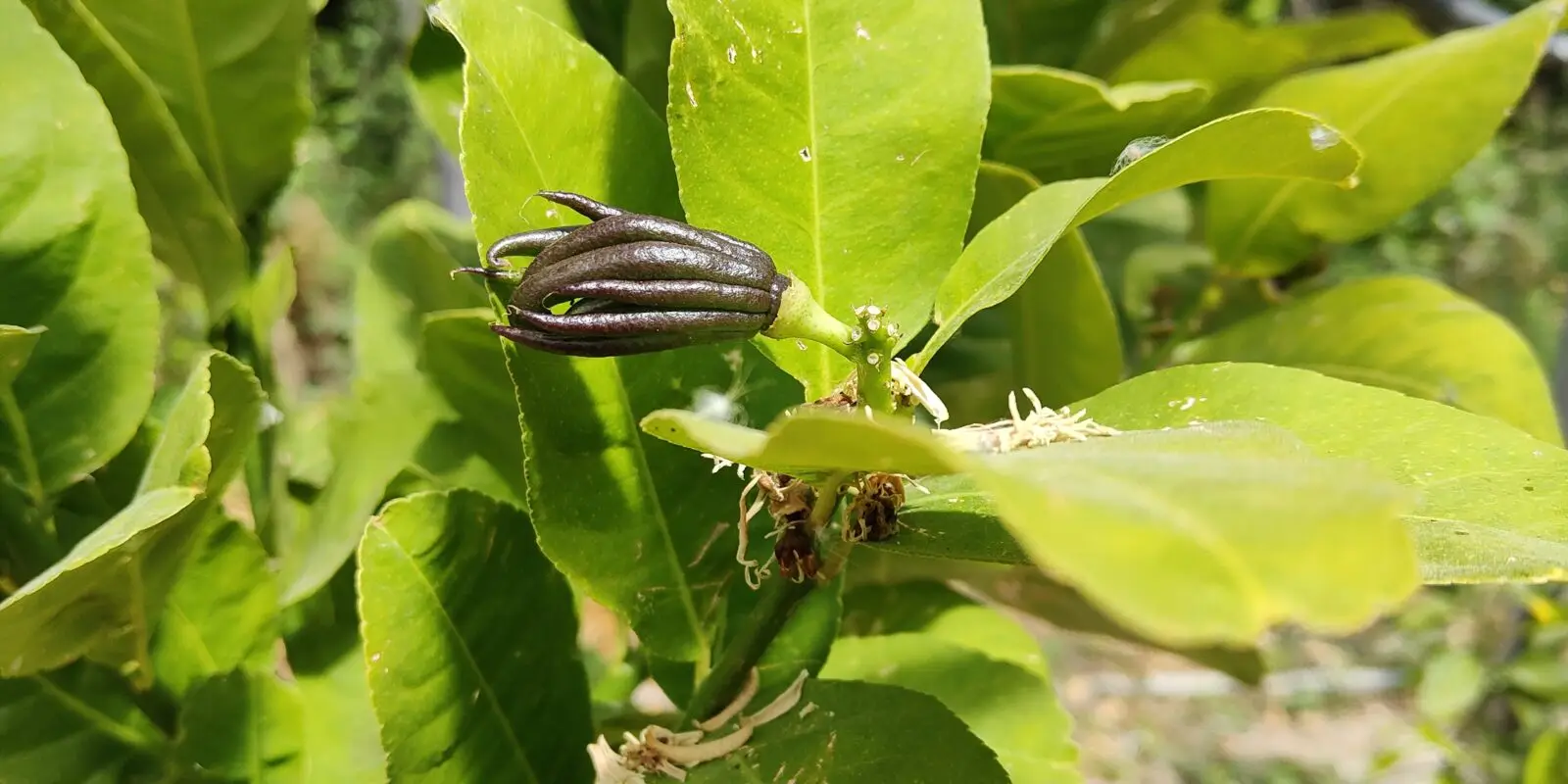
Buddha’s Hand pushes the logic of the citron to the extreme: it is a fingered form of the citron, whose fruit is almost entirely made of zest and pith, in « fingers » more or less open depending on the clone, and with no juice in the culinary sense. You do not press it: you grate it, candy it, dry it, and often you simply set it in a room for its fragrance. Long grown in China and Japan, it keeps there a strong ornamental and cultural value. In the garden, one point dominates: it is a very frost-tender citrus, to be grown in a sheltered pot in almost all of temperate Europe.
Same family as the Corsican citron, of which it is a form; quite another thing from the juice lemons (Eureka, Fino). See also the Citrus & Orchard section.
The reliable facts before you buy
The tree and the fruit
The shrub is thorny, of irregular habit, with white flowers often tinged with purple in bud. The fruit, unique in the world of citrus, divides into « fingers » more or less spread depending on the clone: some stay closed in a fist, others open widely. It is made of highly aromatic zest and pith, without usable pulp or juice. Fruit set and finger shape vary from one specimen and one year to the next: that is normal, and it is not corrected by pollination.
An exceptional fruit, a tree to protect
Buddha’s Hand is grown like a very frost-tender citron: no rootstock will make the top growth hardy, so the key is shelter and container growing. You choose the root for vigour and soil, not for a hypothetical cold resistance.
| Depending on your goal | Rootstock(s) | Why — and the trade-off |
|---|---|---|
| Vigour, mild climate | Volkameriana, Citrus macrophylla | Used in a warm zone; good vigour. ⚠️ do not improve top hardiness. |
| Contained size, pot | Trifoliate, Flying Dragon | Contain vigour in a pot. ⚠️ sensitive to lime; the fruit stays very tender. |
| To keep in mind / verify | Top hardiness | No rootstock makes Buddha’s Hand hardy: rely on shelter. Other roots only if compatibility is tested. |
Buddha’s Hand’s rhythm: the pot above all
In most of temperate Europe, grow in a pot brought in early frost-free. In-ground reserved for the mildest microclimates. Harvest the « hands » in autumn-winter, when they are fragrant.
| Jan | Feb | Mar | Apr | May | Jun | Jul | Aug | Sep | Oct | Nov | Dec | |
|---|---|---|---|---|---|---|---|---|---|---|---|---|
| Repot (pot, spring) | ||||||||||||
| Protect from cold (tub in early) | ||||||||||||
| Move the tub outside | ||||||||||||
| Flowering | ||||||||||||
| Harvest the « hands » | ||||||||||||
| Feed (citrus) |
Getting a Buddha’s Hand right in a pot
Warmth and light
Reserve for it the warmest, brightest and most sheltered spot: an F1 citrus forgives neither cold wind nor shade.
A « fragrance » fruit
Remember you are growing a fruit for zest and fragrance, not juice. You tend the tree’s health to obtain fine fragrant « hands ».
Free-draining pot, early bring-in
A free-draining container, citrus compost, brought in at the first cold. Shelter always takes precedence over the choice of rootstock.
Watch for pests
Inspect when bringing it in: scale insects and red spider mites settle quickly on a plant overwintered warm and dry.
Read the sign, trace the cause, correct, prevent
Very frost-tender and overwintered under shelter, Buddha’s Hand combines cold sensitivity and the pests of potted citrus.
| Sign observed | Probable cause | Correct | Prevent |
|---|---|---|---|
| Browned fingers or shoots, dried young tissues | Cold (F1, very sensitive) | Bring in, shelter, cut deadwood at restart | Early bring-in, warm sheltered spot |
| Yellow leaves with veins staying green | Iron chlorosisYellowing of the foliage caused by poor iron uptake, often linked to chalky soil. (high pH, lime, waterlogging) | Iron chelate; review watering | Free-draining compost, low-lime water |
| Cottony masses or shells on stems and undersides | Scale insects (mealybugs or armoured scale) | Clean off, white oil or soft soap, isolate | Ventilate overwintering, inspect when bringing in |
| Sticky black deposit on the foliage | Sooty mould, on the honeydew of scale or aphids | Treat the honeydew-producing insect first | Watch scale and aphids early |
| Fine webbing, stippled leaves, dry air | Red spider mites (mites) | Mist the foliage, humidify the air | Avoid hot dry air in the overwintering space |
Stay sparing with treatments: clean foliage, bright frost-free overwintering, balanced nutrition. If a notifiable citrus disease is suspected, follow the official instructions in force.
A citrus to flavour, not to press
Juiceless, Buddha’s Hand is defined by its peel functions: its highly aromatic zest flavours sugars, spirits and dishes; its skin is candied and dried; and its lasting fragrance makes it a fruit of atmosphere, set in a bowl. You do not buy it for its flesh — it has almost none — but for its aroma and its presence.
Off the usual scales
Buddha’s Hand is off the sizing scale of lemons and oranges: its fingered shape is not measured by the classic equatorial diameter.
No commercial size code is therefore applied to it, and no generic yield can be published. It is an exceptional fruit, judged on its fragrance, the fine opening of its fingers and the tree’s health — not on a weight or a tonnage. Describe what you observe, without a universal figure.
What people most often ask
Can you eat Buddha’s Hand?
Its peel is used: zest, candying, dried fruit. It has virtually no pulp or juice, so you do not bite into it like a lemon; it is used for its fragrance.
Why are its « fingers » more or less open?
The shape varies by clone, specimen and year. It is a natural feature of the fruit, not a defect, and it is not steered by pollination.
Can it be grown in the ground?
Rarely: it is a very frost-tender citrus (F1). Except in an exceptional microclimate, growing in a pot brought in early frost-free is the only reliable way.
Does a rootstock make it more cold-resistant?
No: no rootstock makes the top growth hardy. It is shelter and early bring-in that protect it.
Sources and control
Last scientific check: 2026-07-18. Fruit measurements and rootstock trials to be completed by clone.
- UC Riverside — Citrus Variety Collection: characters of Citrus medica var. sarcodactylis.
- Buddha’s hand — Wikipedia (EN): fingered form of the citron, history and uses.