Corsican Citron
Citrus medica — citron selections historically grown in Corsica
The citrus grown for its peel, not its juice. A very large fruit with a rough skin and abundant pith, king of candied peel and zest, and one of the most frost-tender citrus, to be handled with care.
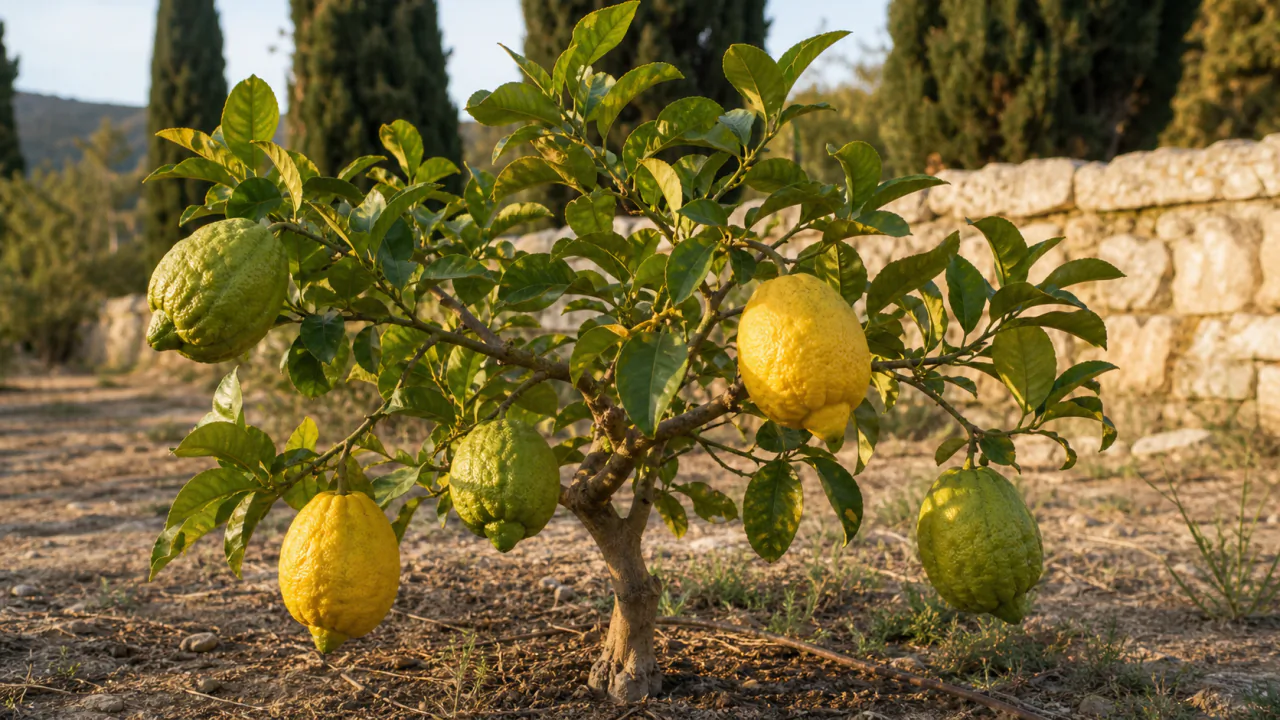
The citron confuses anyone who approaches it like a lemon: you press it, and almost nothing comes out. That is normal — in this ancestral citrus, the pulp is reduced and acidic, while the rough skin and white pith take up most of the volume. That is where its interest lies: a thick, fragrant peel made for candying and zest. A second thing to know before planting one: it is a thorny, irregular and very frost-tender shrub, more sensitive to wind and cold than the lemon tree. So it is grown sheltered, often in a large tub.
To be distinguished from the true lemon trees (Eureka, Fino): same family, quite different use. The citron is the citrus of confectionery and fragrance. See also the Citrus & Orchard section.
The reliable facts before you buy
The tree and the fruit
The citron tree is a shrub to small tree, often thorny and of irregular outline, clearly more sensitive to wind and cold than a lemon tree. Its fruit is bulky, with a rough and very thick skin, with abundant pith (albedo) and a reduced, acidic pulp. It is this anatomy — plenty of peel, little juice — that governs all its uses. The flower is often self-compatible, but this should be checked by clone.
A tender scion: everything rests on shelter
With the citron, the scion’s hardiness stays low whatever the rootstock: no root will make it frost-resistant. The real lever is therefore shelter (warm wall, large tub brought in). The rootstock is chosen mainly for vigour and soil.
| Depending on your goal | Rootstock(s) | Why — and the trade-off |
|---|---|---|
| Vigour, mild climate | Volkameriana, Citrus macrophylla | Used in a mild climate for the citron; good vigour. ⚠️ do not improve the scion’s hardiness. |
| Calcareous or saline soil | Forner-Alcaide 5 (FA5) | A high-pH option, on a tested combination. ⚠️ to be confirmed for the citron. |
| Contained size, pot | Trifoliate, Flying Dragon | Contain vigour in a tub. ⚠️ very sensitive to lime; the citron stays tender. |
| To keep in mind / verify | Scion hardiness | No root makes the citron hardy: rely on shelter. Insist on a proven combination. |
The citron’s rhythm: mostly the tub
In the ground only in a very mild, sheltered zone; elsewhere, a large tub brought in early, before the first cold. Autumn-winter harvest according to the intended use.
| Jan | Feb | Mar | Apr | May | Jun | Jul | Aug | Sep | Oct | Nov | Dec | |
|---|---|---|---|---|---|---|---|---|---|---|---|---|
| Plant (in the ground, very mild zone) | ||||||||||||
| Protect from cold (tub in early / shelter) | ||||||||||||
| Move the tub outside | ||||||||||||
| Flowering | ||||||||||||
| Harvest | ||||||||||||
| Feed (citrus) |
Getting a delicate citron right
Wind as much as cold
Find a warm spot above all sheltered from wind: the citron suffers from cold wind more than from a moderate, calm cold.
A « peel » use
Know from the start that you are growing a fruit to candy, not to press. This changes management: you aim for fine healthy fruit, not a juice yield.
Large tub, early bring-in
A bulky, free-draining container, brought in at the first cold to a bright room. Shelter takes precedence over the choice of root.
Clean foliage, balanced tree
Watch overwintering pests and remove the deadwood of this irregular tree; a healthy specimen gives finer fruit to candy.
Read the sign, trace the cause, correct, prevent
Tender and often overwintered under shelter, the citron shares the troubles of tubbed citrus, with heightened vigilance to cold and wind.
| Sign observed | Probable cause | Correct | Prevent |
|---|---|---|---|
| Browned, dried leaves and young shoots | Cold or cold wind (citron very sensitive) | Shelter, bring in, cut deadwood at restart | Warm sheltered spot, early bring-in |
| Yellow leaves with veins staying green | Iron chlorosisYellowing of the foliage caused by poor iron uptake, often linked to chalky soil. (high pH, lime, waterlogging) | Iron chelate; review watering; suitable rootstock | Free-draining compost, low-lime water |
| Cottony masses or shells on stems and undersides | Scale insects (mealybugs or armoured scale) | Clean off, white oil or soft soap, isolate | Ventilate overwintering, inspect when bringing in |
| Sticky black deposit on the foliage | Sooty mould, on the honeydew of scale or aphids | Treat the honeydew-producing insect first | Watch scale and aphids early |
| Fine webbing, stippled leaves, dry air | Red spider mites (mites) | Mist the foliage, humidify the air | Avoid hot dry air in the overwintering space |
Stay sparing with treatments: clean foliage, bright frost-free overwintering, balanced nutrition. If a notifiable citrus disease is suspected, follow the official instructions in force.
The peel, the whole point
The citron is made for the peel: its thick pith and fragrant skin are the basis of candied peel (the famous cubes of candied citron), of zest and of marmalade. The juice, scarce and acidic, is only anecdotal. It is a citrus of confectionery and fragrance more than of acidic cooking: you choose it to transform its peel, not to press it.
Why the lemon standards do not apply
The citron is not assimilated to the commercial lemon: it has no specific size code in the cited standard. Do not apply the lemon-group thresholds to it.
The weights sometimes quoted — « 1 to 5 kg » — make sense only when accompanied by the precise cultivarA variety produced through selection or cultivation, distinct from the wild original plant. and the measured sample: they are orders of magnitude, not a fixed characteristic. As for any citrus, no generic yield can be published out of context. Measure your own fruit.
What people most often ask
Why does my citron yield almost no juice?
That is normal: the citron is a peel citrus. Its pulp is reduced and acidic, the bulk of the fruit being the skin and pith, intended for candying and zest.
Can it be grown in the ground?
Only in a very mild, sheltered zone (protected Mediterranean coast). Elsewhere, growing in a large tub brought in early frost-free is the only reliable way, as the citron is very frost-tender.
Can a rootstock make it hardier?
Not decisively: the citron’s cold sensitivity stays high whatever the rootstock. It is shelter that makes the difference.
How much does a citron weigh?
The fruit is large, but the quoted weights vary enormously by cultivar and specimen. Be wary of « spectacular » figures cited without stating the variety or the sample.
Sources and control
Last scientific check: 2026-07-18. Fruit measurements and rootstock trials to be completed by cultivar.
- UC Riverside — Citrus Variety Collection: characters of Citrus medica and its citrons.
- Citron — Wikipedia (EN): fruit anatomy and historical uses.