Soil Blocker or Reusable Modules: Which Suits Your Seeds?
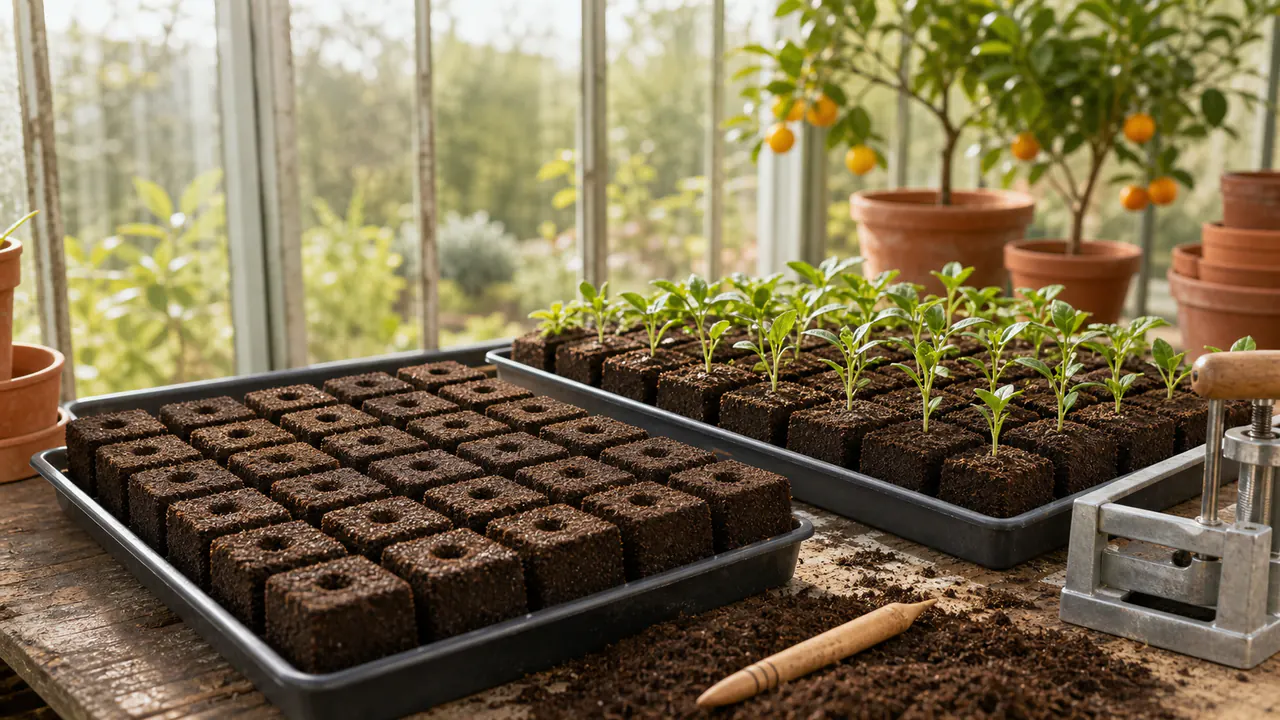
A soil blocker suits seed starting when you can prepare a pressable mix, move the blocks on a rigid tray, monitor exposed surfaces and transplant on time. Reusable modules are more forgiving when watering is irregular, seedlings must remain in the nursery longer or a first batch contains valuable seed. The safest choice is a small parallel batch, recorded from pressing to transplanting, rather than a universal claim that blocks always produce better plants. This guide forms part of Garden Tools.
The hero image illustrates the method, not a test result: two trays contain cubic soil blocks, one with dibbles ready for seed and the other with young plants, while a soil blocker rests at the edge of the table.
Decide between free-standing blocks and reusable modules
Both systems can reduce dependence on disposable pots. Soil blocks remove the cell wall around each plug, while reusable modules keep the mix mechanically supported. That difference changes watering, handling and the margin for error; it does not establish a universal winner.
| Nursery condition | Soil blocks deserve a trial | Reusable modules are the safer default |
|---|---|---|
| You can inspect moisture every day | Exposed faces can be managed deliberately. | Still suitable, but the cell wall offers a wider buffer. |
| Watering will sometimes be delayed | Blocks may dry at edges before the centre shows stress. | Modules usually tolerate an uneven routine better. |
| You want to minimise loose plastic pots | Blocks remove the individual container. | Durable trays remain a low-waste alternative when reused for years. |
| The available compost is coarse or inconsistent | Trial only after screening and moisture adjustment. | Cells give physical support to a less pressable mix. |
| Seedlings must be held for an uncertain period | A larger block or timely potting-on must be planned. | Modules or pots are easier to move on in stages. |
| The seed is scarce, costly or difficult to replace | Keep a control batch in familiar modules. | Familiar handling reduces the number of new variables at once. |
| You sow repeat batches and can keep records | A repeatable blocking routine may save handling. | Useful as the comparison system and fallback. |
The RHS presents soil blocks as one route towards plastic-free gardening while also discussing reusable alternatives. That is the useful frame: the environmental decision is not simply block versus plastic, but disposable use versus a system that can be maintained, reused and watered responsibly.
Begin with one small, comparable batch
Do not convert the whole seed order on the first attempt. Fill one rigid tray of blocks and retain a second, clearly labelled batch in reusable modules. Use seed from the same packet, sow on the same day and keep both in the same light and temperature zone. This is a practical comparison, not a scientific trial, especially if the two systems require different mixes.
Create a short nursery record with these fields:
- crop and seed lot;
- sowing date and intended transplant window;
- base mix and any screened-out coarse material;
- water added in successive adjustments;
- result of the handful and release checks;
- blocks that cracked, slumped or stuck during demoulding;
- behaviour at the first bottom watering;
- edge drying, surface algae or blocks joining;
- date moved on or transplanted;
- reason for keeping, changing or abandoning the method.
The record is the information gain. It turns “soil blocking worked for me” into a method another gardener can inspect. It also prevents a poor first mix from being mistaken for a verdict on every soil blocker.
Make a pressable mix without publishing a universal recipe
A pressable mix must combine fine structure, enough cohesion to survive release, air space for roots and a water regime suitable for the crop and nursery. Those properties can come from different materials. A fixed recipe copied between brands, water qualities and compost batches is therefore unreliable.
Garden Organic’s seed-sowing guidance supports using an appropriate fine seed compost, even moisture and suitable sowing depth. Ladbrooke’s UK blocking instructions add the practical requirements of wetting the mix sufficiently, filling the tool and releasing onto a tray. Neither source proves that one home recipe will work everywhere.
Use the label and current instructions for the chosen compost as a starting point. Screen only when coarse fibres, bark or aggregates prevent an even fill; screening too aggressively can remove structure as well as lumps. Add water in small stages, mix thoroughly and allow dry components time to absorb it before deciding that more is needed.
The handful check is a workshop screening step, not a laboratory threshold. Compress a handful using the same prepared batch. It should hold together well enough to be moved to the blocker, without free water streaming from it. If it falls apart, moisture, fineness or cohesion may be insufficient. If it smears, slumps or releases water, it may be too wet. The actual blocker release remains the decisive check.
Avoid compensating for a poor mix by applying ever more force. Excess pressure can hide an unsuitable texture and may produce a dense block that rewets unevenly. Compare a modest, repeatable press with a slightly adjusted mix, then record the result.
Press, release and reject weak blocks before sowing
Work on a stable surface with a rigid receiving tray. Fill every cavity consistently, press according to the tool instructions, level the base and release without twisting the fresh blocks. Clean the tool when material builds up rather than forcing the next release.
Before any seed is used, reject a batch if several blocks cannot be moved with the tray, lose their corners during release or slump into one another. Correcting at this stage costs only mix and time. Correcting after germination risks roots and irreplaceable seedlings.
The dibble should match the sowing need, but the seed packet remains authoritative for depth. A ready-made depression is not permission to bury every seed to the same level. Fine surface-sown seed may need a different insert or no deep dibble at all.
Block size must also follow nursery duration and handling. Small blocks economise on mix but expose more surface relative to volume and can demand closer moisture attention. Larger blocks use more space and material. Nested systems can allow a small block to be moved into a larger one, but only if the tool sizes, crop timing and handling routine genuinely match.
Use bottom watering as a controlled observation
An unsupported block is vulnerable to a hard jet from above. Ladbrooke recommends bottom watering: place water in the tray so it moves into the blocks, then manage any excess according to the tray and compost instructions. Garden Organic likewise stresses maintaining suitable moisture during germination without waterlogging the compost.
For the first irrigation, watch rather than assume:
- note whether all blocks begin absorbing at a similar rate;
- check that edges remain standing as moisture rises;
- remove prolonged excess water when the system instructions require it;
- record any block that stays dry, collapses or separates from the batch;
- inspect again before the next watering rather than following a fixed timetable.
Do not turn this into a promised daily volume. Tray depth, block size, compost, crop, air movement, temperature and light all change demand. The RHS specifically notes that soil blocks can need more frequent watering than contained seedlings. That warning matters more than a generic calendar.
Keep blocks separated enough to preserve their shape and identify roots crossing between them, but not so exposed that every edge dries immediately. The correct spacing is a nursery adjustment, not a universal measurement. A reinforced or soaker-hose system belongs outside in established beds; young blocks on a tray need a much gentler, controllable supply.
Read symptoms before changing the whole system
| Symptom | Likely variable to inspect | Small correction to compare |
|---|---|---|
| Block crumbles during release | Mix too dry, too coarse or insufficiently cohesive | Remix a small portion, add water gradually or screen obstructive pieces. |
| Block slumps or faces smear | Excess water or weak structure | Rest the mix, blend in a measured dry portion and repeat the release check. |
| Tool sticks and tears corners | Build-up, inconsistent filling or unsuitable moisture | Clean the blocker and compare one evenly filled set before reformulating. |
| Water sits below while centres remain dry | Poor contact, uneven block base or difficult rewetting | Level the base, improve tray contact and compare a small adjusted batch. |
| Outer faces dry much faster | Air movement, heat, spacing or delayed irrigation | Move the tray, inspect sooner and compare closer grouping without fusing blocks. |
| Blocks remain saturated or show algae | Excess standing water, low airflow or overly retentive mix | Remove excess, improve conditions and wait for the next moisture check. |
| Roots bridge neighbouring blocks | Transplant window missed or blocks too close | Move on promptly; separate future blocks enough to monitor them. |
| Seedling must stay longer than planned | Block volume no longer suits the timetable | Pot on, use a larger compatible block or return that crop to modules. |
Only change one main variable per small batch where possible. Adding water, changing compost, pressing harder and altering tray depth together makes the result impossible to interpret.
Plan transplanting before the first block is made
Soil blocking works best as part of a timed nursery sequence. Record the expected planting window, protected growing space and backup container before sowing. Weather, bed readiness or plant development may delay transplanting, so keep reusable modules or pots available rather than forcing an overheld block to remain suitable.
At transplanting, handle the block by supporting its base or moving it with a suitable tool; do not lift a seedling by the stem. Inspect whether the block holds during transport and whether roots have bridged into neighbours. Record the outcome, but do not convert one crop or one season into a universal germination or yield claim.
This is where the comparison with reusable modules becomes honest. Judge practical handling, moisture management, damaged blocks, time to sow and ease of transplanting. Plant height alone is not a verdict, and a difference cannot be attributed to the container if mix, watering or light also differed.
For wider nursery and planting routines, continue through Garden Care & Permaculture, where soil preparation and later crop care belong.
The Chatelain Method and the abandonment gate
- Observe seed value, batch size, compost texture, available trays, daily attention and transplant window.
- Diagnose whether the real aim is less disposable plastic, cleaner transplanting, compact nursery space or a repeatable sowing workflow.
- Correct one small batch through gradual wetting, handful check, consistent pressing, demoulding and bottom watering, while keeping reusable modules as the comparison.
- Prevent loss through a written nursery log, gentle watering, timely transplanting and explicit abandonment criteria.
Abandon soil blocks for the current crop or batch when the available mix repeatedly fails release after controlled adjustments, blocks cannot survive the first watering, daily monitoring is unrealistic, valuable seed would be exposed to too many new variables, or transplanting will be delayed beyond the block’s manageable volume. Returning to a reusable tray is not failure; it is the correct diagnosis.
Documentary selection: three useful systems
These sponsored searches are not a ranking and contain no reproduced prices. Compare construction, block or cell dimensions, replacement parts, tray rigidity and the instructions supplied.
Evidence, method and limits
Our contribution. The article provides a reproducible small-batch decision between soil blocks and reusable modules: pressability screen, handful/release checks, nursery log, bottom-watering observation, symptom-correction table, transplant review and abandonment gate.
Provenance. Plastic-free context and the higher watering attention required by blocks were checked against the Royal Horticultural Society. Pressing, moisture and bottom-watering practice were checked against Ladbrooke Soil Blockers UK, a manufacturer source. General seed-compost, moisture and sowing principles were checked against Garden Organic. The three UK English-language resources were consulted for the F14 review on 11 July 2026.
Method. We separated container choice, mix pressability, water management, handling and transplant timing. The proposed parallel batch keeps dates and conditions visible; it is a garden decision protocol, not a controlled experiment or a claimed test by this publication.
Limits. No recipe, block size, watering interval, germination rate or growth advantage is generalised. Compost batches, water, crop, climate and nursery conditions differ. Ladbrooke is a tool manufacturer, so its operating instructions are useful but do not independently prove superior plant performance. The reader’s seed packet and current product instructions remain decisive.
Do soil blocks always produce better seedlings than modules?
No. A well-made block can simplify transplanting and avoid an individual pot, but exposed faces demand compatible mix, moisture control and timely handling. Reusable modules may outperform a poorly managed block simply because they support the compost and widen the watering margin. Compare one recorded batch under the same nursery conditions and keep the system that gives stable plugs, manageable watering and intact transplants for that crop.
Sources consulted
- How to go plastic-free in your garden — Royal Horticultural Society
- Soil Blocking 101: a step-by-step guide — Ladbrooke Soil Blockers UK
- Successful seed sowing — Garden Organic
Read next
- Garden Tools
- Expandable, reinforced or soaker hose
- Bypass, anvil or electric pruners
- Garden Care & Permaculture
Written and verified by Les Jardins d’un Châtelain, Organization author.
Editorial status — documentary comparison / editorial selection. This guide compares uses based on manuals, horticultural guidance and mechanical criteria; we have not carried out laboratory product testing or ranked brands.