Expandable, Reinforced or Soaker Hose: How to Choose
A reinforced hose is primarily a carrier: it moves water from the tap to a spray gun, sprinkler or irrigation zone. An expandable hose trades some predictability for compact storage and light mobile use; its working length depends on pressure. A soaker hose is a distributing line laid at soil level, not a main hose for filling or washing. Start by deciding whether water must be carried or released slowly, then measure route, flow, bore and fittings. This guide belongs to Garden Tools.
Match the hose family to the job
| Real task | Hose family to assess | Decisive check |
|---|---|---|
| Carry water to several areas, spray gun or sprinkler | Reinforced hose | Internal bore, useful length, working pressure, kinking and couplings. |
| Water a few containers and store in very little space | Expandable hose | Flow while expanded, pressurised length, outer sleeve and replaceable ends. |
| Release water slowly along a hedge, bed or citrus root zone | Soaker hose | Permitted pressure, filtration, zone length and evenness from start to end. |
| Feed a remote soaker zone | Reinforced main hose plus terminal soaker line | Separate conveyance from distribution, with connectors and regulation required by the maker. |
| Long route or change in elevation | Measured reinforced hose | Delivered flow at the far end, bore and actual route loss. |
| Occasional patio wash-down without fixed irrigation | Expandable may suit | Do not choose on collapsed or advertised expanded length alone. |
| Beds with different watering needs | Main hose with separate zones | Valves, line lengths and timing handled separately rather than one excessive loop. |
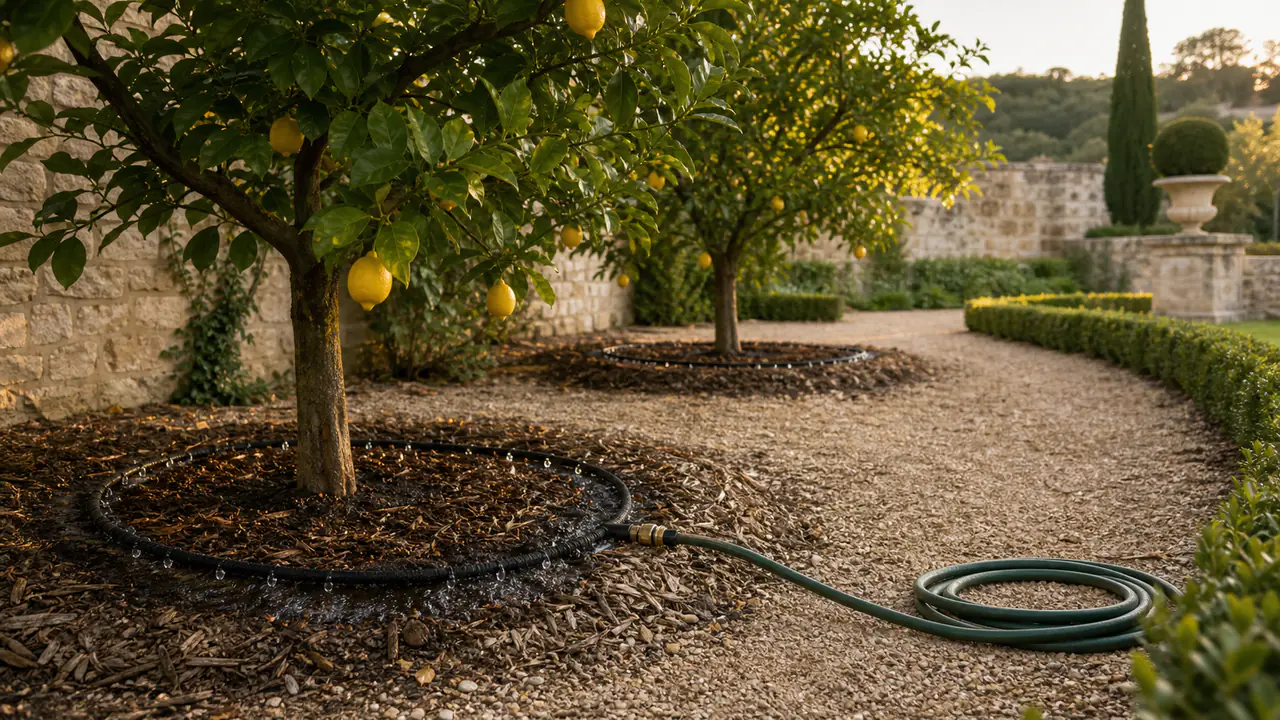
These are different functions, not a best-to-worst ladder. The hero photograph makes the separation visible: a coiled green reinforced hose carries water to a black soaker line around a lemon tree; droplets and damp soil show the distribution stage.
Measure the route and distinguish bore from fitting
Walk from the outdoor tap to the furthest working point, following corners, gates and beds. Add only enough slack to move without pulling the connector. Unused extra length adds weight, storage and hydraulic resistance.
Record separately:
- main carrier length from tap to irrigation zone;
- each soaker-zone length;
- rise or fall between tap and destination;
- tap connector and terminal fitting types;
- gravel, sharp edges, vehicle routes and tight turns;
- where the hose will drain and be stored in winter.
Hose bore and tap thread are not the same measurement. Bore describes the water passage; a BSP tap or connector thread describes mechanical fit. A connector may physically attach while still restricting flow. Product pages should state both clearly enough to design the route.
Run a bucket flow test at the tap and far end
Static pressure at a closed tap does not reveal flow while watering. A bucket and stopwatch give a repeatable comparison:
- use a container with a known working volume;
- open the tap as it would be used and time the fill;
- calculate
flow in L/min = volume in L ÷ seconds × 60; - repeat through the planned hose and connectors at the furthest point;
- compare like with like and record the setup.
A 10 L container filled in 30 seconds represents 20 L/min at that point. It is an example of arithmetic, not the required flow for every sprinkler or soaker hose. Each terminal device has its own specification.
The far-end test combines bore, length, fittings and elevation in the garden as built. A large reduction calls for diagnosis before buying a more powerful accessory: check constrictions, reduced connectors, unnecessary length, route height and the source supply.
Reinforced hose: specify the carrier
Compare internal bore, length, published working pressure, temperature range, weight and fitting construction. “More layers” means little unless the maker explains their purpose. Anti-kink claims cannot remove twists introduced by pulling a closed coil around a corner.
A supple hose is easy to coil but may flatten at a sharp bend; a stiffer wall can resist handling yet become awkward in cool weather. Check whether couplings and washers can be replaced and whether the system matches fittings already used in the garden.
Unroll while walking rather than dragging loops tight. After use, turn off the tap, release pressure and drain before frost as the instructions require. Shade reduces needless exposure, but no universal lifespan can be inferred from colour or layer count.
Expandable hose: compact storage with variable behaviour
An expandable hose lengthens as it fills and retracts after draining. This is useful for balconies, small courtyards and sheds with limited space. The working length and flow, however, depend on supply pressure and construction, making it a poor fixed reference for laying out permanent irrigation.
Read the pressurised length, actual water passage, outer sleeve, end repairability and pressure instructions. Include gravel, masonry edges, wheels and time left pressurised in the route audit. Close, depressurise and drain before storage in accordance with the manual.
Expandable does not automatically mean disposable. It is a convenience choice whose value depends on genuine storage pressure and sufficient delivered flow for the spray attachment. On a long allotment plot, a conventional reinforced carrier is often easier to specify.
Soaker hose: test distribution, not a generic runtime
A soaker hose releases water through its wall. Output can change along the line with pressure, length, gradient, clogging and construction. Do not copy a universal number of minutes without measuring the line and observing the soil.
Lay it over the active root zone rather than against the trunk. The photograph shows a loop around a lemon tree connected to the carrier hose. Run an initial trial at the permitted pressure and check start, middle and end at equal intervals: visible droplets, width of damp soil and depth reached after stopping. If the start puddles while the end remains dry, consider a shorter zone, a different layout, pressure control or filtration specified by the manufacturer.
Keep joints visible until the system has been checked, and provide flushing access if the instructions call for it. Mulch can reduce surface evaporation but may hide a leak, so inspect first.
If hosepipe restrictions or water-company rules apply, follow the current local requirement; a product guide cannot assume the same permissions across the UK.
The Chatelain Method for a hose system
- Observe tap, measured flow, route, elevation, fittings, soil and plants.
- Diagnose whether water needs carrying, hand application or slow distribution.
- Correct by separating reinforced carrier and soaker line, or choosing expandable only where compact mobile use is the real need.
- Prevent leaks and poor distribution with short zones, serviced washers, draining, storage and start/middle/end checks.
This sequence avoids selecting a bore from garden area alone. Two equal-sized gardens can have different tap flow, route length, elevation and irrigation devices.
Evidence, method and limits
Our contribution. We separate carrying from distributing water and add a route map, repeatable bucket test and start/middle/end soaker check.
Provenance. UK handling and fitting criteria were checked against Plot & Patio and ManoMano UK; the Claber English DIY irrigation guide provides the technical irrigation context. The three English-language resources were consulted on 11 July 2026.
Method. The hose families were assessed on function, length, internal bore, measured flow, elevation, fittings, stated pressure, mobility, storage and maintenance. The bucket test is a field comparison, not hydraulic certification.
Limits. This is documentary comparison, not our test of linked products. The sources include commercial guides and ranges change. We do not calculate theoretical head loss without the exact network inputs. Pressure, temperature, filtration and maximum run must be checked in the exact product instructions; local water restrictions can change.
Can a soaker hose connect directly to an outdoor tap?
Sometimes, but only after checking the pressure and assembly allowed by the manufacturer. A legible system often uses reinforced hose to carry water, then a terminal soaker zone with the connector, filter or pressure control specified. Start with one short zone and check evenness before adding more.
Sources consulted
- Garden hose buying guide: length, material and fittings — Plot & Patio UK
- Garden hose buying guide — ManoMano UK
- DIY irrigation guide — Claber, English edition (PDF)
Read next
- Garden Tools
- Corded, battery or petrol lawn mower
- Bypass, anvil or electric secateurs
- Garden Care & Permaculture
Written and verified by Les Jardins d’un Châtelain, Organization author.
Editorial status — documentary comparison / editorial selection. This guide compares uses based on manuals, horticultural guidance and mechanical criteria; we have not carried out laboratory product testing or ranked brands.