Corded, Battery or Petrol Lawn Mower: How to Choose
A corded mower is still rational for a small, simple lawn within a safe cable route. A cordless mower gives freedom around beds and trees, provided the mower, batteries and charger are sized as one system. Petrol remains relevant for long sessions away from mains power or demanding ground that a verified cordless configuration does not cover. Total plot size is not the decision: measure the lawn actually mown, then add slopes, obstacles, desired finish, longer-grass areas, storage and maintenance. This guide sits in our Garden Tools section.
Audit the lawn before choosing a power source
Sketch the house, paving, beds, pond, vegetable plot and any grass intentionally left longer. Only the routinely mown areas belong in the mower calculation. Then mark trees, narrow gates, tight corners, banks and the route from the shed. A small, intricate lawn can take more handling than a larger open rectangle.
Use this transparent estimate to compare cutting widths without promising a mowing time:
forward travel ≈ mown area ÷ (cutting width × efficiency assumption)
The efficiency assumption allows for overlap, turns and imperfect lines. It must be stated rather than hidden; 0.8 is a cautious scenario, not a universal constant. On a 250 m² lawn, a 0.38 m deck at that assumption means roughly 822 m of forward travel, whereas 0.46 m gives roughly 679 m. Neither figure includes emptying a collector, walking to the compost heap or trimming edges.
This calculation explains why maximum area bands conflict. Width can reduce passes on open ground, while extra mass and a wider deck can slow turns between apple trees or borders.
Decision matrix for a UK lawn
| Lawn and working pattern | First option to assess | Condition to verify |
|---|---|---|
| Small open lawn close to a suitable outdoor supply | Corded electric | Safe cable route, outdoor electrical setup and gate width. |
| Regular lawn with beds and trees, cut frequently | Cordless | Published area conditions, usable battery energy, charger and compatible spare battery. |
| Large open lawn or remote paddock edge, long sessions | Properly sized cordless system or petrol | Demonstrated endurance, local service and storage routine rather than a generic area claim. |
| Bank or heavy machine that is tiring to push | Self-propelled drive, regardless of energy | Model-specific slope limit, speed control and full working weight. |
| Grass sometimes becomes long or dense | Adequate torque, higher initial setting and staged return | Deck clearance and discharge matter as much as nominal power. |
| Many islands, corners and narrow access points | Manoeuvrable mower of moderate width | Turning effort, handle folding, gate and shed dimensions. |
| Fine formal lawn, level and cut very frequently | Assess cylinder versus rotary finish | Cutting system and maintenance may matter more than petrol versus battery. |
| Wildlife strip or reduced-mowing area | Exclude it from weekly lawn area | Define how and when that longer vegetation will be managed separately. |
The matrix is a route into the specification sheet, not a decree. Wetness, starting height, collection, gradients, blade condition and battery age all alter work. Treat every stated maximum area as conditional.
Corded: best where the garden plan is simple
Corded electric mowers avoid a fuel engine and battery pack. They can be light, compact and ready whenever the mains setup is suitable. Their real limit is not an arbitrary lawn size but cable management.
Walk from the supply around the complete mowing route. Count trees and corners that could trap the lead, and decide how the cable remains behind the direction of travel. Use outdoor equipment and protection appropriate to the installation and the mower manual. An improvised extension is not a substitute for electrical suitability.
On a rectangular front lawn, corded can be the least complicated answer. In an orchard lawn, repeatedly moving a lead around trunks may dominate the session. The layout should decide before the brochure does.
Cordless: compare the complete battery platform
Cordless removes the lead and routine petrol-engine servicing, but “one battery covers this area” is not a transferable fact. Runtime changes with model, stored energy, grass load, collection, gradient, temperature and battery condition. Read the test conditions attached to every area claim.
Check compatible battery energy, number of slots, published charge time, availability of a second pack and whether other garden tools already use the platform. Sharing packs with a hedge trimmer may be efficient; committing to a range with poor replacement availability is a long-term constraint.
Do not infer coverage from amp-hours alone or compare unlike voltages as if they were equivalent. The useful question is whether the exact mower-and-battery combination covers the audited lawn under a credible cutting regime. If continuity matters, document how it is achieved: sufficient energy, alternating charged packs or a different system.
Petrol: require a positive reason
Petrol provides independence from mains electricity and can suit long, demanding sessions when the mower is correctly specified. It also brings fuel handling, local emissions, noise, periodic engine work, winter storage and a need for parts and servicing.
Avoid the formula “above X square metres, petrol”. Instead ask which verified constraint cannot be met by corded or cordless equipment: remote work, sustained runtime not supported by the available battery platform, or an established service arrangement for a demanding site. Without that reason, a heavy petrol mower may add more routine than value to a suburban lawn.
Noise restrictions and considerate mowing times depend on local arrangements. Check the council, tenancy or site rules that actually apply; do not copy a national-looking timetable from an unrelated area.
Cutting system and grass regime still matter
Power source does not determine the finish. Rotary mowers cover common domestic lawns and varying heights. Cylinder mowers can suit a level formal lawn cut regularly, but their setup and blade care differ. Hover machines may solve particular small banks or awkward shapes, but they should be assessed for control, collection and the manufacturer’s slope guidance.
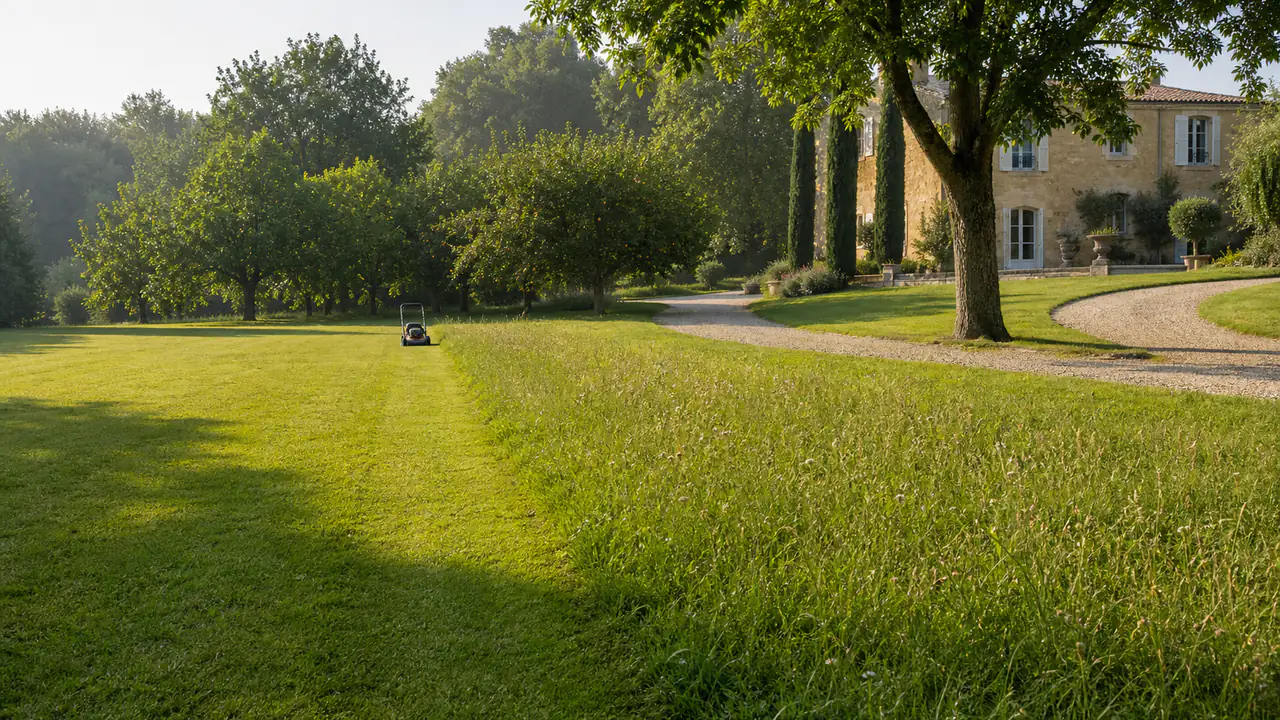
The RHS advises thinking about mowing frequency and lawn purpose. If part of the garden is intentionally allowed to grow longer, map a short path or formal area separately. The hero image shows that exact boundary: closely mown lawn on one side, longer grass on the other and the mower in the distance. Buying for the entire green area would overstate weekly demand.
Collection adds stops and carried mass. Mulching normally relies on regular cuts that the deck can recirculate effectively; it is not a one-pass answer to long meadow grass. Compare height adjustment, discharge path and access for safe cleaning as seriously as motor type.
Slopes, self-propulsion and full weight
On a bank, nominal power is only one factor. A heavy mower can be tiring to turn or hold, while self-propulsion reduces pushing but adds mass and requires controllable speed. Use the model’s stated incline limit and operating instructions; generic advice cannot prove stability on your lawn.
Walk the slope and note roots, hollows, damp patches and hard edges. Compare working weight with battery and collector fitted, ease of disengaging drive and how the machine returns to storage. If the terrain sits outside the published use, change the grass-management method rather than forcing an unsuitable mower.
Never reach under the deck until the energy source has been isolated as instructed. A clean deck and sound blade matter to cut quality and load, but maintenance must follow the current manual.
The Chatelain Method for mower choice
- Observe actual mown area, geometry, slope, grass regime, access and storage.
- Diagnose the dominant constraint: lead, documented battery endurance, traction, width, finish, noise or servicing.
- Correct with the simplest system whose published conditions cover those constraints.
- Prevent clogging, fatigue and over-equipment through an appropriate mowing rhythm, maintained blade and separate long-grass zones.
This order stops the motor category becoming the first decision. It also gives petrol a clear exit test: if no verified constraint requires it, its extra routine should count against it.
Evidence, method and limits
Our contribution. We replace universal lawn-size bands with a reproducible audit, terrain/power matrix and travel-distance calculation whose assumptions remain visible.
Provenance. Mowing regimes and mower types were checked against the Royal Horticultural Society, independent buying criteria against Which?, and the decision sequence against the UK Garden Ninja guide. The three English-language resources were consulted on 11 July 2026.
Method. Corded, cordless and petrol systems were assessed on the same axes: useful area, complexity, slope, grass regime, width, energy continuity, storage, maintenance and parts. Published coverage remains attributed and conditional.
Limits. This is documentary comparison, not our test of linked models. Which? uses its own test method, Garden Ninja is practitioner guidance, and ranges change. Our formula estimates forward travel, not duration. Verify runtime, slope and safety in the exact model’s manual; local noise rules must be checked locally.
Can a cordless mower replace a petrol mower?
Yes when a documented mower-and-battery configuration covers the audited lawn, charging fits the work and local support is available. Not on the basis of an extrapolated runtime. Compare complete working systems under the same lawn conditions rather than motor labels in isolation.
Sources consulted
- Lawn mowing guide — Royal Horticultural Society
- How to buy the best lawn mower — Which?
- How to choose the right lawn mower — Garden Ninja UK
Read next
- Garden Tools
- Bypass, anvil or electric secateurs
- Broadfork or digging fork for your soil
- Garden Care & Permaculture
Written and verified by Les Jardins d’un Châtelain, Organization author.
Editorial status — documentary comparison / editorial selection. This guide compares uses based on manuals, horticultural guidance and mechanical criteria; we have not carried out laboratory product testing or ranked brands.