Seasonal Wedding Flowers: a 2026 UK Planning Calendar for Local, Resilient Designs
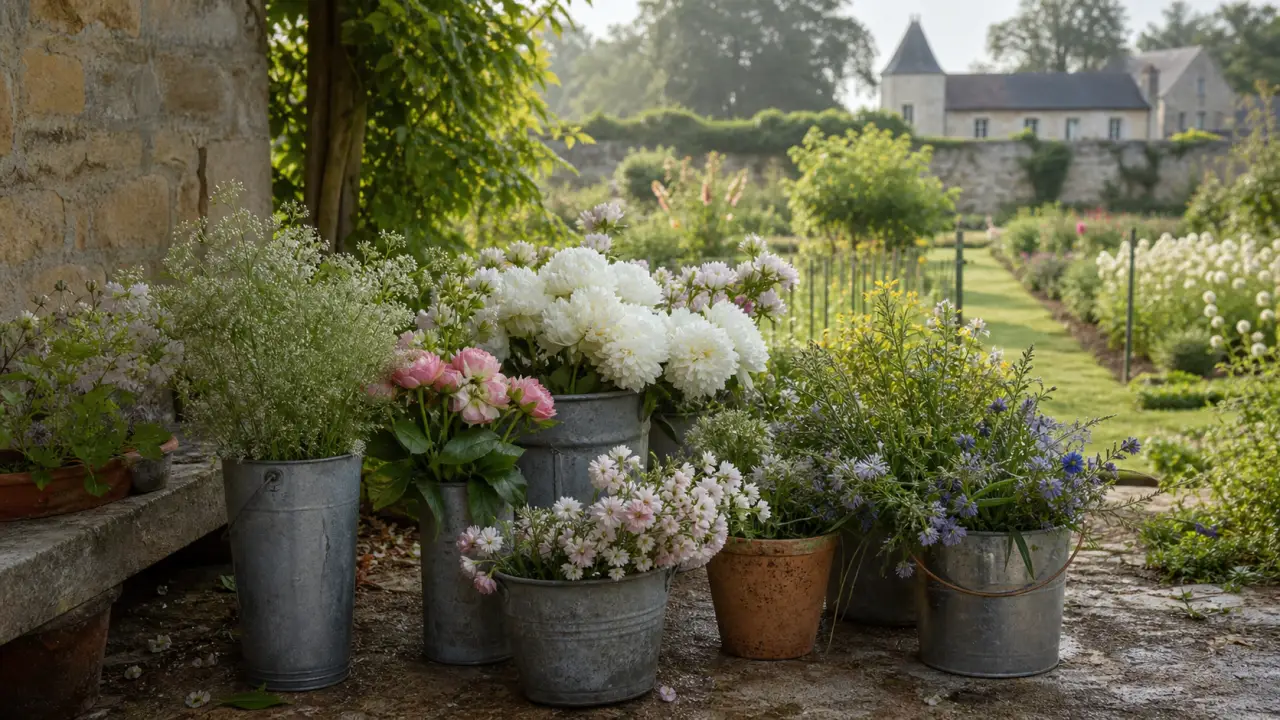
A seasonal wedding-flower calendar is a planning hypothesis, not a promise that a named bloom will be cut near the venue that week. In the UK, county, altitude, frost, rainfall, cultivar and protected growing all move the season. Wholesale availability adds another layer because a stem can be easy to buy yet imported. The reliable approach is to commission floral roles — focal, line, cloud, movement and foliage — then approve two British-grown alternatives for each role and confirm the actual grower lot before installation.
This reference separates flowering season, British harvest and market availability. It is not a stock list. Les Jardins d’un Châtelain is an editorial gardening publication, not a wedding venue, florist or estate-hire business.
Key figures, with their scope left attached
- Flowers from the Farm describes British peonies as having a short season between May and June; this is a UK grower-association guide, not a guarantee for every county or cultivar.
- The same association places the peak of English garden roses in June, with lower abundance continuing through summer until September.
- RHS guidance says spring-sown annual sweet peas can flower in about 12–14 weeks. That cultivation interval is useful for risk planning, but it cannot guarantee stems for a wedding date.
- RHS advice normally places dahlia planting into the flowering position in late May, or early to mid-June in colder regions, once frost risk has passed.
- The RHS describes dahlias as blooming from summer into late autumn and through to the first frosts, so the end of their window is weather-led rather than a national calendar date.
- RHS dahlia flowers range from approximately 5 cm to 30 cm across. A substitution must therefore match the chosen cultivar’s scale, not merely the word “dahlia”.
- The current reference contains 12 planning groups, each paired with a provenance question and a functional replacement rather than an asserted nationwide supply month.
These facts are useful only while source and meaning remain visible. A May–June peony window does not prove that a particular colour, stem length, quantity or farm lot is available throughout both months.
A UK planning calendar built around evidence
The table uses Flowers from the Farm and RHS guidance to identify sensible starting points. “Working window” keeps the wording broad where the source is broad. The supplier must still confirm county, grower, protected or outdoor cultivation, harvest week and the actual batch.
| Planning group | Documented UK starting point | Useful design role | Question before approval | Functional fallback |
|---|---|---|---|---|
| Winter shrubs and foliage | RHS identifies camellia, quince, forsythia and witch hazel as winter or early-spring cutting material | branch, scent or architectural line | was it grown for cutting, and can the shrub spare the material? | local evergreen or pruned cultivated branch |
| Narcissi and early bulbs | RHS places many bulbs in late winter or early spring | small focal, repeated bud vase | field-grown or forced; exact cultivar and sap handling? | another locally grown bulb of similar scale |
| Tulips and hyacinths | early-season bulb group; forcing can alter timing | clean line or dense colour | British-grown, protected or imported? | narcissus, ranunculus or another confirmed bulb |
| Ranunculus | Flowers from the Farm proposes British ranunculus outside the summer period as an alternative to imported roses | layered focal | which grower and harvest week? | another spring focal with a similar visual weight |
| Sweet peas | summer into early autumn for the species; sowing time changes the crop | fragrance and light movement | outdoor or protected, scented cultivar, stem length? | locally grown scented or airy stem |
| Peonies | short British window, May to June | large rounded focal | farm, cultivar, colour range and backup lot? | garden rose, ranunculus or another rounded focal |
| English garden roses | June peak, less abundant through September | focal, scent and heritage character | farm-grown lot or wholesale market rose? | another scented garden-form flower |
| Delphiniums and foxgloves | RHS lists both as useful cut-flower perennials/biennials | height and vertical rhythm | stem strength, toxicity management and wind exposure? | cultivated spike or branching line flower |
| Cosmos | late summer into autumn until frost for Cosmos bipinnatus |
airy movement and open centre | local harvest, transport and heat plan? | scabious or another light open flower |
| Dahlias | late summer and autumn, ending at frost | focal from modest to very large | cultivar size, rain damage and harvest stage? | zinnia, chrysanthemum or another confirmed focal |
| Hydrangeas and seed heads | late-season material varies greatly by cultivar and garden | volume, texture and dried transition | fresh, conditioned or dried; legally and responsibly cut? | cultivated foliage, berries or seed heads |
| Dried material and evergreens | especially useful when fresh local supply narrows | texture, line and winter structure | provenance, storage, fire plan and reuse? | potted plant or reusable cultivated foliage |
The table does not authorise cutting from a venue garden. Wild plants, protected species and established shrubs remain untouched unless the owner and competent gardener explicitly approve a sustainable cut. “From the garden” is not automatically the same as “suitable for floristry”.
Four terms that should not be merged
British-grown is an origin claim. It should identify a grower or at least a traceable UK production route. Buying from a British florist does not establish where the stems grew.
Seasonal refers to a crop cycle within a stated place and growing method. Protected cultivation may extend a crop; that is not inherently undesirable, but it must not be silently described as outdoor local season.
Available simply means a supplier can obtain a stem. It says nothing by itself about country of origin, heating, freight, abundance or whether the batch has been reserved.
Conditioned means the cut material has been prepared for its use and environment. Conditioning, vase life and heat tolerance depend on species, cultivar, harvest stage, water, hygiene, container, transport, wind and exposure. A calendar cannot predict them.
Use the Chatelain Method before naming the flower
The Chatelain Method — Observe, Diagnose, Correct, Prevent — turns an inspiration board into a garden-led brief.
Observe. Walk the venue at the hours when flowers will be installed and seen. Record shade, wind corridors, reflected heat, the cool holding area, carrying distances and the character of existing planting. Dated photographs from previous years may suggest what the garden did, but they do not promise a repeat. Map where arrangements sit near food, candles, children, paths and direct sun.
Diagnose. Describe what each saved image contributes: a rounded focal, a tall spire, a frothy cloud, scented movement, seed-head texture or a restrained colour. This matters more than the cultivar name. Diagnose constraints too. A tall spike may interrupt conversation; a delicate stem may fail on a sunny arch; a heavily scented flower may be unsuitable beside a meal; berries or toxic material require professional judgement.
Correct. Replace a rigid species demand with a role, scale and palette. Ask a grower florist to propose a preferred British crop and two alternatives with the same visual job. A September wedding need not imitate a May peony. A dahlia can supply rounded volume, but its geometry and season should be celebrated rather than disguised.
Prevent. Put origin, growing method, proposed harvest week, substitution rule and decision-maker in the quotation. Review once when the design is contracted and again when the grower can see the crop. A planned substitution is design; an undisclosed replacement on installation morning is an emergency.
Give every floral role an evidence grade
This reference uses three grades:
- A — confirmed batch: named grower, intended crop or family, likely volume and accepted fallback are recorded;
- B — documented window: the plant fits a credible regional guide, but no batch is yet reserved;
- C — inspiration only: a photograph, desired name or wholesale listing without traceable growing evidence.
No structurally important part of the design should rely on a C-grade flower. A B-grade candidate can remain in the brief if two A-grade alternatives can perform its role. The grade measures evidence, not prestige or beauty.
Use this working sheet:
| Role | Intended character | Grade today | Origin evidence needed | Alternative one | Alternative two | Who approves |
|---|---|---|---|---|---|---|
| Bouquet focal | rounded, soft, pale | B | grower, cultivar family, harvest week | British garden rose | local dahlia or ranunculus, season-dependent | couple and florist |
| Movement | fine, fragrant, flexible | B | outdoor/protected and stem length | sweet pea | light branching stem | florist |
| Ceremony line | upright, restrained | C | grower and wind/conditioning plan | cultivated branch | local spike | florist and venue |
| Tables | low mixed stems | A pending | batch and number of vessels | foliage | grower’s seasonal mix | florist and caterer |
For table dimensions and sight lines, use the separate rustic wedding table guide. This page retains the sourcing and seasonality question.
Substitute by shape, movement and use
A substitution should preserve the purpose of the design, not pretend that one flower is another. Compare silhouette, visible diameter, density, movement and colour. Add scent and handling when they matter. A ruffled focal cannot automatically replace a rigid globe; a tall spike cannot simply be cut short for a low table without changing its character.
For a ceremony frame, stem strength, wet weight, wind and exposure come before name. The outdoor wedding arch guide owns the structural boundary: flowers do not make an unverified frame safe. For tables, several small vessels often tolerate seasonal variation better than one exact, dense centrepiece. For bouquets and wearable flowers, the professional should also assess weight, pollen, sap, fragrance, berries and potentially harmful plant material.
Colour flexibility need not mean a random mix. Contract a narrow colour family and permitted tonal movement. “Warm white, pale apricot and soft green, no blue” gives a grower room to use the crop while protecting the visual direction. “Exactly thirty blush peonies” removes that resilience.
Confirm twice without forcing the crop
The first confirmation belongs before the design is signed off: source area, grower, protected or outdoor production, likely volume and two fallbacks. The second belongs close enough to harvest for the supplier to assess weather, buds and quality. It should activate an agreed rule, not restart the design.
Growing the wedding flowers in the venue garden can be meaningful, but seed packets are not delivery contracts. RHS guidance notes that some perennials do not flower in their first year, while spring-sown sweet peas have a cultivation interval rather than a fixed wedding date. Spread risk across established plants, a professional grower and an approved backup. The 180-day wedding-garden timeline explains why event milestones cannot substitute for horticultural conditions.
For winter or shoulder-season weddings, British material can include forced bulbs, flowering shrubs, evergreens, dried seed heads and stored dried flowers. Label each honestly. Dried British material is still seasonal in origin, but it is not a fresh crop from the wedding week. A pot is reusable only if someone has a viable plan for its care after the event.
Methodology, scope and limitations
Version 1.0 uses UK sources actually opened for this research: Flowers from the Farm, a trade association for British flower farmers, and the Royal Horticultural Society’s cut-flower and plant guidance. Exact date ranges are retained only where the source states them. Broad terms such as “late summer” remain broad; they have not been converted into invented national months.
The twelve groups are a decision aid assembled by Les Jardins d’un Châtelain. Their design roles and evidence grades are editorial tools, not measured vase-life trials. No prices, carbon figures, nationwide stock levels or success probabilities were calculated. Northern and upland sites, islands, urban heat, sheltered southern gardens and protected cropping can produce markedly different windows.
The source set for version 1.0 was collected on 14 July 2026. To reproduce the method, open the cited pages, record the source wording and UK scope, then obtain a written origin and batch confirmation from the intended supplier. Do not infer British production from a retailer’s address or market availability.
Sources
- Flowers from the Farm — Wonderful weddings with British flowers
- RHS — Cut flowers: growing and selection
- RHS — How to grow dahlias
- RHS — Sweet peas and how to grow lathyrus
- RHS —
Cosmos bipinnatus
FAQ
Can a florist guarantee British peonies for a particular wedding date?
A florist may be able to reserve a likely grower lot, but a published May–June season is not a guarantee of cultivar, colour, quantity or quality for one date. Ask who grows the peonies, how the crop is progressing and what happens if the batch is early, late or weather-damaged. Approve two rounded focal alternatives in advance. If peonies have strong personal meaning, use a confirmed small quantity in the bouquet and allow the wider scheme to follow the best available British crop.
Version history
- 1.0 — initial UK reference; twelve planning groups; distinction between flowering, British harvest and market stock; evidence grades A/B/C.
How to cite this page
Source: Les Jardins d’un Châtelain, “Seasonal Wedding Flowers: a 2026 UK Planning Calendar”, version 1.0. This reference treats a flowering window as a hypothesis that requires origin and batch confirmation, not a supply guarantee. You may reuse the table with a link to this page and its limitations intact.
Written and checked by the editorial team of Les Jardins d'un Châtelain.