Rustic Wedding Table Decorations for a Garden Reception: Seasonal Flowers, Materials and Working Proportions
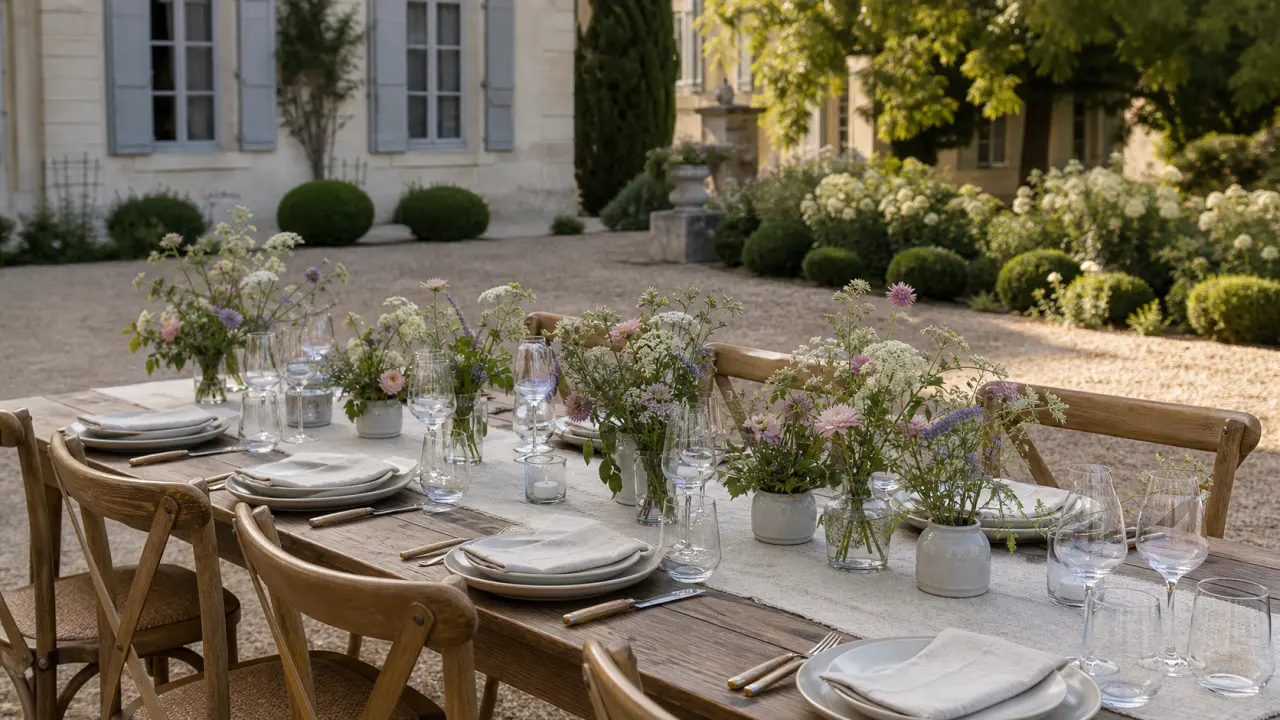
This article uses one fully laid trial table as an editorial prototype. Its record has separate observation fields for sightlines, the place setting, declared service space, object movement and the florist’s stated hydration method. The team records what it sees and who accepts each point; the article does not turn the five fields into a professional approval standard.
This approach treats the table as part of the wedding breakfast rather than a photograph taken before guests arrive. It develops the palette established in our guide to an English country garden wedding but does not redesign the whole event or compare country-garden, boho, formal and modern themes. The structure and positioning of a rustic outdoor wedding arch, the month-by-month flower calendar and the whole-event weather plan remain separate decisions. Les Jardins d’un Châtelain is not presented here as a wedding venue, florist or décor-hire supplier.
Begin with the wedding breakfast, not a saved image
UK inspiration pages such as Bridebook and Hitched usefully show bud vases, runners, candles, seasonal flowers and different place settings. They cannot know the width and condition of your tables, how many glasses will be used, whether bread and water stay on the table, or whether food is plated or shared.
Our mock-up sheet lists table shape, surface, chairs, linen, place setting and the service items declared by the venue and caterer. It is a prompt for reproducing the agreed table, not a complete banqueting inventory asserted by this article.
A flat lay can conceal the problem because it removes people, elbows, serving hands and conversation. A centrepiece can look restrained from above yet block a face at seated eye level. A loose arrangement of small vases can seem flexible until each vessel needs water, a stable position and collection after the meal.
Apply the Chatelain Method to one trial table
The Chatelain Method follows four passes—Observe, Diagnose, Correct, Prevent—before the design is repeated across the reception.
Observe from the chairs
Lay one table with the genuine items or accurate samples. Seat two people opposite each other and several people side by side. Look across, diagonally and along the table. Photograph the arrangement from seated eye level, not only from the end of the table while standing.
Repeat the observation at approximately the time and place of the meal. Note direct sun, shade, heat retained by paving, movement of air, an uneven surface and the route used by waiting staff. These are conditions to pass to the venue, florist, caterer and hire company; they are not evidence for an invented wind or temperature threshold.
Diagnose competing uses
Mark every conflict on the complete table: a vase where a carafe must stand, a menu in a serving hand’s path, a flower mass across two guests’ faces, or a runner that bunches under glassware. Ask the caterer which areas must remain available for hands, bottles, shared dishes and clearing.
Inspect the flowers as working cut material. Can every vessel hold an adequate water supply for the florist’s plan? Can that water be checked without dismantling the arrangement? Will the flowers wait in direct sun before guests sit down? “Seasonal” is not a promise that every stem will tolerate the same handling or exposure.
Correct by subtracting first
Remove, space out or relocate the item that creates the conflict. Low groups may preserve conversation better than one broad mass, but several small vessels also multiply water checks and collection tasks. An elevated arrangement may leave a clear view through its base, but only the trial can show whether it works with the actual guests, table and service.
The correction is successful when the table functions, not when it conforms to a fashionable formula. If an object must be moved as soon as the first dish arrives, it probably does not belong in the approved version.
Prevent drift between prototype and reception
Ask the venue, caterer and florist to approve the same completed trial. Photograph it with every place setting, write down the sequence of assembly and identify any item staff may move. Use that record when the remaining tables are dressed.
Include the strike in this approval: who empties vessels, who counts hired pieces, where linen goes, when flowers may be redistributed and which team performs the final table and ground check. A design is not fully specified while its removal depends on an unnamed person improvising late at night.
Run the six-part blank-table test
Use the same order for every trial: working space | seated sightline | stability | hydration | service | strike. This is an observation sheet, not a design standard. A pass depends on the real table, items and responsible suppliers.
| Check | Question at the trial table | Evidence to record | Response if it fails |
|---|---|---|---|
| Working space | Do the full settings, glasses, bread, water and planned dishes fit without an improvised move? | Complete table and service rehearsal with the caterer | Remove, separate or relocate decoration |
| Seated sightline | Can guests see faces opposite and diagonally without leaning around the display? | Seated photographs from several places | Change the mass, spacing, position or vessel |
| Stability | Do vessels, menus and textiles remain secure under the conditions of this site? | Venue and supplier approval of the actual items | Replace the item or layout; do not invent a fixing |
| Hydration | Can flowers remain in clean water that is accessible and does not leak? | Florist’s conditioning and checking plan | Change the vessel, stem choice or dressing time |
| Service | Can staff place, pour and clear everything in the agreed sequence? | Short rehearsal with the real equipment | Keep hand, bottle and dish zones clear |
| Strike | Does each item have a named owner, collection route and next destination? | Shared collection and removal list | Assign hire return, reuse, redistribution or disposal before ordering |
The value of the sheet lies in forcing one decision to survive all six checks. An arrangement that preserves sightlines but prevents serving has not passed. Neither has a beautiful series of vessels that nobody can refill or account for after the reception.
Let place settings and service determine the proportions
Usable space is not a standard number. It changes with table shape, number of covers, plate size, glassware, linen and service style. A table that works for plated courses may become crowded when sharing platters, bread boards and bottles remain between guests.
Set down everything expected during the busiest part of service. Ask a member of the catering team to place a dish, pour water and remove a setting. Mark the areas their hands and equipment need. Decoration can occupy only what remains after these uses have been protected.
On a long table, a continuous floral runner is not automatically more coherent. It may compete with water, wine and shared dishes along the entire length. Spaced groups can create useful gaps, but their rhythm must be tested at every place. On a round table, one central arrangement is not automatically practical: its width, vessel, water, menus and serving method still determine the result.
Judge the arrangement in three dimensions from the chairs. Width and density can obstruct conversation even when the flowers are low. A taller element can leave a visual opening but may still be unstable or interfere with service. This is why a copied centimetre rule answers the wrong question.
Choose British seasonal flowers as working material
Seasonal British flowers can connect the table with the garden and date, provided availability remains flexible. Flowers from the Farm encourages couples to work with flowers likely to be growing at the time and to embrace seasonal variation. Ask the florist which locally grown stems are expected, what substitutions preserve the colour and movement, and when the final choice can reasonably be confirmed.
Origin and season do not remove the need for conditioning. The Royal Horticultural Society recommends cutting well-hydrated material, placing stems into water promptly, removing foliage below the waterline, making a clean re-cut and conditioning flowers in clean water in a cool place. Those practices are useful starting points; they do not guarantee an identical vase life for every species on a warm outdoor table.
The worksheet asks the florist to enter the vessel, intended hydration, holding arrangement and dressing time for the chosen flowers. Those entries come from the supplier rather than an event-specific protocol created here. At the trial, the team records any observed leak or handling problem and returns it to the relevant supplier; the detailed seasonal list remains in the separate guide.
Use rustic materials without dressing the table as a costume
Linen, timber, ceramic and glass can all suit a garden reception, but using all of them is not a requirement. Carry one material or colour from the wider setting, then add contrast only where it improves the place setting. The table should feel connected with the property rather than assembled from a checklist of rustic symbols.
Test a runner or cloth on the actual surface. Observe whether it moves, creases beneath a glass, catches at a place setting or obstructs the caterer’s hand. Any fastening or treatment must be agreed with the venue or responsible supplier; this guide gives no generic fixing method.
Apply the same discipline to menus, table numbers and lights. Several lightweight signs may create more instability and visual interruption than one floral vessel. If candles are proposed, their use and placement must follow the venue’s and suppliers’ fire arrangements; an attractive table image is not a fire plan.
Include weather, ground and service without inventing thresholds
Outdoor tables must be assessed in their actual position. A sheltered courtyard, open lawn and terrace beside a wall can behave differently over the course of the day. Met Office warnings provide an official picture of wider weather risk, but they do not define whether a particular menu, vase or textile is stable.
The venue and suppliers decide how the proposed setup responds to changing conditions. Replace an object that cannot be made suitable within their documented arrangements; do not solve it with an improvised weight or attachment. The covered fallback and the decision to move the wedding breakfast belong to the whole-event contingency plan.
Service access also begins outside the tabletop. The Health and Safety Executive’s event site-design guidance emphasises planning the site, access and circulation around the event. In the prototype, the venue supplies the approved staff route and the team observes the decorated table against it; planted areas and shortcuts are not classified remotely by this article.
Plan hire and reuse from the strike backwards
Hiring can be sensible for crockery, linen or vessels that have no planned use after one reception. It is still a logistics decision: confirm the exact reference, quantity, condition, delivery window, missing-item terms, cleaning responsibility and collection. The trial should use the item that will actually arrive, not a similar piece borrowed for the photograph.
Give every component a destination before ordering it: return to the hire company, continued use at home, an agreed recipient, or the appropriate waste route. Flowers can be redistributed only when the timing, wrapping, vessels and responsible people are arranged. The venue and florist decide what plant material their local waste system can accept.
Working backwards from collection often improves the design. If thirty small vessels require emptying, counting and repacking but add little from the seated view, fewer pieces may be the stronger solution. Hire is not a reason to add more decoration; it is one way to organise items that have a clear role.
Common failures exposed by the trial
Choosing decoration before the service plan. Shared dishes or water arrive with nowhere to stand. Rebuild the table with the caterer’s real equipment.
Measuring an empty tabletop. Glasses, napkins, menus and bread change the available space. Approve the complete setting from a chair.
Treating seasonal as automatically robust. A locally available flower may still need particular water and timing. Ask the florist to approve its exact use.
Multiplying rustic signals. In this framework, hessian, rough wood, lace, jars and dried material are not retained as a set by default. The prototype records the practical role of each material and removes those that do not continue the setting.
Leaving collection until the next morning. An item without an owner becomes lost stock, unwanted storage or waste. Strike is one of the six design checks.
FAQ
What height should a rustic wedding centrepiece be?
There is no universally useful height. Set the complete table, sit opposite one another and test conversation, serving access, stability and flower water. Width, density, vessel and position matter as much as height. Keep the arrangement only when it passes that real trial; do not defend a failed layout with a number copied from another table.
Evidence, method and scope
Our contribution. The six-part blank-table sheet joins working space, seated sightline, stability, hydration, service and strike in one repeatable approval record. It is an editorial coordination tool, not the result of a controlled field trial.
Method. The framework combines the UK F14 search-intent review with UK flower-conditioning guidance, seasonal-grower context, official weather information and event site-design principles. Inspiration sources are used to understand the market vocabulary, not to establish technical limits.
Scope. The prototype records the table in use. Centrepiece dimensions, vessel stability, fire arrangements, fixings and weather responses remain in the current venue, catering, floristry and supplier documents carried into the event risk assessment.
Sources and further reading
- Flowers from the Farm — seasonal British wedding flowers
- Royal Horticultural Society — cutting and conditioning cut flowers
- Met Office — UK weather warnings
- Health and Safety Executive — venue and site design for events
Written and checked by the editorial team of Les Jardins d'un Châtelain.