Rustic Outdoor Wedding Arch: Structure, Position and Flowers That Last
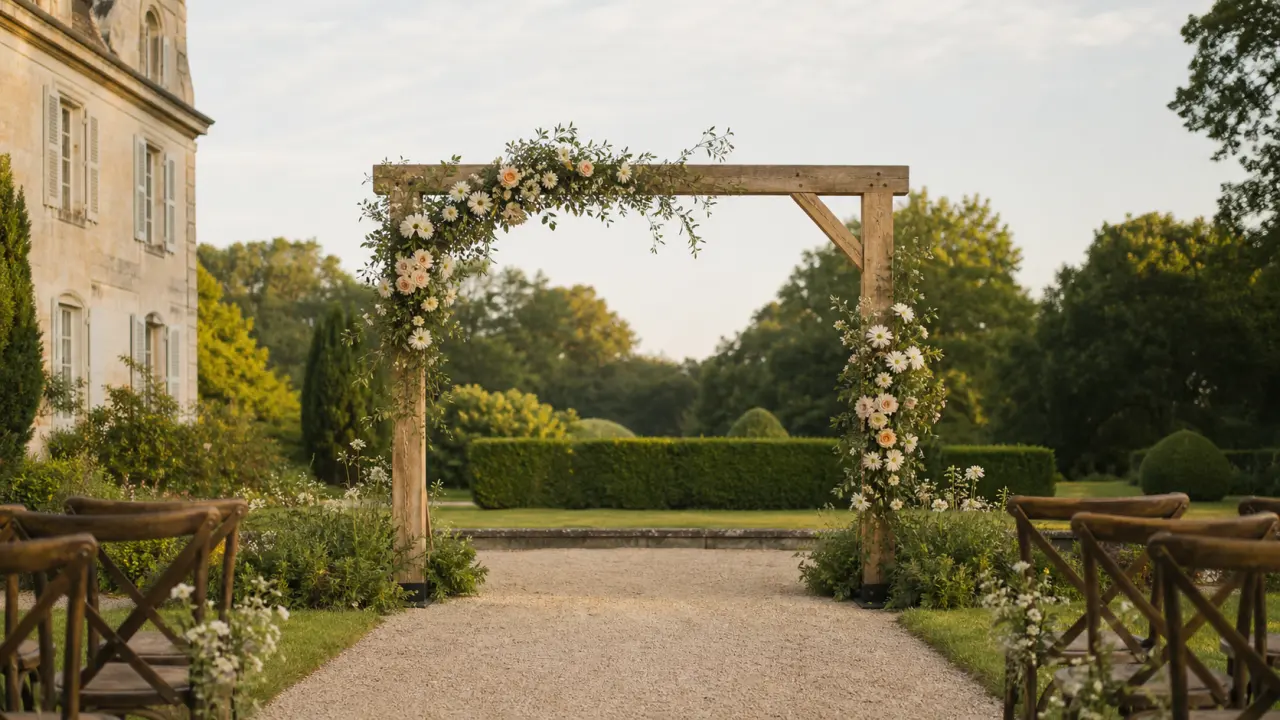
A successful outdoor wedding arch is chosen in a strict order: frame the best existing view, assess the ground and exposure, select a structure documented for outdoor use, follow its specified anchoring and weather-response plan, and only then design the flowers and drapery as additional load. If the supplier cannot explain how the completed arch is installed, monitored and taken down safely, appearance is no reason to use it.
The arch is a small temporary outdoor installation, not a decorative object placed on any convenient patch of lawn. This guide deals with that installation from sightline to strike. The wider country-garden palette belongs to the general styling plan; whole-event rain, heat and wind decisions belong to the contingency plan; flower seasonality belongs to the floral calendar. Here, structure and flowers meet at one controlled focal point within our approach to outdoor design.
Start with the picture, not the arch catalogue
The best arch may be no arch at all if a doorway, mature tree, clipped opening or distant view already frames the vows. Where a structure does help, its purpose is to make that view legible rather than replace it with a portable backdrop.
Stand at the guest arrival, walk the aisle and sit where the front row will be. Photograph the intended position at the ceremony time. Check what will appear within and immediately beside the frame: the house, horizon, service door, parked vehicle, bright sky, dark foliage or an awkward junction between surfaces. Then place two people where the couple will stand. An empty arch can appear perfectly proportioned and become visually cramped once faces, shoulders and a celebrant occupy it.
Choose the axis before choosing the shape. A circular frame, timber rectangle, asymmetrical pair of uprights or open structure can all work; none is inherently safer or more “rustic”. Geometry, joints, base, material, decorative loading and anchoring form one system. A shape selected only because it suits a saved image may obstruct the house or create a second focal point in front of a better one.
During the position test, record where the ceremony frame and the standing positions fall into sun or shade at the planned time. Pass that observation to the venue, structure supplier, photographer and florist without turning it into a weather threshold.
The Chatelain Method for an outdoor ceremony frame
The Chatelain Method—Observe, Diagnose, Correct, Prevent—keeps four different decisions in the correct sequence.
Observe the view and the ground
Record the background, aisle axis, slope, surface, visible roots, buried-service information supplied by the owner, prevailing wind direction and sun at the ceremony time. Do not infer ground strength from appearance. A dry lawn may conceal soft soil; gravel may cover a membrane or services; a paved terrace may prohibit fixings.
Diagnose the complete system
Ask what the proposed arch was designed to do. Is outdoor use stated? Which components create stability? What anchoring or base does the manufacturer specify for this surface? What changes when fabric, foliage, water reservoirs and flowers are added? Who is competent to install it, and what condition triggers alteration, exclusion or dismantling?
Correct the weak link before decorating
If the background is poor, move the position before adding more flowers. If the ground and anchoring are incompatible, change the system rather than improvise ballast. If a supplier approves only a limited decorative arrangement, redesign the floristry. Decoration must fit the verified structure, never be used to conceal uncertainty at its base.
Prevent change from going unnoticed
The coordination sheet has named fields for the completed-arch check, monitoring, access decisions and the supplier’s response plan. Its strike section records the removal sequence declared by the teams, the items they intend to count and the final condition requested by the venue; it is an editorial handover record, not a universal restoration protocol.
Complete one decision sheet before approval
This sheet is an editorial coordination tool, not an engineering calculation. Every row needs an accountable answer or a named person who will obtain it.
| Decision field | What must be recorded | Reason to stop or rework |
|---|---|---|
| Background and aisle | Photograph with people in position; arrival and seated sightlines | The frame hides the setting, faces merge into the background or the aisle misses the opening |
| Ground and slope | Surface, level, visible roots, owner restrictions and buried-service information | The system requires a fixing the site cannot accept, or the base cannot sit as designed |
| Exposure | Prevailing wind direction, shelter, sun and local observation point | No one has linked conditions at the arch to a documented response |
| Structure | Model or build specification, dimensions, materials and stated outdoor use | Indoor/photo-booth frame, incomplete parts or unknown joints |
| Anchoring | Manufacturer or competent supplier method for this exact surface | Generic internet ballast, improvised guying or attachment to trees/buildings |
| Decorative load | Location of flowers, foliage, fabric, signs and water-bearing mechanics | Floristry changes balance or sail area beyond the supplier’s approved arrangement |
| Flower hydration | Conditioning method, water source, protected holding place and latest practical dressing sequence | Stems are expected to wait dry or in heat without a species-appropriate plan |
| Weather response | Source monitored, named decision-maker and supplier actions for changing conditions | No stop, exclusion or dismantling rule is available |
| Strike | Order, responsible team, inventory of fixings and final garden check | Removal depends on pulling against plants or leaves unaccounted material |
The sheet deliberately contains no universal weight of ballast and no wind-speed cut-off. Those values depend on the designed system, its geometry, height, base, fabric area, decorative mass, ground and instructions. Copying a figure from another arch creates the appearance of precision while discarding the factors that made that figure meaningful.
Select an outdoor system, not merely a shape
Wedding arches are sold, hired and built from timber, steel, aluminium and composite components. The material name tells you little about the completed installation. A substantial-looking timber frame can have weak joints or an unsuitable base. A slender metal system can be properly engineered for a defined outdoor arrangement. A circular retail frame may be intended only for an indoor photo backdrop.
Request the instructions before confirming the florist’s design. Useful documentation identifies components, assembly, surface or anchoring requirements, outdoor limitations, inspection and response to adverse conditions. A hire company that supplies the complete system, installs it and coordinates with the venue can reduce uncertainty, but “hired” is not itself evidence of competence. Ask who designed the setup and who accepts changes requested by the florist.
The UK Health and Safety Executive advises event organisers to assess ground conditions, anchoring points, site topography and prevailing wind when positioning temporary structures. Its separate guidance on professional outdoor support equipment is for much larger equipment, not a wedding-arch formula; the transferable principle is that equipment must be fit for purpose, assembled to design or manufacturer instructions and managed for foreseeable wind and ground conditions.
Do not turn that principle into amateur structural design. If a one-off handmade arch has no competent specification for outdoor use, it has no documented operating envelope. A craftsperson may be able to produce one with appropriate design input; a collection of attractive timber and screws is not equivalent.
Ground and anchoring must be agreed together
On lawn, the question is not simply whether stakes are possible. The owner must confirm where penetration is permitted, and the system designer must specify the method. Roots, irrigation, drainage, electrical supplies and other buried services may make a seemingly open area unsuitable. The HSE explicitly advises considering underground-service hazards before driving stakes for temporary structures.
For gravel, paving or a slope, the editorial sheet records the surface information supplied by the venue, whether penetration is permitted and the installation method confirmed by the structure supplier. Packing, drilling and attachment remain unresolved until those entries are completed; this article assigns no generic structural effect to them.
Trees, branches, railings, façades, pergolas and garden ornaments are not convenient anchor points. They may be living, protected, fragile or simply not designed for the applied force. Use them only where the owner and a competent designer expressly approve a non-damaging method. Otherwise, choose an independent system.
The article gives no generic ballast recipe. The sheet simply quotes the amount, position, retention and protection stated in the documentation for the completed setup, and marks the field unresolved when that information is missing.
Flowers and fabric are part of the loading
Floristry begins after the structure and location are accepted. Fabric increases exposed area; wet foliage, water-filled mechanics and dense flowers add mass; an asymmetrical arrangement changes balance. These effects do not make abundant decoration impossible, but they require one coordinated drawing rather than separate assumptions by the arch supplier and florist.
Record the proposed location and fixing method of each floral mass and drape. The structure supplier then identifies the permitted fixing areas and the venue records any proposed contact with a living tree; the article does not infer acceptable wire pressure, clamp force or tree capacity. The completed configuration is photographed for the handover record after dressing.
Freshness is also planned, not promised by the phrase “seasonal flowers”. The RHS recommends cutting when stems are well hydrated, placing them into water promptly, removing foliage that would sit below the waterline, re-cutting cleanly and conditioning prepared stems in clean water in a cool place. Those are sound starting principles, not a guarantee that every species will tolerate the same dry exposure on an arch.
The prototype asks the florist to declare, for the actual stems, the intended hydration method, holding conditions, dressing time and any substitute. These are supplier-provided entries rather than an arch-specific triage invented by this article. The seasonal availability of peonies, roses, dahlias or foliage remains outside this page.
Build a controlled sequence from trial to strike
The safest workflow prevents late decorative changes from bypassing the system check.
- Venue approval: the owner confirms the location, protected features, permitted access and surface restrictions.
- Supplier approval: the exact outdoor system, anchoring and weather response are documented for that position.
- Visual trial: the bare structure is assembled or accurately mocked up and photographed with people in place.
- Florist coordination: the decorative layout, attachments, fabric and hydrated mechanics are reviewed as part of the completed setup.
- Completed check: a competent person inspects the dressed arch, base, clearances and guest approach before access opens.
- Monitoring: a named person watches the local conditions and applies the supplier’s actions; a general weather app does not replace observation at the structure.
- Strike: floristry and structure are removed in the agreed order, components counted and the ground inspected.
Met Office warnings help identify wider UK weather risk, but they do not give a particular arch its safe operating limit. That limit and the actions around it come from the structure’s design and responsible supplier. The full decision to move, postpone or reconfigure an outdoor wedding remains in the whole-event weather plan.
Keep the neighbouring guides out of this decision
The global styling plan supplies the palette and material language; this sheet records whether one ceremony frame belongs in the selected view.
The contingency guide records whole-event decisions for wind, rain and heat. On this sheet, weather appears as a condition for which the arch supplier documents the response of the selected system.
The floral guide records month-by-month availability and local substitutions. This sheet starts after the florist has selected the materials and records conditioning, hydration and coordination with the structure.
FAQ
Can a wedding arch be secured on a lawn without concrete ballast?
Possibly, but there is no generic yes. The sheet separates three entries: property permission for any penetration, site information supplied by the venue, and the method confirmed by the structure supplier for the completed decoration. It does not presume which roots, irrigation or services exist, and it leaves the location unresolved while an entry is missing.
Evidence, method and scope
Our contribution. The decision sheet joins the photographic view, site conditions, structure, anchoring, decorative load, flower care, weather response and strike in one approval record. It is an editorial coordination method, not structural engineering.
Method. The framework applies the F14 UK intent review, HSE site-design principles, HSE cautions for outdoor support equipment and RHS flower-conditioning guidance. It deliberately separates verified source statements from decisions that only the venue, competent supplier and florist can make.
Scope. The sheet coordinates the visual and operational decision. Ballast, wind resistance, anchoring and load capacity are documented for the exact system by its manufacturer or competent supplier and carried into the venue risk assessment and whole-event weather plan.
Sources and further reading
- Health and Safety Executive — venue and site design for events
- Health and Safety Executive — outdoor equipment, ground and wind loading
- Royal Horticultural Society — cutting and conditioning cut flowers
- Met Office — UK weather warnings
Written and checked by the editorial team of Les Jardins d'un Châtelain.