How to Prepare a Garden for a Wedding: A 180-Day Timeline to the Morning After
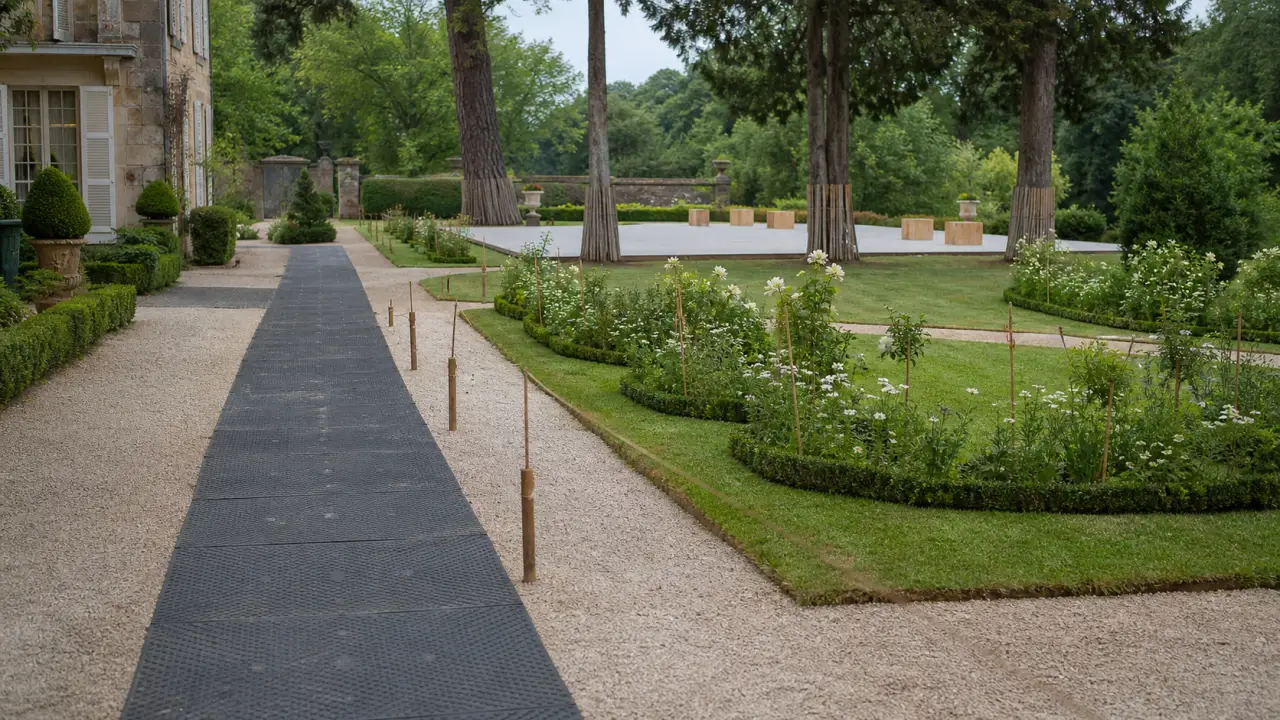
Prepare a garden for a wedding by surveying it 180 days out, mapping guest and service routes, and approving only work that suits the plants, soil, weather and available recovery time. As the date approaches, replace speculative changes with reversible pots or route changes, keep traffic and storage away from roots and wet ground, and record the condition before installation. The morning after, inspect first and wait for suitable soil conditions before bringing in repair machinery.
This is a timeline of decision gates, not a fixed British gardening calendar. Day −180 may fall in a drought, a waterlogged winter or a late cold spell. A relative wedding date cannot tell a gardener when a particular lawn should be sown, a shrub cut or a plant expected to flower.
Les Jardins d’un Châtelain is an editorial gardening website. It is not a wedding venue, estate-hire business or landscaping contractor. The owner, venue, gardener, arborist and competent event suppliers retain authority over the real site and applicable rules.
Map the event before changing the garden
Start with uses rather than decorations. Mark arrival, ceremony, drinks, meal, toilets, deliveries, waste, the covered backup and any route that must remain available. Draw guest, service and emergency access separately. A picturesque side path can work for photographs yet fail when a wheelchair, catering trolley and departing guests need it at the same time.
Add hardstanding, slopes, steps, narrow gates, low points, drains, inspection covers, irrigation, underground services, unstable edging and low branches. Ask the venue where vehicles, temporary structures, stakes, ballast, cables and storage are permitted. Empty grass is not automatically load-bearing, and green turf can conceal saturated ground.
Use three working zones:
- robust — existing hard surfaces and routes already accepted for the intended use;
- controlled — lawn or other ground the venue may release for a defined use, duration and load after inspection;
- closed — beds, drains, soft ground, young planting and tree-root areas identified with the gardener or arborist.
Do not invent a root-protection radius from a generic diagram. Tree species, age, structure, soil and previous disturbance all matter. Where consequences could be serious, a competent arborist should define the protected area. Until then, route people, vehicles, containers, generators, water tanks and stored materials away from trunks and beneath canopies.
Use the Chatelain Method to make each decision
The Chatelain Method has four passes: Observe, Diagnose, Correct, Prevent.
Observe. Take dated photographs from repeatable viewpoints. Note recent rain, ground that deforms under light footfall, plant condition and the actual shade at the event hour. Photographs from the same part of previous years can inform expectations, but they cannot guarantee this year’s flowering.
Diagnose. Separate a symptom from its cause. Pale turf might reflect drought, shade, mowing, species or compaction. Applying feed simply because a wedding is approaching is not a diagnosis. A branch that narrows a route might be avoided by moving the route rather than cut. A low wet patch should be closed, not hidden under loose flooring.
Correct. Prioritise legibility and reliable access: clear an approved path, repair a small edge with enough recovery time, remove clutter or move an activity to hardstanding. Established container plants and movable screening can add structure without disturbing a bed that may not recover.
Prevent. For every task, record who decides, which soil or weather condition is required, what evidence shows success and what triggers postponement. Keep a reversible substitute. The garden does not fail when a job is deferred; the plan fails if it has no alternative.
Use this day −180 to day +1 decision table
Localise the rows with the venue and professionals. The date alone never makes the condition column green. Give the live version an update date and one named record owner.
| Deadline | Task | Decision-maker | Weather / soil condition | Evidence of success | Reason to postpone |
|---|---|---|---|---|---|
| Day −180 | Baseline survey, dated photographs, route and sensitive-zone map; principal supplier visit | Owner or venue, gardener, coordinator | Site can be inspected safely; relevant drawings and areas are accessible | Versioned plan, reference album and named responsibilities | Ground unsafe, buried-service information missing, event use or numbers unresolved |
| Day −120 | Select feasible corrections and a reversible substitute for each | Gardener; arborist for tree issues; venue | Species, observed stage, local season and recovery window are compatible | Written work scope with acceptance test and fallback | Uncertain recovery, active nest, permission or diagnosis missing, change mainly cosmetic |
| Day −90 | Trial guest and service routes; close conflicts; route lawn decisions to the dedicated guides | Venue, coordinator, gardener | Ground is neither saturated nor distorted by exceptional conditions | Photographed walk-through with widths, turns and no-go areas corrected | Route crosses roots or beds, access conflict, bearing condition not accepted |
| Day −60 | Confirm protective zones, deliveries, technical positions and container planting | Venue and relevant suppliers | Current condition supports the agreed installation; no forecast is treated as a guarantee | Approved layout and inventory of movable items | Unknown service, unapproved stake or load, unstable pot or unacclimatised plant |
| Day −30 | Compare the garden with baseline; reserve locally available substitutions | Gardener and couple with venue | Actual plant condition, water position and local controls checked | Dated “keep, correct, substitute” list with photographs | Flowering uncertain, water stress, unidentified disorder or insufficient recovery time |
| Day −14 | Freeze drastic pruning, cultivation, speculative treatments and risky new planting; repeat route test | Venue, gardener, coordinator | Wildlife, tree and local restrictions checked; ground remains serviceable | Frozen work register and marked route plan | Work could leave bare soil, unstable growth, residues or a wilted plant on the day |
| Day −7 | Gentle clearance, approved light edging, obstacle removal and protection check | Gardener and venue | Ground has drained enough; low-risk work suits the plant and local conditions | Photographs of routes, barriers and storage zones | Smearing soil, excessive heat, water restriction, wind or need for heavy machinery |
| Day −2 / −1 | Mow only if growth, ground, grass and equipment permit; position movable elements | Gardener or venue grounds lead | Turf and soil are not excessively wet; method suits the established lawn | Even cut without rutting or scalping; routes still clear | Soft soil, wet leaf, drought or heat stress, unsuitable blade or machinery |
| Wedding day | Final inspection, physical closure of red zones, route and contractor briefing | Venue lead, coordinator and supplier leads | Actual conditions fit the agreed plan and current instructions | Time-stamped sign-off or message; barriers and signs in position | Warning, flooded low point, marking ground, suspect branch or installation, blocked access |
| Day +1 | Photograph, restrict traffic, sort waste and plan repair after the ground is ready | Venue and gardener; supplier where relevant | Inspection can occur without worsening compaction | Before/after record, closed zones and written recovery brief | Saturated soil, unknown cause, machinery too heavy or condition needs joint inspection |
A blank cell is not approval. “Postponed: soil still smears under a light tread” is a useful outcome because it prevents a calendar task from becoming fresh damage.
From day −180 to −90, preserve what already works
Six months creates opportunities to observe, not a licence to redesign everything. Walk the garden after ordinary rain, where permission allows, and record where water stands or traffic leaves marks. Check the sun at the planned ceremony and drinks times; shade seen during a viewing can move substantially by season and hour.
Resolve functional defects early: a loose edge, concealed step, dead branch needing professional assessment, delivery gate that is too narrow or lack of an all-weather route. These may require a contractor, permission and a restoration interval. A border flowering differently from an inspiration photograph is not, by itself, a functional defect.
Avoid duplicating a lawn treatment programme here. Our guide to protecting a lawn during a garden reception explains traffic, loads and protection. Its scenario uses a football gathering, but the soil and route logic transfers to a wedding. The gardener can then decide whether any lawn work is locally appropriate. If the season or recovery window is wrong, move footfall to hardstanding rather than force a renovation.
From day −60 to −30, build reversible greenery
By two months out, suppliers should understand permitted routes and protected ground. Give every pot, screen, sign and item of furniture a planned position. Check that it does not cover a drain or inspection chamber, narrow an accessible route, add an unapproved load near roots or require watering that may be restricted.
Create three layers of planting expectation: established garden structure observed on site; mobile plants already acclimatised to suitable conditions; and a non-living or reusable styling substitute. A local nursery may confirm stock nearer the date, but neither it nor a photograph can promise that a plant in open ground will flower on a chosen day. Pots must be stable, drain correctly, suit the light and remain movable along an approved route.
Do not order severe hedge or tree cutting just to open a view. In the UK, protected trees, conservation areas, wildlife law and local controls can affect work. GOV.UK guidance also warns that drastic hedge reduction may not regrow successfully and that nesting birds must be considered. The legal position differs across the four nations, and local authority or professional advice may be required.
From day −14 to the wedding, stop trying to transform it
At two weeks, change the objective from improvement to preservation. Freeze cultivation, speculative feeding or treatment, risky planting, scarification and structural pruning. A late intervention can leave loose soil, residues, unstable growth or visible stress without enough time to recover.
At day −7, check current Met Office warnings, any water-use restrictions, and the venue’s arrangements. Temporary Use Bans and other restrictions are not one uniform UK rule; use the relevant water company and location. Do not overwater in pursuit of a greener photograph. The result may be soft ground, weak growth or unnecessary demand on water.
At day −2 or −1, mowing remains conditional. RHS guidance emphasises growth and actual conditions rather than a fixed calendar, and advises against mowing when grass or ground is overly wet. Follow the established lawn’s normal method. If wheels mark, clippings clump or the blade tears, postpone. Slightly longer grass is easier to accept than fresh ruts or scalping.
On the wedding morning, walk the agreed circuit with someone authorised to close a zone. Put barriers in place before supplier arrivals. No trolley, pallet, ballast, generator, water container or flight case gets a “temporary” resting place in a bed or root area. Capture the completed layout from the baseline viewpoints.
If conditions require a weather switch, use the separate outdoor wedding weather plan agreed with the venue. This gardening timeline does not replace emergency arrangements, structural instructions or official advice.
The morning after, inspect before repairing
Close soft areas first. Remove light items by hand from authorised routes and leave heavy installations to the responsible supplier. Repeat the baseline photographs of turf, tree bases, beds, drains, edges and delivery access. Record ruts, polished or smeared soil, displaced edging, rubbed branches, forgotten ties and standing water.
Do not aerate, roll or level saturated ground to make it look finished. Soil damage depends on moisture, texture, load and repeated passes; a quick machine movement can deepen it. Where a root, tree stability or buried service may be affected, preserve evidence and obtain competent advice.
Use our separate guide to repair a lawn after a garden reception for diagnosis and recovery sequencing. As with the protection guide, its event example is football-led, but the post-traffic principles apply. The first action may simply be to keep people off and wait for the ground to drain.
Adapt the timeline to nation, season and site
There is no single UK garden season. Exposure, altitude, rainfall, soil, shade and local climate shift growth and soil readiness. The relative wedding date cannot prescribe sowing, feeding, planting or pruning.
For tree or hedge work, use the GOV.UK guidance below to check Tree Preservation Orders, conservation-area notice requirements and nesting birds, then confirm the position with the authority responsible for the nation and site. Record any other venue or event condition only from the document or competent body that actually applies; this guide does not infer noise, waste, water or heritage consent from tree guidance. HSE event guidance cited in our research is framed for Great Britain; Northern Ireland has its own competent bodies. Law, official instruction, site safety and the living garden take priority over this table.
FAQ
What if the garden will not recover in time for the wedding?
Do not accelerate major work. Close the vulnerable patch, move the route to a robust surface and create the needed height or colour with established containers or a reusable mobile screen approved by the venue. Record who accepted the substitution. A visible but protected imperfection is safer than late sowing, drastic pruning or cultivation with no demonstrated recovery window.
Evidence, method and limits
Our contribution. The day −180 to day +1 table ties every task to a decision-maker, a weather or soil condition, evidence and a postponement trigger. It makes “do nothing yet” a documented professional choice.
Method. We compared UK garden-wedding search expectations with RHS, GOV.UK, Met Office and HSE material on mowing, trees and wildlife, weather, routes and site conditions. Wedding and supplier pages were used to identify questions, not to set horticultural or structural limits.
Limits. Without a visit, plant identification, soil history, service drawings, venue rules and near-date weather, this article cannot approve pruning, planting, load, anchoring or repair. The owner and competent professionals must decide on the actual garden.
Sources and further reading
- RHS — How to mow a lawn, for condition-led mowing rather than a rigid date.
- GOV.UK — Over the garden hedge, for protected trees, conservation areas, nesting birds and drastic hedge reduction.
- HSE — Venue and site design, for ground, routes, weather, temporary structures and buried services in Great Britain.
- Met Office — Warnings and advice, for current official warning information.
- RHS — Get your patio ready for a party and Abacus Marquee Hire, consulted to characterise UK search expectations, not to approve a site or installation.
Written and checked by the editorial team of Les Jardins d'un Châtelain.