Verna Lemon
Citrus × limon ‘Verna’ — also called Berna, Verna 50
The large late lemon that takes over from the Fino and extends the season into summer. Its asset — arriving when other lemons are lacking — has a counterpart: a real tendency to alternate bearing, to be mastered by management.
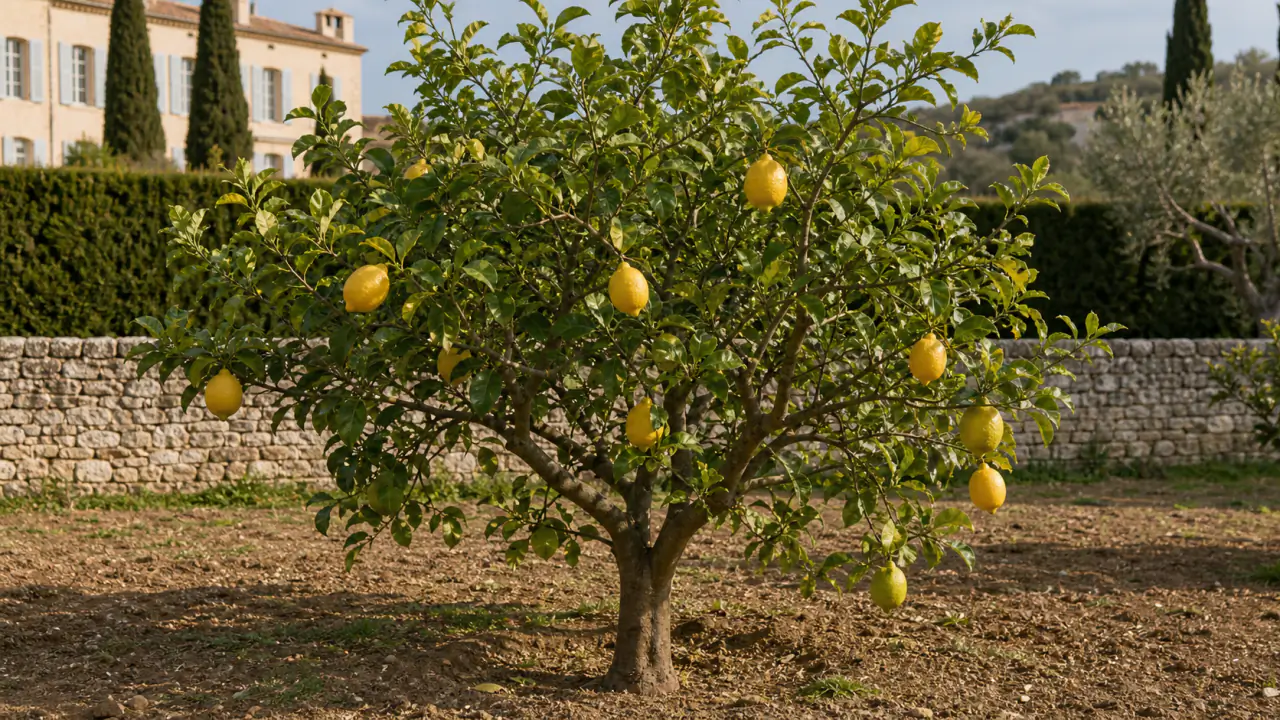
When the Fino has finished bearing, the Verna begins: it is the Spanish late lemon, harvested from spring into early summer. The fruit is large, often with a thicker skin, relatively few-seeded, excellent as juice and as zest. Its real particularity — the one that decides success — is a marked tendency to alternate bearing: a heavy-crop year tends to be followed by a light one. Well managed, the Verna beautifully spreads the season; left to itself, it bears « every other year ».
The late counterpart of the Fino / Primofiori; see also the Eureka and the Meyer. For container growing, see the Citrus & Orchard section.
The reliable facts before you buy
The tree and the fruit
The Verna is distinguished by its large fruit with a skin often thicker than the Fino’s, relatively few-seeded, with fine juicy flesh. The tree can flower several times, which spreads the harvest but complicates the balance: crop load and vigour must be watched. Its characteristics — size, skin thickness, juice — are very sensitive to harvest timing and rootstock, more than in other lemons. The flower is self-compatible.
Mastering alternate bearing
This is the Verna’s real subject: without intervention, it tends to bear heavily one year, little the next. Management therefore aims to smooth the crop load — avoiding the excesses that exhaust the tree, sustaining nutrition, harvesting at the right time. The rootstock, here again, weighs heavily on quality; it is chosen according to pH, salinity, cold and the goal.
| Depending on your goal | Rootstock(s) | Why — and the trade-off |
|---|---|---|
| Quality, contained size, pot | Trifoliate (Citrus trifoliata), Flying Dragon (dwarf) | Concentrated fruit, compact tree, good cold tolerance. ⚠️ very sensitive to active lime, slow. |
| Productivity, warm soil | Volkameriana, Citrus macrophylla (control) | Vigour and yield in a Mediterranean zone. ⚠️ low cold tolerance. |
| Calcareous or saline soil | Forner-Alcaide 5 (FA5) and other FA | Documented tolerance to chlorosisYellowing of the foliage caused by poor iron uptake, often linked to chalky soil. and salinity. ⚠️ in the Elche trial, Verna 50 proved the least efficient of the three cultivars — a local result, not a rule. |
| To avoid / verify | Extrapolation beyond the trial | No ban to publish without a source for the Verna; quality very sensitive to the harvest × rootstock pairing. Insist on a proven combination. |
The Verna’s rhythm: in the ground or in a pot
A late lemon, the Verna is harvested from spring into early summer. In a mild zone, in the ground with protection; elsewhere, in a large tub brought in frost-free.
| Jan | Feb | Mar | Apr | May | Jun | Jul | Aug | Sep | Oct | Nov | Dec | |
|---|---|---|---|---|---|---|---|---|---|---|---|---|
| Plant (in the ground, mild zone) | ||||||||||||
| Protect from cold (pot in / fleece in ground) | ||||||||||||
| Move the pot outside | ||||||||||||
| Flowering (sometimes repeated) | ||||||||||||
| Harvest (late) | ||||||||||||
| Feed (citrus) |
A regular Verna, not « every other year »
The year’s crop load
Note whether the tree is in a « full » or « empty » year: it is the signal that governs all Verna management.
Alternation and root
Marked alternation betrays a crop/nutrition imbalance; also check that the rootstock suits your soil, the Verna’s quality being very sensitive to it.
Smooth the crop load
Regulate the load in heavy years, sustain nutrition, harvest at the right stage: aim for a regular crop rather than an exhausting peak.
Steady water and feeding
Regular watering and feeding across the Verna’s long season: consistency of inputs is the best guard against alternate bearing.
Read the sign, trace the cause, correct, prevent
On the Verna, alternate bearing and chlorosis on calcareous soil top the points of vigilance, along with the usual overwintering pests.
| Sign observed | Probable cause | Correct | Prevent |
|---|---|---|---|
| Abundant crop then very light the following year | Alternate bearing | Regulate the load, sustain nutrition | Smooth the load every year, steady inputs |
| Yellow leaves with veins staying green | Iron chlorosis (high pH, lime, waterlogging) | Iron chelate; review watering; lime-tolerant rootstock | Free-draining compost, low-lime water, suitable root |
| Cottony masses or shells on stems and undersides | Scale insects (mealybugs or armoured scale) | Clean off, white oil or soft soap, isolate | Ventilate overwintering, inspect when bringing in |
| Sticky black deposit on the foliage | Sooty mould, on the honeydew of scale or aphids | Treat the honeydew-producing insect first | Watch scale and aphids early |
| Fine webbing, stippled leaves, dry air | Red spider mites (mites) | Mist the foliage, humidify the air | Avoid hot dry air in the overwintering space |
Stay sparing with treatments: clean foliage, bright frost-free overwintering, balanced nutrition. If a notifiable citrus disease is suspected, follow the official instructions in force.
A large end-of-season lemon
The Verna gives a clean, acidic juice to sharpen, and its thick skin makes it an excellent candidate for zest and candied peel: the peel, generous, works well. Its practical interest lies in its season — it supplies lemons in spring and early summer, when the Fino and the Eureka are scarce.
What the standards say — and what they do not
The Verna belongs to the lemon group of the European standard. The equatorial diameter is measured, never the variety alone.
- Commercial minimum (lemon group): diameter ≥ 45 mm, juice content ≥ 20 %.
- Size codes: 0 (79–90 mm) to 7 (45–52 mm) — the Verna, large, sits rather in the low codes.
In the IVIA Elche trial (calcareous soil, pH 8.5), Verna 50 proved the least efficient scion of the three cultivars compared — a local result, tied to that soil and those rootstocks, not to be raised into a universal rule. Always measure your own crop.
What people most often ask
Why does my Verna bear every other year?
It is its natural alternate bearing, accentuated by heavy-crop years. Regulating the load, steady nutrition and harvesting at the right stage limit it markedly.
What is the difference with the Fino?
The Fino is early (autumn-winter), smaller and juicier; the Verna is late (spring-summer), larger, with thicker skin. They are paired to cover the whole year.
Is its thick skin a defect?
Not in the garden: it lends itself well to zest and candied peel. It is mainly a commercial criterion; for home use it is even an asset.
Which rootstock to choose?
Depending on the soil: Forner-Alcaide (FA5…) on calcareous soil, macrophylla in a warm zone. As the Verna’s quality is very sensitive to the root, insist on a proven combination.
Sources and control
Last scientific check: 2026-07-18.
- IVIA — Instituto Valenciano de Investigaciones Agrarias: rootstock × lemon trials (Elche).
- Lemon — Wikipedia (EN): botanical framework of Citrus × limon.