Owari satsuma
Citrus unshiu ‘Owari’ — Owari satsuma, unshiu mikan
One of the most cold-tolerant edible mandarins, but not a reliably hardy tree for British gardens. Early, easy-peeling and usually seedless, Owari makes a distinguished container citrus when given bright frost-free shelter in winter.
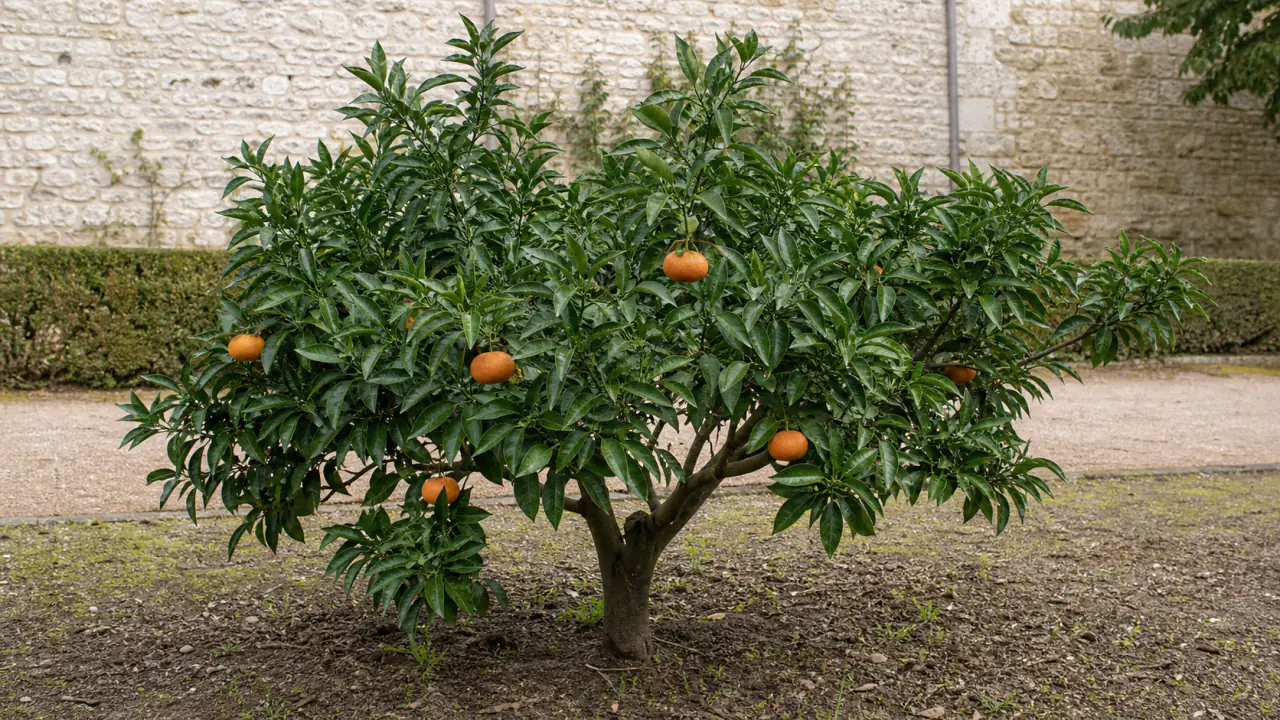
Owari is an old Japanese satsuma selection valued for an unusually useful combination: relative cold tolerance within edible citrus, an early season, a thin loose peel and tender, juicy flesh. In Britain, that tolerance is an advantage during a sheltered summer outdoors, not a promise of permanent open-ground hardinessA plant's ability to survive winter cold without protection.. Choose a grafted container tree, acclimatise it to a sunny sheltered position after frost risk has passed, then overwinter it in a bright, frost-free greenhouse, conservatory or glazed porch. The fruit is usually seedless, not absolutely so: Owari sets without a polliniser, while compatible citrus pollen nearby can occasionally result in pips.
Compare it with the common clementine and Willowleaf mandarin. For the cool season, use our guide to overwintering a potted citrus in a cold climate.
Reliable points to check before buying
For Britain, choose the container and the right rootstock
Owari is more cold-tolerant than many edible citrus, but that comparison must not be turned into a British hardiness claim. A container is the dependable choice: give the tree a warm, sheltered summer position, then move it to a bright frost-free place before damaging cold. Its early fruiting season is helpful because fruit has less winter to face, yet ripening still depends on light and accumulated warmth. Taste a fruit before picking the crop rather than waiting for a uniformly deep-orange peel.
Pollination requires similar precision. Owari is self-fruitful in practice through parthenocarpic fruit set, so a polliniser is not required for a crop. Its fruit is generally seedless, although nearby compatible citrus can occasionally introduce pips. Ask the nursery for the named cultivarA variety produced through selection or cultivation, distinct from the wild original plant. and rootstock in writing: those two labels influence vigour, response to lime and container management, unlike the pollination-sensitive Nadorcott.
| According to your aim | Rootstock(s) | Why — and the trade-off |
|---|---|---|
| Container, restrained vigour, cold priority | Trifoliate orange (Poncirus trifoliata), where offered | Can help restrain vigour and is used where cold tolerance matters. ⚠️ unsuitable for lime-rich compost or water; relatively slow growth. |
| Relatively high pH | Forner-Alcaide 5 (FA5), if available | Selected for relative tolerance of calcareous conditions. ⚠️ availability varies and it does not make chlorosisYellowing of the foliage caused by poor iron uptake, often linked to chalky soil. impossible. |
| General production under suitable conditions | C35 or Carrizo, where offered | Established citrus rootstocks. ⚠️ response to high pH and final vigour must be checked with the supplier. |
| Before ordering | Cultivar × rootstock label | Buy a grafted, named ‘Owari’ and obtain the rootstock identity; do not accept an unlabelled “satsuma” as equivalent. |
The Owari year in a British container
A sunny, sheltered summer position and a bright frost-free winter place form the reliable British pattern. The exact flowering and picking dates move with light, shelter and the temperature of the winter quarters.
| Jan | Feb | Mar | Apr | May | Jun | Jul | Aug | Sep | Oct | Nov | Dec | |
|---|---|---|---|---|---|---|---|---|---|---|---|---|
| Pot or repot | ||||||||||||
| Bright frost-free shelter / fleece during transitions | ||||||||||||
| Flowering (conditions dependent) | ||||||||||||
| Taste and pick (timing varies) | ||||||||||||
| Citrus feed during active growth |
Keeping an Owari sound through a British winter
Read the winter site
Check light, minimum temperature and draughts in the intended greenhouse, conservatory or glazed porch before the tree is moved.
Separate cold from wet roots
Yellowing or leaf drop in winter can reflect low light, chilled roots or waterlogging. Test the growing medium before adding water or feed.
Give light, drainage and frost protection
Move the container to bright frost-free shelter, keep it away from cold draughts and let excess water drain freely.
Acclimatise every seasonal move
Move the tree outdoors and back under cover gradually. Sudden changes in light and temperature can cause avoidable leaf drop.
Read the symptom, find the cause, correct it and prevent a repeat
For a British container-grown Owari, winter light, root-zone moisture and pests in sheltered quarters deserve more attention than a headline claim of cold tolerance.
| Symptom observed | Likely cause | Correct | Prevent |
|---|---|---|---|
| Blackened shoot tips after cold weather | Frost or cold draught; Owari is not reliably UK-hardy | Return to frost-free shelter; remove dead wood only once regrowth shows the boundary | Monitor the winter quarters and move the tree before frost |
| Yellow leaves with greener veins | Iron chlorosis associated with high pH or waterlogging | Check drainage and water quality; use an appropriate iron treatment only as directed | Match rootstock and compost, and avoid leaving the pot waterlogged |
| Cottony patches or scales on stems and leaf undersides | Mealybugs or scale insects favoured by sheltered conditions | Remove by hand and use only a product authorised for the crop, following its label | Inspect before housing and ventilate the winter quarters |
| Sticky black coating on foliage | Sooty mould growing on insect honeydew | Control the honeydew-producing pest first, then clean the foliage | Monitor scale insects and aphids early |
| Silvery winding mines in young leaves | Citrus leaf miner | Remove only badly affected soft shoots; avoid unnecessary treatment | Avoid excessive nitrogen that drives vulnerable soft growth |
Keep treatment proportionate and follow the current UK label for any plant-protection product. For a regulated plant-health concern, use the latest official guidance rather than a generic citrus remedy.
The effortless early mandarin
Owari is made for eating fresh: its thin loose peel comes away readily and the tender segments deliver mild, abundant juice. The fruit is usually seedless, which makes it especially convenient, but an occasional pip is botanically possible where compatible citrus flower nearby. It also presses into a gentle juice, works in marmalade, and the peel or segments can be dried. Use untreated fruit whenever the peel is eaten.
How to judge a home-grown Owari
The reference citrus marketing standard groups satsumas separately; its figures are commercial context, not a ripeness target for fruit grown in a British container.
- Satsuma-group commercial reference: diameter at least 45 mm, juice content at least 33%, and a sugar-to-acid ratio of at least 6.5:1.
- Home-grown quality: judge ease of peeling, juice, flavour and sound fruit rather than forcing a retail size grade onto a small crop.
UCR describes Frost Owari as productive, spreading and drooping, with oblate, easy-peeling, tender and juicy fruit. That is a cultivar description, not a yield promise for Britain: rootstock, container volume, light, pollination and winter conditions all change the crop.
What British growers most often ask
Can Owari satsuma stay outdoors all year in Britain?
Do not assume so. It is cold-tolerant relative to many citrus, but RHS-style British care favours a grafted container tree with a sheltered summer position and bright frost-free winter quarters.
Is Owari satsuma completely seedless?
No absolute promise is justified. It is usually seedless and UF/IFAS records seeds only rarely, but compatible citrus pollen nearby can occasionally result in pips.
Does Owari need a polliniser?
No. It is self-fruitful in practice and can set fruit parthenocarpically. A nearby compatible citrus is not needed for cropping and may increase the chance of occasional pips.
When should I pick an Owari satsuma?
Use taste rather than peel colour alone. Published harvest seasons from warmer regions are context, not a fixed British date; light and winter shelter shift the timing.
Sources and checks
Latest scientific and market check: 2026-07-31. Cultivar traits and British container care are kept distinct; no cultivar-specific frost threshold or UK yield is asserted.
- Royal Horticultural Society — Grow your own citrus fruit: British container culture, acclimatisation and bright frost-free winter shelter for Citrus.
- UC Riverside Citrus Variety Collection — Frost Owari satsuma: cultivar origin, habit and fruit characters.