Common Clementine (Fine de Corse)
Citrus × clementina, Common group — including the Fine de Corse
The dessert clementine par excellence: fine, juicy, easy to peel, sweet-tart. Its secret lies in a quirk of nature — it is seedless, but not because it would be « self-fertile ».
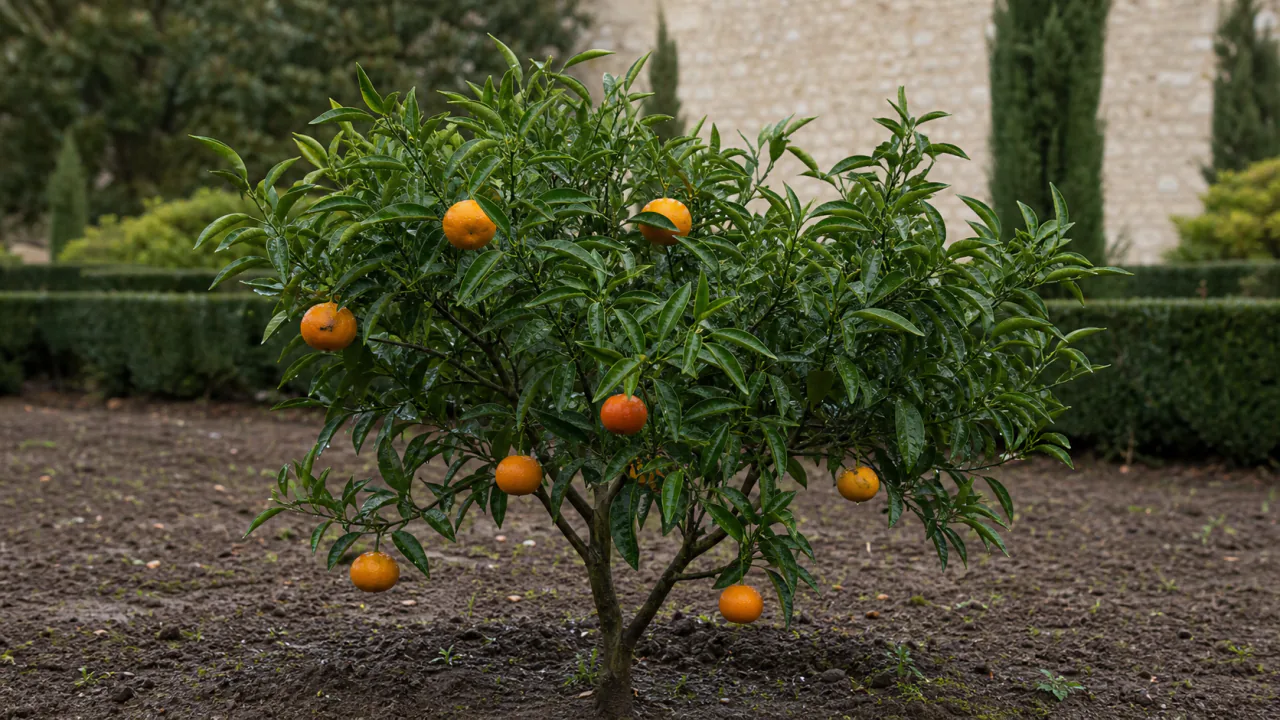
The clementine arose from a cross between mandarin and orange, and the common clementine — the Fine de Corse being its figurehead — remains the benchmark eating fruit: thin, easily peelable skin, juicy flesh, sweet-tart flavour. Two received ideas deserve correction. First, its fruit is seedless not because the tree would be « self-fertile », but because it is both self-incompatible and parthenocarpic: it sets fruit without fertilisation, and produces seeds only if compatible pollen from another citrus is brought by insects. Second, the orange colour is not a maturity test: it depends above all on cool nights.
Not to be confused with the Clemenules, Nova/Clemenvilla and other hybrids: these are distinct varieties. The « Fine de Corse » refers to the Corsican clementine (see the PGI in force with INAO). See also the Citrus & Orchard section.
The reliable facts before you buy
Seedless, but not « self-fertile » — and why it is useful to know
Here is the most misunderstood point about the clementine. The tree is self-incompatible: its own pollen does not fertilise its flowers. It is also parthenocarpic: it forms fruit without fertilisation. As a result, in an isolated orchard, clementines are seedless. But if another compatible citrus flowers nearby, bees carry its pollen, fertilisation happens, and seeds appear. « Seedless » is therefore not a guarantee of the variety, but a consequence of isolation.
The practical consequence is simple: if you want seedless clementines, avoid planting nearby a citrus that flowers at the same time with fertile pollen; if you accept a few seeds, the question does not arise. And be wary of the word « self-fertile » on a label: it hides this real biology.
Choose the root according to soil and climate
As for all citrus, the root is chosen according to the soil and the goal — there is no universal « best ».
| Depending on your goal | Rootstock(s) | Why — and the trade-off |
|---|---|---|
| Quality, acid soils, cold zones, pot | Trifoliate (Citrus trifoliata) | Concentrated quality, contained size, better cold tolerance. ⚠️ very sensitive to active lime, slow. |
| Production, suitable soils | Carrizo, C35 | Good early cropping and quality on not-excessively-calcareous soils. ⚠️ chlorosisYellowing of the foliage caused by poor iron uptake, often linked to chalky soil. at high pH. |
| Calcareous or saline soil | Forner-Alcaide 5 (FA5) | Documented tolerance to chlorosis and salinity. ⚠️ not « universal ». |
| To verify | Sour orange (traditional) | Good quality but high vulnerability to CTV: only with health management and a safe combination. |
The clementine’s rhythm: in the ground or in a pot
In the ground in a mild zone, in a pot elsewhere (good light, sufficient root volume). The harvest runs from autumn to early winter, but judge ripeness by taste, not by colour alone.
| Jan | Feb | Mar | Apr | May | Jun | Jul | Aug | Sep | Oct | Nov | Dec | |
|---|---|---|---|---|---|---|---|---|---|---|---|---|
| Plant (in the ground, mild zone) | ||||||||||||
| Protect from cold (pot in / fleece in ground) | ||||||||||||
| Move the pot outside | ||||||||||||
| Flowering (spring, fragrant) | ||||||||||||
| Harvest | ||||||||||||
| Feed (citrus) |
Fine, ripe clementines
The pollen neighbourhood
Note the citrus flowering at the same time nearby: they are what decide whether or not there are seeds in your clementines.
Ripeness by taste
Do not trust the colour: taste. A clementine can be green and ripe, or orange and acidic depending on the night climate.
Suitable root and shelter
Rootstock matched to the soil, winter protection: the clementine (F3) tolerates cold a little better than the lemon, but still needs protecting.
Regular water and nutrition
Steady watering and citrus feeding in season ensure fine fruit and a regular crop.
Read the sign, trace the cause, correct, prevent
The clementine shares the troubles of citrus; on calcareous soil, chlorosis is the first point of vigilance.
| Sign observed | Probable cause | Correct | Prevent |
|---|---|---|---|
| Yellow leaves with veins staying green | Iron chlorosis (high pH, lime, waterlogging) | Iron chelate; review watering; lime-tolerant rootstock | Free-draining compost, low-lime water, suitable root |
| Cottony masses or shells on stems and undersides | Scale insects (mealybugs or armoured scale) | Clean off, white oil or soft soap, isolate | Ventilate overwintering, inspect when bringing in |
| Sticky black deposit on the foliage | Sooty mould, on the honeydew of scale or aphids | Treat the honeydew-producing insect first | Watch scale and aphids early |
| Silvery galleries in the young leaves | Citrus leaf miner | Remove badly affected shoots | Limit soft flushes, encourage beneficials |
| Seeds appearing in usually seedless fruit | Cross-pollination by a neighbouring citrus | Move away or limit compatible citrus flowering at the same time | Isolate the clementine from compatible pollinators |
Stay sparing with treatments: clean foliage, airy overwintering, balanced nutrition. If a notifiable citrus disease is suspected, follow the official instructions in force.
The eating fruit par excellence
The clementine is eaten first of all fresh: its thin skin comes away on its own, its sweet-tart flesh shares into clean segments. It presses into a mild juice, cooks into a fragrant marmalade, and its fine peel can be candied. It is the citrus of dessert and snacking — the one whose appeal lies in ease and sweetness, not in acidity.
What the standards say
The clementine belongs to the clementine group of the European standard, with its own thresholds.
- Commercial minimum: diameter ≥ 35 mm, juice content ≥ 40 %, sugar/acid ratio ≥ 7.0:1.
- Maturity: judged by the sugar/acid ratio and by taste — never by the skin colour alone.
No generic yield can be published out of context: it depends on the clone, the rootstock, the soil and the age. Measure your own crop.
What people most often ask
Why do my clementines have seeds?
Because a compatible citrus flowered nearby and bees brought its pollen. The clementine is self-incompatible but produces seeds if pollinated by another variety.
Is the clementine self-fertile?
No, that is a misleading shortcut. It is self-incompatible and parthenocarpic: it makes fruit without fertilisation, hence seedless in isolation, but does not self-pollinate.
My clementine is still green: is it ripe?
Perhaps. Colour depends on cool nights, not only ripeness. Trust the taste and the sugar/acid ratio rather than the hue.
Difference with the Clemenules or the Nova?
These are distinct clementine or hybrid varieties, with their own calendars and characters. The common clementine (Fine de Corse) is the historical form.
Sources and control
Last scientific check: 2026-07-18. For the Corsican Clementine PGI, refer to the specification in force.
- UC Riverside — Citrus Variety Collection: characters of Citrus × clementina.
- INAO: status and specification of the Corsican Clementine (PGI).