Naveline Navel orange tree
Citrus × sinensis ‘Naveline’ — the early Navelina orange
An early Navel dessert orange: characteristically seedless, sweet and juicy, with a small navel. Its practical advantage is ripening ahead of Washington Navel, although British fruit still needs enough protected warmth and light.
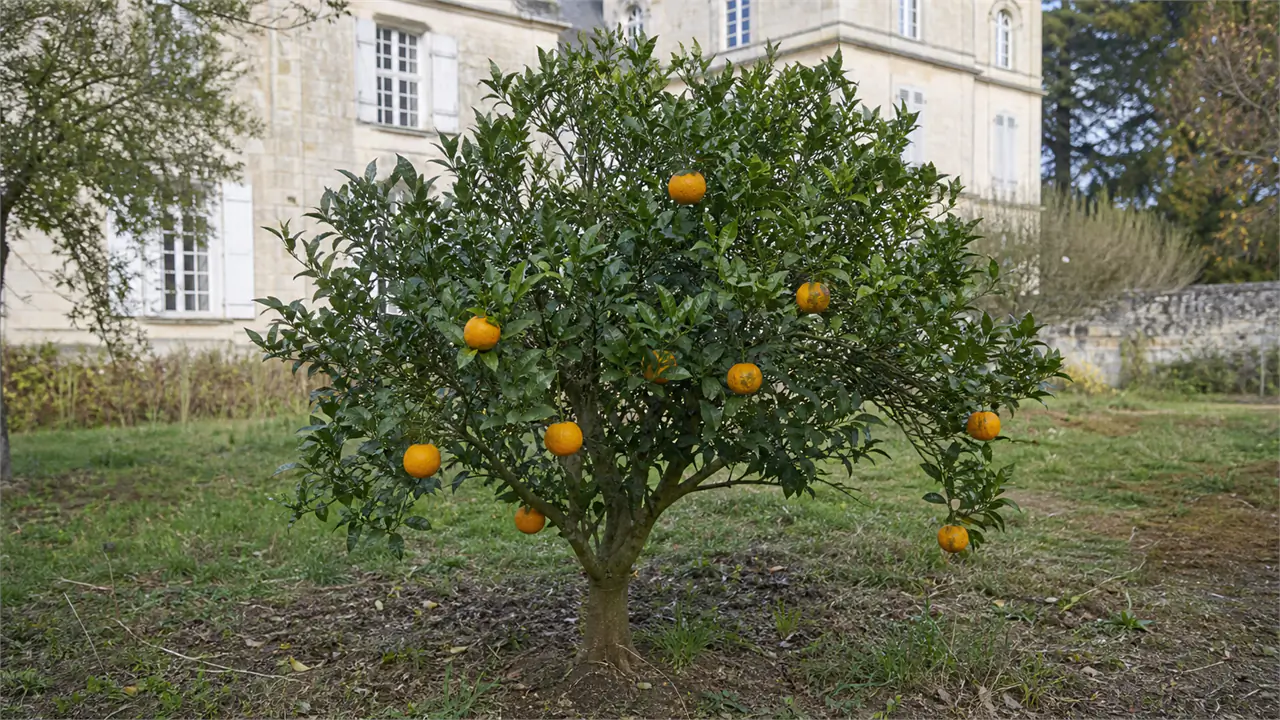
Naveline, widely called Navelina, is an early Navel orange. The exact accession record describes a tree of moderate to low vigour whose fruit is usually a little smaller and much earlier than Washington Navel. The fruit is sweet and juicy, characteristically seedless, and bears a small navel — a secondary fruit at the blossom end. For a British grower its merit is relative, not magical: it needs protected heat to ripen, but its earlier season can shorten the race against winter.
It opens the Navel sequence in this encyclopedia: classic Washington Navel, late Navelate and pink-fleshed Cara Cara. Naveline is the early entry point.
Reliable points to check before buying
An early dessert orange — before the deepest part of winter
Choose Naveline for earliness within the Navel group. In established citrus districts it can begin before Washington Navel; in Britain, that is not a fixed month but a useful genetic head start. The fruit is intended chiefly for fresh eating: sweet and juicy, easy to segment, characteristically seedless and marked by a small navel. Compared with Washington it is generally earlier and a little smaller, not inherently undersized.
Navel juice is best drunk promptly because delayed bitterness can develop after extraction as limonin forms. Below ground, choose for the actual medium and water, and ask the nursery to confirm the exact scion–rootstock combination.
| Your medium or objective | Rootstock option(s) | Why — and the trade-off |
|---|---|---|
| Production and quality in suitable media | Carrizo, C35 | Options to discuss for compatible soils. ⚠️ High pH and active lime can increase chlorosisYellowing of the foliage caused by poor iron uptake, often linked to chalky soil. risk; confirm locally. |
| Container and restrained size | Trifoliate orange, Flying Dragon | Can help contain vigour. ⚠️ Active lime and salinity can limit suitability. |
| Lime-rich soil or saline water | Forner-Alcaide 5 (FA5) | Worth assessing where chlorosis or salinity is a concern. ⚠️ Trial tolerance does not make it universal. |
| Remember | Confirm for your medium and water | Validate the graft combination with the nursery; rootstock affects vigour and fruit size but does not transfer its cold hardinessA plant's ability to survive winter cold without protection. to the Naveline crown. |
A container-first Naveline calendar for Britain
Keep it in a container with bright, frost-free winter quarters. The harvest row is an indicative protected-ripening window, not a promise that a British plant will copy a Spanish orchard.
| Jan | Feb | Mar | Apr | May | Jun | Jul | Aug | Sep | Oct | Nov | Dec | |
|---|---|---|---|---|---|---|---|---|---|---|---|---|
| Repot or renew the surface compost | ||||||||||||
| Keep in bright, frost-free winter quarters | ||||||||||||
| Move the container outdoors gradually | ||||||||||||
| Flowering (spring, fragrant) | ||||||||||||
| Potential early-Navel harvest | ||||||||||||
| Feed container-grown citrus |
Bring Naveline to flavour, then pick in time
The race between flavour and winter
Watch both fruit flavour and the protected environment. Earliness is useful only if the fruit receives enough warmth and light to balance its acidity.
Tart or merely smaller than Washington?
Tart fruit may still be immature. A fruit a little smaller than Washington can be typical, but persistent poor growth calls for checks on roots, light and crop load.
Wait for balance, not just colour
Taste a representative fruit. Allow sweetness to develop while keeping conditions stable; peel colour alone is not a reliable ripeness test.
Squeeze at the last moment
If you make juice, press only what will be drunk promptly. That limits the practical risk of delayed Navel bitterness.
Read the sign, trace the cause, correct, prevent
Naveline shares the usual citrus problems. In a British container, winter-quarters pests, waterlogged compost and lime-induced chlorosis deserve the first checks.
| Sign | Likely cause | Correct | Prevent |
|---|---|---|---|
| Juice becomes bitter after squeezing | Delayed limonin formation in Navel-orange juice, not decay in the fruit | Drink freshly squeezed juice promptly | Press immediately before serving |
| Fruit tastes tart despite orange peel | Internal maturity is lagging behind external colour | Test flavour and leave the remaining fruit if conditions allow | Provide maximum light and steady moisture while fruit develops |
| Young leaves yellow while veins stay green | Iron chlorosis linked to high pH, hard water or impaired roots | Check drainage and roots; use an appropriate iron chelate only after confirming the diagnosis | Match rootstock and compost to water chemistry; never leave the pot standing in water |
| Cottony masses or brown scales on stems and leaf undersides | Mealybugs or scale insects | Isolate and remove light infestations; use only a currently authorised product according to its label | Inspect before moving indoors and keep winter quarters airy |
| Silvery winding mines in young leaves | Citrus leaf miner | Remove only badly damaged soft growth where practical | Avoid forcing repeated soft flushes and encourage natural enemies |
Keep treatment proportionate: begin with identification, hygiene and growing conditions. If a regulated pest is suspected, follow current official plant-health guidance for your part of the UK.
The early fruit-bowl Navel
Naveline is chiefly a dessert orange: characteristically seedless, juicy and pleasantly sweet when properly ripe. Eat it fresh in segments. Its aromatic zest and peel also suit marmalade and candied peel. If squeezed, drink the juice at once because delayed bitterness can develop in Navel juice.
What the marketing standard actually says
Naveline belongs to the Navel orange group in the citrus Specific Marketing Standard used in England and Wales.
- Commercial minima for Navels: 53 mm diameter, 33% juice and a sugar-to-acid ratio of 6.5:1.
- CultivarA variety produced through selection or cultivation, distinct from the wild original plant. comparison: accession descriptions place Naveline a little smaller than Washington Navel, but not universally “small”.
Those figures grade fruit offered for sale; they are not a promise about home-grown Naveline. Do not quote a generic yield without the rootstock, tree age, site and growing system.
What growers most often ask
What is special about Naveline?
It is an early member of the Navel group. Compared with Washington Navel, the fruit usually matures earlier and is often a little smaller, while remaining a fine dessert orange.
Naveline or Washington Navel?
Choose Naveline for earliness and Washington for the classic larger mid-season Navel. In Britain, either still needs sufficient protected warmth and frost-free wintering.
Does Naveline contain pips?
It is characteristically seedless and develops fruit parthenocarpically, but horticultural descriptions should not turn that usual trait into an absolute guarantee.
Can I juice Naveline oranges?
Yes, but drink the juice promptly. Navel-orange juice can develop delayed bitterness after extraction, so the fruit is primarily valued for fresh eating.
Sources and checks
Last scientific and local horticultural check: 2026-08-01. Harvest timing and rootstock performance remain site-dependent.
- RHS — orange ‘Navelina’: exact UK profile for Citrus × sinensis ‘Naveline’ and container/conservatory cultivation context; general winter practice checked against the RHS citrus guide.
- GOV.UK — citrus Specific Marketing Standard: commercial minima for Navel oranges. Cultivar identity was cross-checked against UCR accession CRC 4015, and delayed bitterness against Maier & Beverly (1968), DOI 10.1111/j.1365-2621.1968.tb03661.x.