Fortune mandarin
Citrus reticulata hybrid ‘Fortune’ — the late mandarin with active pollen
A late, aromatic mandarin whose pollen may increase seed numbers in some compatible clementines when flowering overlaps. Neighbourhood matters, but timing alone does not identify the cause.
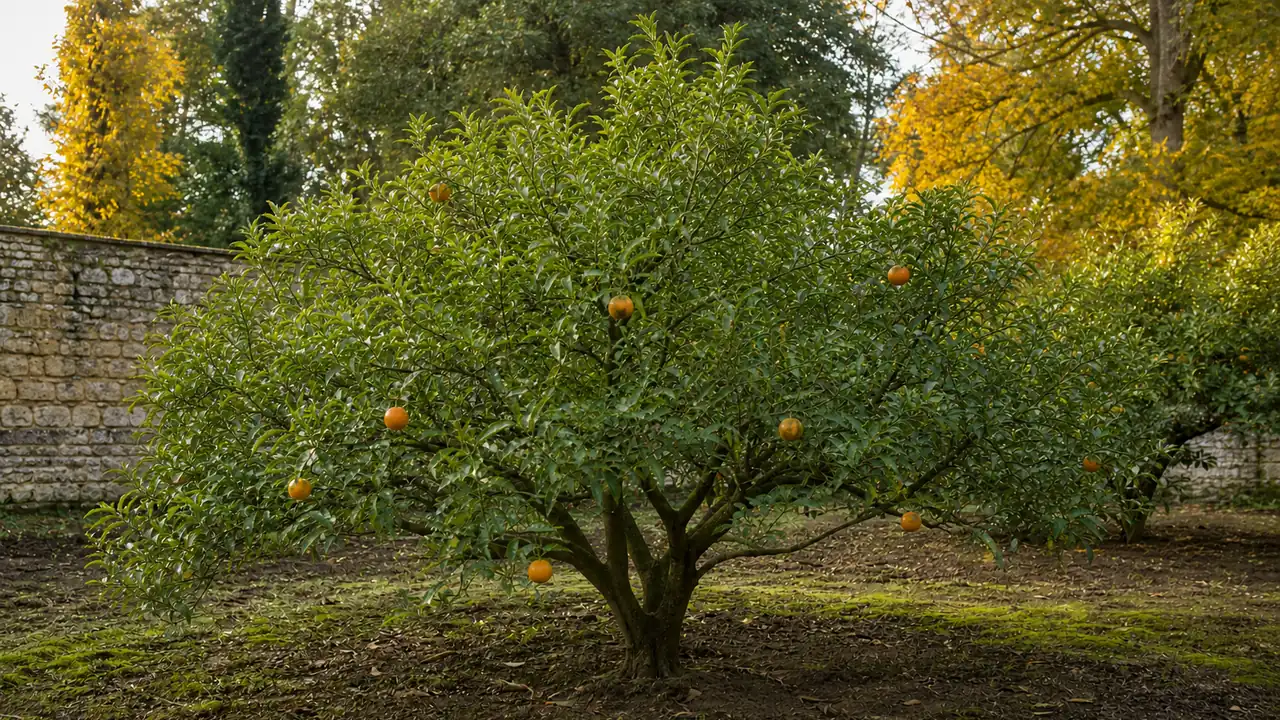
The Fortune mandarin is a late hybrid of clementine × probably Orlando tangelo; parentage work excludes Dancy as the certain pollen parent. Its medium fruit has a thin rind and rich, sprightly subacid flavour. Fortune pollen may fertilise some compatible clementines and increase seed counts when flowering overlaps. This possibility makes siting important, but seedier fruit appearing later does not by itself prove Fortune was the donor.
Compare Nova, whose set may respond to compatible pollen, and the late mandarins Nadorcott and Orri. Each cultivarA variety produced through selection or cultivation, distinct from the wild original plant. pairing and flowering overlap needs separate verification.
Reliable points to check before buying
Where to plant it — the key question
The important decision is where to grow Fortune. Its pollen may fertilise some compatible clementines when bloom overlaps and increase their seed numbers. Greater separation may reduce exposureThe amount of sunlight a spot in the garden receives (full sun, part shade, shade). but cannot guarantee seedlessness, because insects and other flowering citrus can also supply pollen. Identify nearby cultivars and flowering periods before drawing conclusions.
The rind is thin, while any specific rind-disorder sensitivity remains to be documented. UCR records the parentage as clementine × possibly Orlando tangelo, and molecular markers exclude Dancy as the certain parent. Choose rootstock for the actual soil and confirm the exact combination with the nursery.
| Soil / aim | Rootstock(s) | Why — and the compromise |
|---|---|---|
| Quality, production | Carrizo, C35 | Good balance of quality and vigour. ⚠ ChlorosisYellowing of the foliage caused by poor iron uptake, often linked to chalky soil. risk at high pH. |
| Container, cooler site, restricted size | Trifoliate orange, Flying Dragon | Dwarfing with concentrated quality. ⚠ Sensitive to active lime. |
| Calcareous or saline soil | Forner-Alcaide 5 (FA5) | Tolerance to chlorosis. ⚠ Not universally suitable. |
| Key takeaway | Neighbouring cultivars + flowering overlap | Greater separation may reduce risk but cannot guarantee seedlessness. |
The rhythm of Fortune: late ripening, container or shelter
Container culture with frost-free winter shelter is standard in Britain. Late maturity means fruit remains on the tree through late winter, exposed to cold, while spring flowering is when its pollen affects neighbours.
| Jan | Feb | Mar | Apr | May | Jun | Jul | Aug | Sep | Oct | Nov | Dec | |
|---|---|---|---|---|---|---|---|---|---|---|---|---|
| Planting (mild sheltered sites) | ||||||||||||
| Frost protection (late fruit!) / container sheltered | ||||||||||||
| Move container outdoors | ||||||||||||
| Flowering (active pollen affects neighbours) | ||||||||||||
| Harvest (late winter → spring) | ||||||||||||
| Feed (citrus feed) |
A well-placed and well-managed Fortune
Identify the actual neighbourhood
Record neighbouring cultivars, flowering overlap, other citrus in bloom and insect activity; the word “clementine” alone is not enough.
Treat timing as a clue
Seeds appearing after Fortune make it a plausible donor, not a proven one. Confirm identity, synchrony, compatibility and other pollen sources.
Reduce a confirmed risk
If the pairing is confirmed, increase separation or redesign the planting with agronomic advice. No distance by itself guarantees seedless fruit.
Keep flowering records
Record bloom and seed observations from year to year while also monitoring rind condition, crop load and plant health.
Read the symptom, find the cause, correct it, prevent a repeat
Fortune shares standard mandarin challenges; its thin rind and polliniser role call for specific vigilance.
| Symptom observed | Likely cause | Correct | Prevent |
|---|---|---|---|
| Neighbouring clementines becoming seedy | Fortune pollen is possible if cultivar compatibility and bloom overlap are confirmed; other donors may exist | Confirm identity, synchrony and compatibility before changing the planting | Map flowering citrus; distance may lower risk but does not remove it |
| Thin rind marks or blemishes | Rind sensitivity to document (verify before diagnosing a disorder) | Observe, ventilate, avoid excess humidity; inspect if recurrent | Good ventilation; follow official guidance if in doubt |
| Yellow leaves with green veins | Iron chlorosis (high pH, lime, waterlogging) | Iron chelate; adjust watering; suitable rootstock | Free-draining compost, low-lime water |
| Cottony patches or scales on stems and leaf backs | Mealybugs or scale insects | Clean, horticultural soap or approved oil, isolate | Ventilate winter shelter, inspect before moving indoors |
| Irregular harvests | Alternate bearing depending on management | Thin heavy years; regular nutrition | Balance crop load annually |
Keep treatments proportionate: clean foliage, ventilated winter quarters, balanced feeding. For regulated plant health concerns, follow current official UK guidance.
A characterful late mandarin
At the table, Fortune delivers: a late and richly scented mandarin, sweet and sprightly, excellent fresh in segments and for juice. Its intense zest and thin rind suit aromatic zest and marmelade. Depending on pollination, it may contain seeds: entirely normal. Its asset is end-of-season flavour — with the main challenge in the garden being correct positioning.
What the standards say
Fortune falls under the mandarins and hybrids category in marketing standards.
- Regulatory group: other mandarins and hybrids; standard thresholds apply — check commercial specifications, with no invented figures published here.
- Polliniser effect: outside grading standards, yet decisive at orchard or garden scale — a primary siting criterion.
No generic yield is published: it depends on management, rootstock, soil, age and climate. Evaluate your own harvest.
What growers most often ask
Why do my clementines have seeds since I planted a Fortune?
Fortune is a plausible hypothesis if the cultivar is compatible and flowering overlaps, but timing alone is not proof. Check other pollen donors too; separation may reduce risk without guaranteeing seedlessness.
Does Fortune itself contain seeds?
This varies according to cross-pollination: it may contain seeds. This is not a defect.
What is its appeal?
A late mandarin, highly aromatic and sweet-subacid, extending the season into spring. Properly positioned, it is an exceptional fruit.
What is its exact pedigree?
Current sources give clementine × probably Orlando tangelo. Parentage analyses exclude Dancy as the certain pollen parent, while Orlando must remain qualified as probable.
Sources and checks
Latest scientific review: 31 July 2026. Parentage, compatibility and causality remain qualified; no universal separation distance is claimed.
- Royal Horticultural Society — Citrus reticulata (Mandarin Group) “Fortune”: UK plant record for the horticultural name and its unresolved name status; not a citrus-care guide or proof of pollen causality.
- Royal Horticultural Society — How to Grow Citrus fruit: British container culture and bright, frost-free winter shelter.
- Givaudan Citrus Variety Collection at UCR — Fortune mandarin: foreign US exact-cultivar evidence for fruit traits and clementine × possibly Orlando parentage; Riverside dates are not UK dates.
- Barry et al. — Investigating the Parentage of “Orri” and “Fortune” Mandarin Hybrids: foreign primary research excluding Dancy and supporting Orlando as the probable, not certain, pollen parent.
- Bono Úbeda, Soler Aznar & Buj Pascual / IVIA — Parámetros de calidad de los cítricos. El problema de las semillas: foreign Spanish evidence preserved in the Generalitat Valenciana’s official REDIVIA repository, for compatibility, flowering overlap and seed formation; no universal distance is inferred.