Aubergine
Solanum melongena L. — aubergine, eggplant
A nightshade of hot climates whose fruit is picked before it is ripe: the gloss of the skin, not the size, tells you when. Past that point the flesh turns bitter and full of seed.
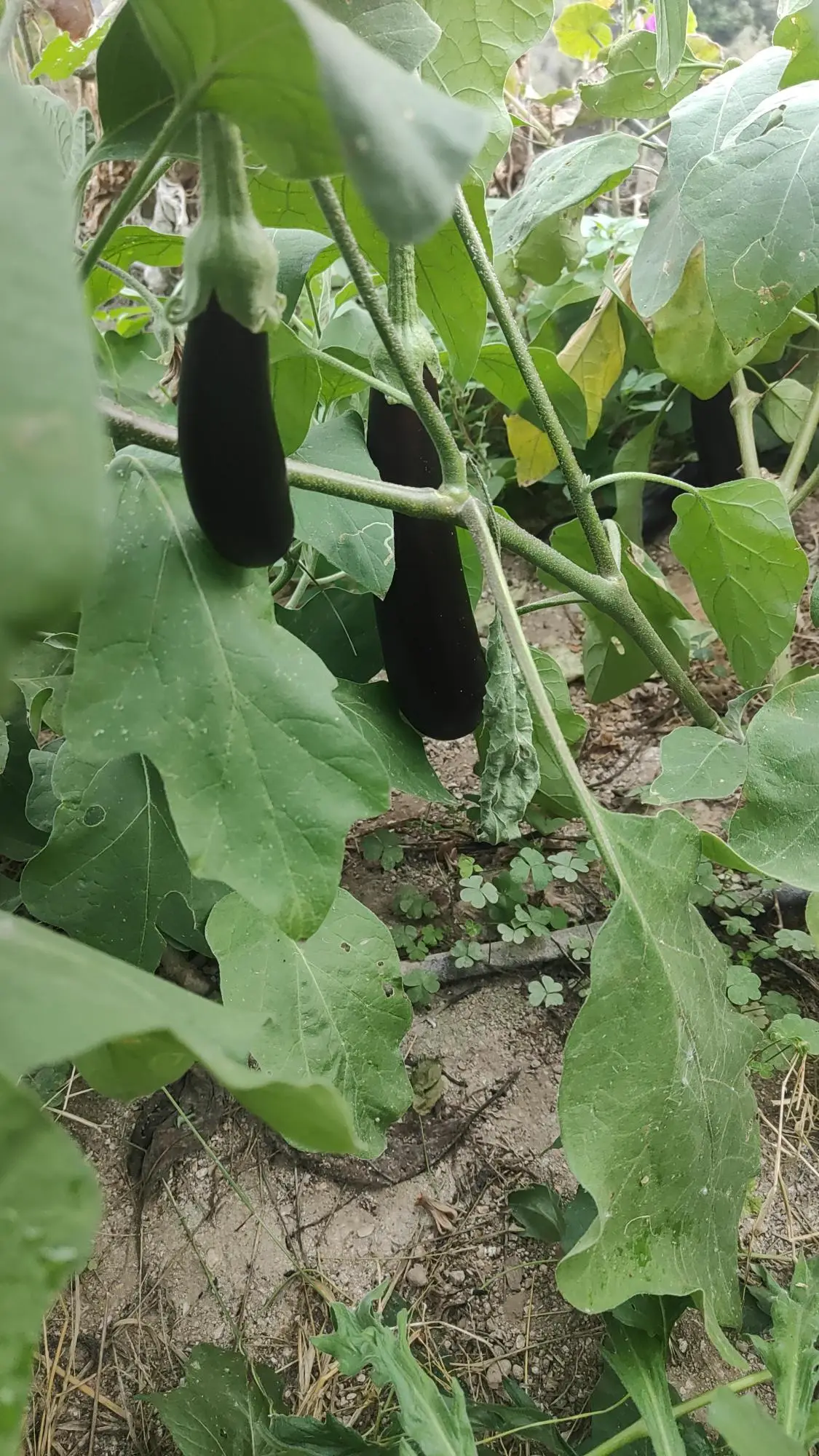
The aubergine (Solanum melongena) is an annual in the nightshade family, grown for a fleshy fruit harvested while still immature. Full sun, a hot sheltered spot, fertile free-drainingDescribes soil that lets water flow away easily, without pooling around the roots. soil. Allow at least five months from sowing to the first picking, and note that germination demands 21 °C minimum. No hardinessA plant's ability to survive winter cold without protection. whatsoever: the least frost ends it.
Same family as the tomato and the potato, with which it shares several pests and diseases — a point that weighs heavily on crop rotation.
Reliable figures before you sow
The plant, and two shapes of fruit
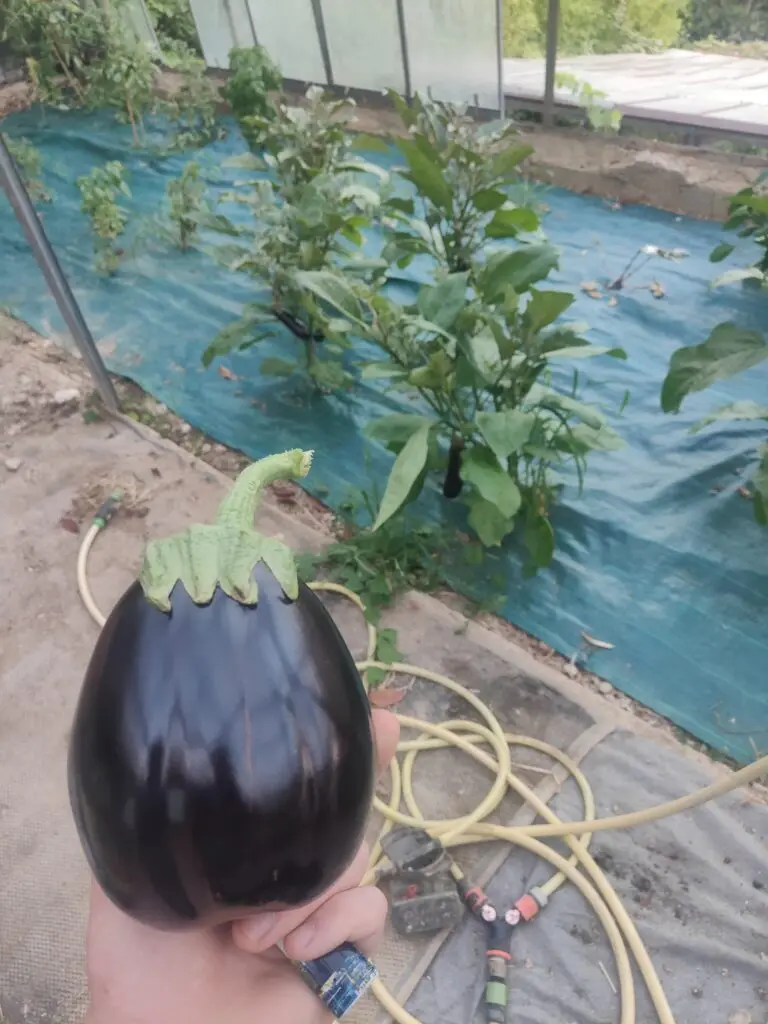
The plant is bushy and downy, with large soft grey-green leaves, sometimes spiny along the midrib, and the star-shaped violet flowers typical of nightshades. The fruit, botanically a berry, comes in two broad cultivated types often grown side by side: the long cylindrical forms, which hang below the foliage, and the round to oval forms, stockier and heavier, which demand serious staking. The choice is not merely aesthetic — for the same volume a round fruit gives more flesh in one piece, a long one slices more evenly.
The real obstacle is not light, it is the temperature at the start
Aubergines rarely fail for want of sun: they fail from a cold start. The seed needs 21 °C at minimum to germinate, and the plant then wants air settled around 16-18 °C. Since at least five months separate sowing from the first picking, a late or chilly sowing is never made up: the plant flowers as the nights are already shortening, and the fruit stops swelling. In Britain this arithmetic is what pushes the crop under glass — the greenhouse is not a refinement here, it is what makes the five months possible.
| Your situation | Approach | Why — and the trade-off |
|---|---|---|
| Most of Britain | Greenhouse, ideally heated | Secures the full five-month cycle. ⚠️ under cover, red spider mite and whitefly build up. |
| A very mild district, a long hot summer | Outdoors in a sheltered warm spot | Possible, and satisfying. ⚠️ a cool July costs the crop. |
| No open ground | Container of at least 30 cm diameter | Warms quickly in spring. ⚠️ daily watering in hot spells, or the flowers drop. |
The aubergine year
A long cycle that begins in the warmth well before the fine weather. Dates shift with the growing situation: earliest under heated glass, latest outdoors.
| Jan | Feb | Mar | Apr | May | Jun | Jul | Aug | Sep | Oct | Nov | Dec | |
|---|---|---|---|---|---|---|---|---|---|---|---|---|
| Sow warm (21 °C min.) | ||||||||||||
| Pot on | ||||||||||||
| Plant final position | ||||||||||||
| Flowering | ||||||||||||
| Harvest | ||||||||||||
| Feed (high potassium) |
The aubergine is picked before maturity, exactly as the globe artichoke is. The signal is not size but the gloss of the skin: as long as it reflects the light, the flesh is tender and the seeds discreet. The moment the skin turns dull, the fruit has tipped over into its true biological maturity — the one that serves seed-making — and the flesh turns bitter and pippy. Waiting for it « to get a bit bigger » is the costliest mistake there is, and it costs twice: the fruit spoils, and the plant, now busy ripening seed, slows its next production.
Behaviour, mechanism and limits
Domesticated in the Myanmar-Yunnan region from the wild species Solanum insanum, the aubergine has kept from that tropical origin a thermal requirement nothing replaces. Its Latin name still carries the trace: melongena comes from the Italian melanzana, itself from mela insana, the « mad apple » — a memory of the days when nightshades from elsewhere inspired suspicion.
In the garden, the plant behaves like a fruiting machine so long as it is not allowed to exhaust itself. Two gestures are said to govern yield: pinching out at about 30 cm, which forces branching instead of a single stem, and picking regularly, which stops the plant tipping into seed-production mode. The second is beyond dispute. The first, we do not practise: our aubergines are never pinched, they grow freely and they crop. We draw no general conclusion from that — under our tunnel, in our climate, with our plants, it has simply never been missed. Staking, on the other hand, is not optional on the round forms: a ripe fruit is heavy, and a branch snapped mid-season costs the rest of the crop on that limb.
The limits are blunt. No hardiness at all: the first frost ends the crop, there is nothing to protect and nothing to hope for. And the kinship with tomato and potato imposes a genuine rotation: verticillium wilt passes from one nightshade to the next, and planting aubergines where the tomatoes struggled is handing them the problem.
Seeing an aubergine through
The gloss, then the hand
A well-coloured, shining fruit is ready; a dull skin promises bitterness and seed. We double that visual check with a tactile one: a fruit still firm under thumb pressure is at the right stage.
Flowers dropping
Flowers falling without setting: look first for dryness at the root or a cold snap, before any pest.
Stake before the weight comes
Put in solid support before the fruit begins to pull the branches down, not after.
Break the nightshade rotation
Do not replant aubergine, tomato or potato in the same ground from one year to the next.
Read the sign, trace the cause, correct, prevent
Soft foliage and warmth draw sap-suckers, and the family exposes the crop to soil-borne vascular disease. One line below concerns an insect you should report rather than treat.
| What you see | Likely cause | Correct | Prevent |
|---|---|---|---|
| Mottled, faded leaves, fine webbing, hot dry air | Red spider mite | Damp down the foliage morning or evening: these mites avoid water | Avoid still, hot, dry air under cover |
| Yellow egg clusters under leaves, red larvae and boldly striped adults stripping the foliage | Colorado potato beetle (Leptinotarsa decemlineata) — a notifiable quarantine pest, not present in Great Britain | Do not treat: photograph it and report it to the plant health authority | Britain’s first outbreak since 1977 was found in Kent in 2023; vigilance on imported produce |
| Progressive yellowing of part of the foliage, plant declining with no visible pest | Verticillium wilt, a soil-borne vascular fungus | Lift and dispose of affected plants; no garden cure | Long rotation: the fungus persists in the soil |
| Clusters of small insects on young shoots, sticky foliage | Aphids | Hose off, encourage ladybirds and lacewings | Avoid excess nitrogen, which softens the growth |
| Clouds of small white insects beneath the leaves, sticky deposit | Glasshouse whitefly | Ventilate, sticky traps, encourage natural enemies | Do not let still, humid warmth build up |
| Flowers dropping without setting fruit | Usually physiological: water stress or unsuitable temperatures | Even out the watering before suspecting a parasite | MulchA layer of material (bark, straw…) laid on soil to retain moisture and limit weeds., consistent watering, no jolts |
Keep intervention light: rotation, steady watering, airy foliage, natural predators. Any plant protection product must follow its label and current regulations.
Flesh that drinks whatever you give it
Aubergine flesh is spongy: it absorbs fat rather than repelling it, which is why the same recipe can turn out light or heavy depending on how the cooking is handled. Picked young and glossy, it needs no salting to draw out bitterness — that old step was aimed at over-ripe fruit. The round forms, fleshier, suit stuffing and thick slices; the long ones, more regular, suit fine cuts.
What we do, and what we actually see
Our aubergines grow under an old carnation propagation house — a metal-framed one, where the others on the estate are timber. It once raised the seedlings of the carnations that covered these Nice hillsides; today it shelters our aubergines. Little says better what became of Nice horticulture than that continuity of use under the same frame.
The ground beneath is covered with black plastic mulch and served by drip irrigation on a timer. From the mulch we expect two things and not three: it removes weeding, and it cuts watering by blocking evaporation. The gain in earliness so often attributed to it, we have not observed. It does demand a vigilance of its own — the moisture it holds benefits the crop, but it benefits rots just as well, and you have to go and look at the collar rather than assume it is sound.
On pests, our reality does not match the standard list — and here the British reader and we are in the same position for opposite reasons. The Colorado potato beetle, so feared on this crop across continental Europe, is not our problem either. Our two subjects are red spider mite and aphid — or rather, they were. Ladybird releases repeated season after season, not the single release people imagine will do, eventually established a population that holds. Combined with the diversity of crops around, it makes regulation nearly automatic. Red spider mite, we see less and less of.
The word « nearly » is not coyness. This way of working means accepting damage that is not zero: we are not after eradication but a balance, and anyone taking it up should know what they are giving up.
As for the two shapes we grow side by side, the long and the round, the reason is not agronomic at all: they are two different vegetables in the kitchen, and we like both. The round goes to stuffed dishes and thick slices, the long to even cuts. Sometimes a practice has no better justification than that, and it is worth saying so rather than inventing a theory.
Varieties worth knowing
| Variety | Useful characters | Garden situation |
|---|---|---|
| Violette de Barbentane | Long, cylindrical, deep purple; a Provençal variety from near Avignon | The Mediterranean classic, even slicing |
| Violetta di Firenze | Round and ribbed, pale purple streaked white, sweet white flesh; mid-early Italian variety, large fruit | For stuffed dishes |
| Ronde de Valence | Round, deep purple, firm white flesh, pronounced flavour; old, very productive variety | Compact plant, staking essential |
What people ask most
How do I know an aubergine is ready to pick?
By the gloss of the skin, not the size. A well-coloured, shining fruit is at the right stage; a dull skin means the fruit has gone too far and will be bitter and seedy. A fruit still firm under thumb pressure confirms it.
Do I need to pinch out the growing tip?
It is widely advised, at around 30 cm, to encourage branching. We do not do it on our own plants and they crop perfectly well — but our conditions are hot and under cover, so treat this as an observation rather than a rule.
Why do my aubergine flowers drop without setting?
Most often it is physiological: irregular watering or unsuitable temperatures. Steady the water before looking for a pest.
Can aubergines be grown outdoors in Britain?
Only in very mild districts or during long hot summers. A greenhouse is the reliable route, because the crop needs at least five months from sowing.
What should I do if I see a Colorado potato beetle?
Report it. It is a notifiable quarantine pest and is not present in Great Britain; photograph it and notify the plant health authority rather than treating it yourself.
Sources and verification
Last checked: 27 August 2026.
- Kew Science — Plants of the World Online, Solanum melongena: taxonomic check.
- Kew — Aubergine: domestication from Solanum insanum, etymology.
- RHS — Aubergines, grow your own: temperatures, sowing, spacing, pinching, harvest.
- AHDB — What to do if you see the Colorado potato beetle: UK notifiable status and reporting.
- INRAE Ephytia — Aubergine pests and diseases.