Tomato
Solanum lycopersicum L. — synonym Lycopersicon esculentum Mill.
The most widely grown vegetable in kitchen gardens, and the one where consistency of watering decides almost everything: fruit set, splitting and blossom end rot all turn on that single variable.
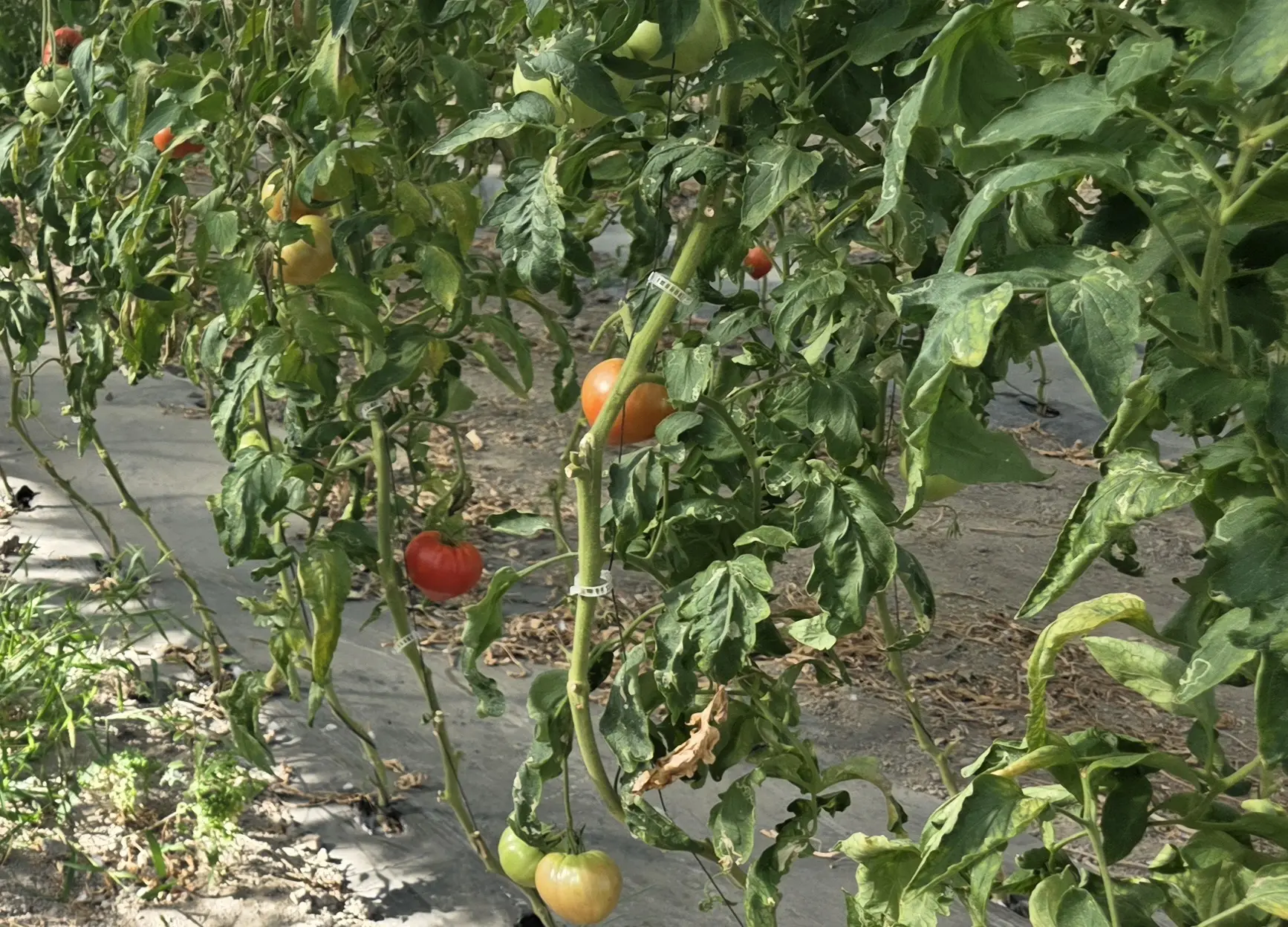
The tomato (Solanum lycopersicum) is an annual in the nightshade family, grown for its fleshy fruit picked ripe. Full sun, fertile free-drainingDescribes soil that lets water flow away easily, without pooling around the roots. soil, planting out in early summer once temperatures are reliably above 16 °C, and 45–60 cm between plants. Two very different regimes apply: cordon (indeterminate) varieties are trained and side-shooted, bush (determinate) varieties are left alone.
Same family as the aubergine and the potato, with which it shares blight and several pests: rotation is not a precaution here, it is a requirement.
Reliable figures before you sow
Cordon or bush: the choice that shapes the whole summer
Before the variety, before the colour of the fruit, one question decides everything: is the plant indeterminate or determinate? An indeterminate keeps growing from a terminal bud — it climbs, it produces over a long season, and it needs serious support plus the regular removal of side-shoots, those growths that appear in the angle above each leaf. A determinate stops itself at a set size, fruits in a more concentrated flush, and is not side-shooted at all.
| Your aim | Type | Why — and the trade-off |
|---|---|---|
| A long, spread-out harvest | Cordon (indeterminate) | Produces until the first cold. ⚠️ tall supports and side-shooting at every visit. |
| Low maintenance, small space, pots | Bush (determinate) | Compact, no side-shooting. ⚠️ shorter season, more concentrated picking. |
| Earliest possible fruit | Cherry varieties | Ripen markedly faster than large-fruited types. ⚠️ small unit size. |
The tomato year in Britain
Sow under cover well before planting out, and plant only once the temperature is reliably above 16 °C. Outdoor crops face the blight window from mid-season onward; greenhouse crops trade that risk for a different one.
| Jan | Feb | Mar | Apr | May | Jun | Jul | Aug | Sep | Oct | Nov | Dec | |
|---|---|---|---|---|---|---|---|---|---|---|---|---|
| Sow under cover (~18 °C) | ||||||||||||
| Plant out (above 16 °C) | ||||||||||||
| Side-shooting (cordons) | ||||||||||||
| Harvest | ||||||||||||
| Feed (high potassium) | ||||||||||||
| Blight risk (humid weather) |
Blossom end rot — the sunken brown patch at the base of the fruit — is the most persistent misunderstanding in the kitchen garden. It is treated by adding calcium; that is almost always pointless. Calcium is indeed missing in the fruit, but rarely in the soil: it travels with water, and it is irregular watering that interrupts its transport to the developing fruit. Alternating dry and saturated soil, transpiration swinging up and down, and the calcium no longer arrives in the right place at the right time. The practical consequence is blunt: a calcium feed on a badly watered plant changes nothing, whereas evening out the watering clears the problem from the next truss onward. Fruit already marked will not recover.
Behaviour, mechanism and limits
The tomato is generous but legible: nearly all of its troubles trace back to the same cause, irregularity. Split fruit follows heavy rain or watering after a dry spell — the flesh swells faster than the skin can stretch, and it tears. Blossom end rot has the same root. So, often, does flower drop. A mulchA layer of material (bark, straw…) laid on soil to retain moisture and limit weeds. and steady watering solve more problems than any product.
One planting detail is worth knowing: tomatoes are planted deeply, with part of the stem buried. Unlike most vegetables, they produce adventitious roots all along that buried stem — a bigger root system, therefore better access to water, which serves the consistency you are after.
The limits are real. No hardiness at all: the crop ends with the first cold. And in Britain late blight (Phytophthora infestans) is the dominant outdoor threat in humid weather. It marks the leaves with yellow then brown patches before reaching stems and fruit, and once it is on a plant there is no garden cure — everything is decided beforehand, by air movement, watering at the base and rotation. It is precisely why so many British gardeners move tomatoes under glass.
Growing a tomato without jolts
The soil, not the plant
Check the soil a few centimetres down rather than waiting for the foliage to wilt: by then the damage is done.
Tell the marks apart
Sunken brown patch at the base of the fruit means watering. Patches on leaves then stems in humid weather mean blight.
Mulch and even out
Mulch and steady base watering rather than a calcium feed or a reflex treatment.
Airflow and rotation
Space, train, never wet the foliage, and do not plant a nightshade in the same ground next year.
Read the sign, trace the cause, correct, prevent
On tomatoes several dramatic-looking symptoms are not diseases at all but faults of management. Telling them apart saves pointless treatments.
| What you see | Likely cause | Correct | Prevent |
|---|---|---|---|
| Dry, sunken brown patch at the base of the fruit | Blossom end rot: calcium not transported, for want of steady watering | Even out the watering; affected fruit will not recover | Mulch, consistent watering, soil rich in organic matter |
| Fruit split after rain or heavy watering | Splitting: sudden water uptake after a dry spell | Pick split fruit promptly | Avoid dry/saturated swings, mulch |
| Yellow then brown patches spreading from leaves to stems and fruit in humid weather | Late blight (Phytophthora infestans) | Remove and dispose of affected parts; no garden cure | Airflow, water at the base, rotation, resistant varieties |
| Leaves yellowing on a plant declining with no visible pest | Often a soil-borne vascular disease (insufficient rotation) | Lift and dispose of the plant | Long rotation of all nightshades |
| Clouds of small white insects under the leaves, sticky deposit | Glasshouse whitefly | Ventilate, sticky traps, encourage natural enemies | Do not keep the crop confined |
| Shield-shaped brown bug, pale dots behind the head; punctured fruit with corky patches | Brown marmorated stink bug (Halyomorpha halys) — not thought to be established in the UK | Do not treat on suspicion: photograph and report it | Watch imported goods; nymphs, unlike native shield bugs, carry spines along the body sides |
| Flowers dropping without setting | Usually water stress or temperature extremes | Even out watering before suspecting a pest | Mulch, light shading in heatwaves |
Keep intervention light: consistency of water, airflow, rotation. Any plant protection product must follow its label and current regulations.
Two observations that contradict the literature
Our plot lies within the Bellet appellation area, on the Nice terraces above the left bank of the Var. This terroir has a documented peculiarity: the Var valley channels the movement of air, and that windiness is credited with limiting humidity and fungal disease. We experience it daily as a near-constant light wind.
First consequence, and it runs counter to everything above: we only get blight under glass. Never outdoors. That is the reverse of the usual framing, which makes blight the outdoor grower’s problem in humid weather — a framing that comes largely from wetter climates, Britain among them. The mechanism is simple enough: outside, wind dries the foliage and shortens the leaf-wetness period; under cover, the air is still. Here it is the protection that creates the risk, and ventilating the greenhouse becomes the first plant-health task of the week.
Second consequence: our real pest is not a disease but the brown marmorated stink bug (Halyomorpha halys), recognisable by its mottled brown shield-shaped body and the white bands on its antennae. Its puncture injects digestive enzymes that necrotise the flesh around the point of impact: a punctured fruit is lost.
Our practice, with no embellishment: watching and hand-picking, insect netting — the fine-mesh physical barrier remains the most satisfactory documented protection — and, when we are overwhelmed, early harvest. There is no simple answer, and claiming otherwise would be a lie. For British readers the point is different but worth keeping: the insect is not yet established in your country, and recording a sighting is currently more useful than treating one.
We grow mainly large slicing tomatoes and heritage varieties, saving our own seed wherever we can, on black plastic mulch with drip irrigation on a timer. That mechanised consistency is not a luxury: it is what keeps blossom end rot and splitting at bay.
What people ask most
Should I add calcium for blossom end rot?
Rarely useful. The calcium is missing in the fruit, not in the soil: irregular watering blocks its transport. Evening out the water clears the problem on later fruit.
Why do my tomatoes split?
Because a sudden uptake of water follows a dry spell: the flesh swells faster than the skin can stretch. Mulch and steady watering limit it.
Do I need to remove side-shoots?
On cordon (indeterminate) varieties, yes, regularly. On bush (determinate) varieties, no — they stop themselves.
Why are tomatoes planted deeply?
Because they root along the buried section of stem. A larger root system means better access to water.
Is the brown marmorated stink bug a problem in Britain?
Not yet: it is not thought to have an established population in the UK, though it has been intercepted at the border. If you think you have seen one, photograph it and report it rather than treat.
Sources and verification
Last checked: 26 August 2026.
- Kew Science — Plants of the World Online: Solanum lycopersicum accepted, Lycopersicon esculentum a synonym.
- RHS — Tomatoes, grow your own: cordon and bush types, sowing, spacing, side-shooting, watering.
- RHS — Brown marmorated stink bug identification guide: UK status, identification, reporting.
- University of Georgia, CAES — Blossom-End Rot and Calcium Nutrition: the real mechanism.
- University of California ANR — Fighting Blossom End Rot: role of soil moisture fluctuation.