Purple globe artichoke
Cynara cardunculus var. scolymus (L.) Benth., purple Mediterranean types — synonym Cynara scolymus L.
The small, early, conical artichoke of the Mediterranean coast — picked young enough that the heart can be eaten raw, with good olive oil and coarse salt. In a British garden, the challenge is not growing it but getting it through winter.
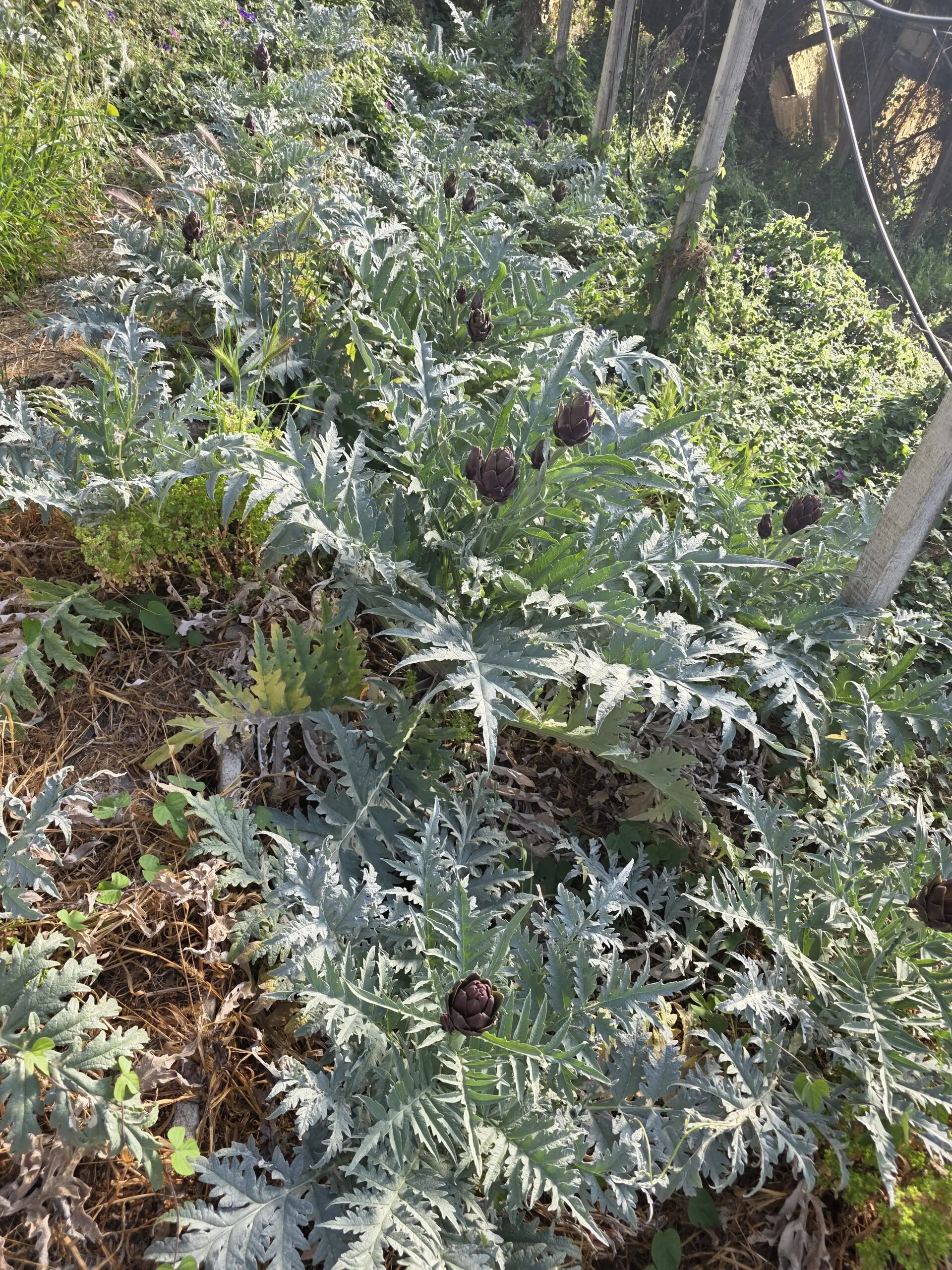
The purple globe artichoke (Cynara cardunculus var. scolymus) is a perennial in the daisy family, grown for a flower bud harvested while still closed. Full sun, free-drainingDescribes soil that lets water flow away easily, without pooling around the roots. soil, 75–90 cm between plants, 1–1.5 m tall at maturity. HardinessA plant's ability to survive winter cold without protection. is variety-dependent, and in Britain the decisive factor is winter wet as much as winter cold: the crown rots long before it freezes.
Bred from the wild cardoon (Cynara cardunculus), with which it shares the deeply cut silver foliage. The difference is a less spiny, fleshier head, selected to be eaten rather than for its leaf ribs.
Reliable figures before you plant
The plant, and what you actually eat
The plant is a bold, clump-forming perennial with deeply divided silver-grey foliage that can pass 1.5 m in full leaf — architectural enough to earn a place in an ornamental border, as its cardoon relatives do. What you eat is not a fruit but an immature flower head: fleshy bracts packed around a receptacle (the heart) and a mass of undeveloped florets, the choke. Left standing, that same bud opens into a large purple thistle flower. Harvesting is precisely the act of intervening before it does.
Offsets or seed — and why it is not a neutral choice
Artichokes can be raised two ways, with different outcomes. Seed is straightforward when you have no mother plant, but seed-raised offspring are not reliably true to type: two seeds from one packet can give heads of noticeably different shape or colour. To reproduce a particular purple form faithfully, the dependable route is an offset — a basal shoot detached with a piece of root, which gives an identical clone.
| Your aim | Method | Why — and the trade-off |
|---|---|---|
| True to type | Offsets (division of the clump) | An exact clone of the parent. ⚠️ requires an established, healthy mother plant. |
| Starting from nothing | Seed | Practical for a first bed. ⚠️ variable offspring, heads not guaranteed identical. |
| Keeping vigour | Divide every 4–5 years | Renews a tiring clump. ⚠️ the same operation as taking offsets, so plan them together. |
The year of a globe artichoke in Britain
Spring planting, first real harvest in the second year, and a winter that has to be actively managed. The purple Mediterranean types are earlier than green ones, but that early flush only materialises where the winter has been survived intact.
| Jan | Feb | Mar | Apr | May | Jun | Jul | Aug | Sep | Oct | Nov | Dec | |
|---|---|---|---|---|---|---|---|---|---|---|---|---|
| Sow under cover | ||||||||||||
| Plant out / take offsets | ||||||||||||
| Harvest (from year two) | ||||||||||||
| MulchA layer of material (bark, straw…) laid on soil to retain moisture and limit weeds. the crown | ||||||||||||
| Fleece in hard frost |
What sets the purple Mediterranean types apart is not their colour but a moment of harvest. Picked small, before the choke has formed, the heart stays tender enough to be eaten raw — sliced thin, dressed with good olive oil and a pinch of coarse salt. In France this is served à la croque au sel; along the Riviera and in Provence it is simply how the first spring heads are eaten, with no cooking and no sauce. The window is narrow and it is the only thing that matters: a head cut later, with the choke developed and the bracts thickened, has to be cooked and trimmed like any other artichoke.
Behaviour, mechanism and limits
In the garden the artichoke takes real space: a mature clump readily exceeds a metre in every direction, and the silver foliage stays handsome well outside the picking season. It is not a plant for a small bed — its proper place is a structural border or a dedicated row, with enough room to read its mature shape.
The governing mechanism is simple: the earlier the cut, the more tender and versatile the head; the later, the more the choke develops and the more cooking becomes compulsory. The raw window therefore depends on frequent picking, not on the variety alone — even a purple type left too long has to be cooked.
Now the British part, which is where most attempts fail. Globe artichokes are killed by very cold or very wet winters, and the wet does more damage than the cold: the crown rots in ground that lies waterlogged. Two consequences follow. First, site selection is a winter decision, not a summer one — free-draining soil, or a raised bed. Second, the mulch you use matters: cover the crown with spent foliage and, in colder districts, add a thick insulating layer of straw, garden compost or well-rotted manure, but avoid fresh green material or sodden compost, which packs into a wet mat and freezes solid around the crown. Young plants are the vulnerable ones in their first winter; add fleece in frosty spells.
Getting the raw window, then the winter
Firmness of the head
A small head, tightly closed, bracts not parting: the only stage at which raw eating makes sense.
The choke showing
Bracts opening, fine down forming at the centre: the head has moved from raw to cook-and-trim.
Cut with a length of stem
Cut cleanly with secateurs, keeping a hand’s length of stalk, ideally in the cool of the morning.
Drain first, insulate second
Free-draining ground or a raised bed, then a light dry mulch over the crown — never a wet mat.
Read the sign, trace the cause, correct, prevent
Dense foliage and a tight head shelter aphids readily; the rest of the risk sits with drainage and air movement.
| What you see | Likely cause | Correct | Prevent |
|---|---|---|---|
| Dense black colonies between the bracts or on young shoot tips | Black bean aphid (Aphis fabae), the most damaging | Hose off, crush colonies, encourage ladybirds and lacewings | Water at the base, avoid overcrowded planting |
| Pale angular blotches turning yellow then brown, white felt beneath the leaf | Downy mildew (Bremia lactucae) | Remove affected foliage, open up the clump | Water at the base, keep foliage dry |
| Greyish-white bloom on leaves, especially in dry summers | Powdery mildewA foliage disease caused by a fungus, recognisable by its white, powdery coating. (Leveillula taurica) | Remove affected leaves | Avoid drought stress, keep air moving |
| Leaves holed or stripped in summer | Caterpillars, including Helicoverpa armigera | Pick off by hand, encourage predators | Check regularly through warm spells |
| Young plants grazed at the base | Slugs and snails | Barriers, evening patrols | Protect young plants and freshly planted offsets |
| Crown soft and rotting after winter | Waterlogging, not frost | Nothing curative — lift and inspect, replant elsewhere | Free-draining site or raised bed; dry insulating mulch only |
Keep intervention light: drainage, spacing, base watering, natural predators. Any plant protection product must follow its label and current regulations.
Two artichokes in the same plant
A purple artichoke gives two different results depending on when it was cut. Very young — before any choke forms — it is trimmed and sliced thin, then simply dressed with good olive oil and coarse salt: no cooking, no sauce, the Mediterranean way with the first spring heads. A more developed head needs cooking, steamed or boiled, and the choke removed before eating the heart and the base of the bracts — the standard treatment for the large green types more familiar in British kitchens.
What we see on our own clumps
Our artichokes grow on a plot within the Bellet appellation area, on the Nice terraces above the left bank of the Var — a landscape of dry-stone terraces whose soil, formed from conglomerate and rolled pebbles, is 80 to 90 % sand. We make no wine there: it is the soil and the climate of that area that concern us.
Three points of practice, from our own plants. The clumps stay in place for several years: we do not renew them on a schedule, we divide the roots — griffes, as we call them — when a clump grows too dense. They come through winter with no protection at all: the roughly −5 °C hardiness figure quoted nationally in France is simply not the limiting factor here. Set against the British reality described above, the contrast is instructive — our winters are dry as well as mild, and it is the combination that lets the crowns sit unprotected.
Finally, judging the raw stage. We do not go by size but by how tightly the bracts are closed, and we cut one head open to check that no choke has formed. That check is destructive, deliberately so: sacrificing one head to know where the row stands beats serving raw artichokes that had stopped being raw-worthy.
Types worth knowing
| Type | Useful characters | Garden situation |
|---|---|---|
| Purple Mediterranean types (Violet de Provence and similar) | Small, conical, purple bracts, early; two harvest windows in mild climates | The types eaten raw when picked very young |
| Large green globes (Camus type) | Broad rounded green head, cook-only | The familiar kitchen-garden standard |
| Gros Vert de Laon | Old green variety, large head, robust | Traditional cultivation, good constitution |
What people ask most
Can you eat globe artichokes raw?
Only when picked very young, before the choke forms — sliced thin with good olive oil and coarse salt. A more developed head must be cooked and the choke removed.
Do globe artichokes survive a British winter?
Established plants are fairly hardy, but very cold or very wet winters kill them. Waterlogging is the greater risk: plant on free-draining ground or in a raised bed and mulch the crown.
What is the difference between a globe artichoke and a cardoon?
Both belong to the same wild species, Cynara cardunculus. The cardoon was selected for its fleshy leaf ribs, the globe artichoke for its immature flower head.
How long does a globe artichoke plant last?
A clump stays productive for several years but loses vigour: divide it, or take offsets, every four to five years.
What mulch should I use over winter?
Spent foliage over the crown, plus straw, garden compost or well-rotted manure in colder districts. Avoid fresh green material and sodden compost, which mat and freeze around the crown.
Sources and verification
Last checked: 26 August 2026.
- Kew Science — Plants of the World Online: taxonomic check, Cynara cardunculus var. scolymus.
- RHS — Globe artichokes, grow your own: spacing, offsets, division, yield, overwintering.
- RHS — Overwintering tender plants: lifting and mulching: crown protection and mulch choice.
- CTIFL — Artichoke pests and diseases: aphids, downy and powdery mildew, caterpillars.