Natural Pool in a Heatwave: Keep the Water Clean and Cool
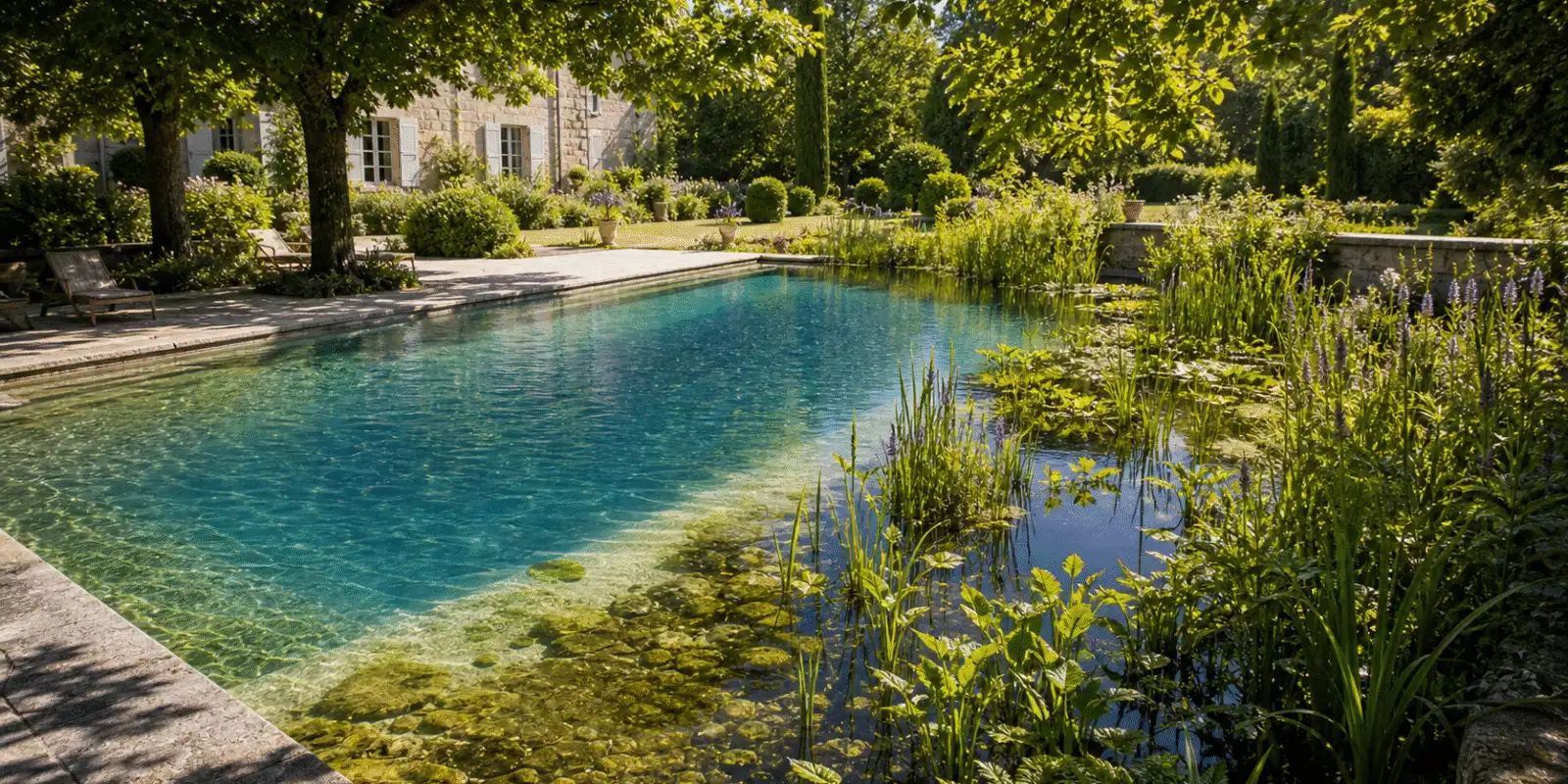
In a heatwave, a natural swimming pool warms up and loses its clarity: above 24 to 25 °C, the biological balance becomes fragile and bacteria can multiply. The remedy fits in three words: continuous circulation, partial shade and a properly sized regeneration zone. Unlike a chlorinated pool, you never « dose » anything — you support the ecosystem. This guide complements our article on garden ponds in a heatwave.
The Chatelain Method at the swimming pond
We observe the water temperature and clarity; we diagnose the source of the imbalance (heat, organic load, poor circulation); we correct with shade and water movement; we prevent with a generously sized regeneration zone.
Why heat unbalances a natural pool
A biological swimming pond works thanks to a planted regeneration zone (the lagoon), which filters the water naturally: reeds, water irises and rushes absorb nitrates and phosphates on a mineral substrate (gravel, pozzolana). This zone usually represents 30 to 50 % of the total surface area.
A heatwave puts this system to the test:
- The temperature rises: water above 24-25 °C favours bacteria and can make swimming less safe.
- Clarity drops: micro-algae and organic matter multiply and the water turns cloudy (see green water and algae in hot weather).
- Oxygen decreases: as in any pond, warm water holds less of it.
The Chatelain’s rule of thumb. The clarity of a natural pool normally drops during heat peaks; it is a sign that the ecosystem is working, not failing. A properly sized regeneration zone recovers its balance within a few days. Giving in to chlorine would ruin the whole principle.
The right moves to keep the water healthy in a heatwave
| Goal | Action | Why |
|---|---|---|
| Limit the heat | Partial shade over the swimming zone | Less sun = cooler water |
| Support purification | Continuous circulation/pump | The lagoon filters around the clock |
| Preserve oxygen | Waterfall, jet, surface movement | Stirs the surface, especially at night |
| Reduce the load | Limit sunscreen, remove leaves | Fewer nutrients for algae |
| Keep the level up | Top up with unchlorinated water | Evaporation concentrates nutrients |
- Keep the water circulating without interruption. Plant filtration only works if the water keeps passing through the lagoon zone. The pump is never switched off during a heatwave.
- Partially shade the swimming zone. A sail, a planted pergola or well-placed trees lower the water temperature.
- Lighten the organic load. A shower before swimming limits sunscreen input; leaves and debris are removed regularly.
- Compensate for evaporation with rainwater or dechlorinated water, in small amounts (see pond evaporation in a heatwave).
- Reinforce the purifying plants if the regeneration zone is undersized — the root cause of water that « turns » in summer.
To compare this type of swimming with conventional pools, see natural pool vs traditional pool: budget and care and our guide to the natural swimming pond.
The fatal mistake: « rescuing » the water with chlorine
Faced with cloudy water, some owners give in and chlorinate. It is the absolute mistake: chlorine destroys the purifying ecosystem (beneficial bacteria, micro-fauna) that gives a natural pool all its value. Let the system rebalance itself, support the lagoon, add shade, and clarity returns without any product.
FAQ
At what temperature does a natural pool stay healthy?
Aim for water below 24 to 25 °C. Beyond that, heat favours bacteria and the water loses clarity. Shade, continuous circulation and a generous regeneration zone help contain the rise.
Why does my natural pool turn cloudy in summer?
Heat and strong light make micro-algae and organic matter multiply. This is normal during peaks; a properly sized lagoon zone restores balance within a few days, without any chemical treatment.
Can you add chlorine to a natural pool during a heatwave?
No. Chlorine destroys the purifying ecosystem that makes biological swimming work. Correct with natural means: shade, circulation, more purifying plants, a lighter organic load.
Does a natural pool need a heat pump?
In very hot regions, a reversible heat pump can help keep the water below the critical threshold. It is not essential everywhere: good shading and a generous lagoon are often enough.