English Country Garden Wedding: Elegant, Natural Styling Without the Clichés
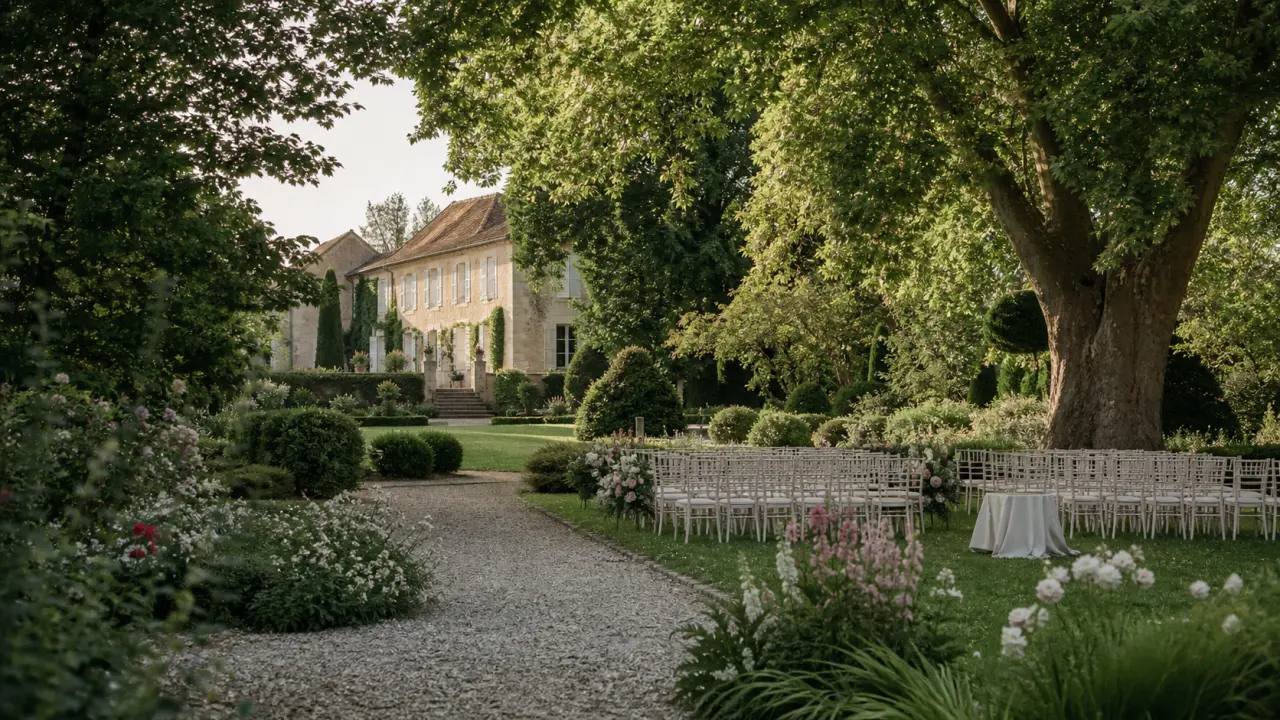
An elegant English country garden wedding begins with what the place already offers: the proportions of the house, the line of a path, mature trees, clipped hedging, a productive kitchen garden or borders at their seasonal best. Decoration should clarify those qualities, not bury them beneath hessian, jam jars and hired “rustic” props. Read the setting at the hour of the ceremony, decide what guests need to notice or understand, then use a small number of reversible interventions to frame the day.
This is a setting-first guide to the overall visual language of the wedding. It does not turn a garden into a venue catalogue, and Les Jardins d’un Châtelain is not presented as a property for hire. The method belongs to our wider approach to outdoor design: the living garden remains the principal work; the event is its temporary guest.
Country garden is a setting, not a box of rustic props
“Country garden” and “rustic wedding” are often treated as synonyms, but they lead to different decisions. Rustic styling usually starts with objects: rough timber, string, jars, crates, lace, signs and bales. A country garden wedding should start with relationships: house to lawn, gate to path, border to terrace, shade to sun and ceremony to reception.
A Georgian façade and long lawn may need only a framed ceremony axis; a brick walled garden can draw on clay tones and trained fruit; a colourful cottage border may require quieter textiles. None becomes more authentic because a pallet sign has been added. Ask what kind of garden this is and what the styling must accomplish. Useful decoration generally performs one of four roles:
- it frames a view or a moment;
- it guides guests without cluttering the route;
- it softens or screens a genuinely distracting area;
- it supports comfort or function while remaining visually coherent.
If an object does none of these, it must earn its place through a particularly strong relationship with the house or garden. “It is popular at country weddings” is not enough.
Use the Chatelain Method before choosing a palette
The Chatelain Method applies four passes—Observe, Diagnose, Correct, Prevent—to a temporary event. It keeps the wedding recognisably yours while preventing the theme from overpowering the grounds.
1. Observe from the four views that matter
Visit at approximately the ceremony time: midday light is a poor guide to late afternoon. Walk the route and photograph the unembellished setting from four positions:
- the first point at which arriving guests see the garden;
- the principal approach or aisle;
- the intended focal point of the ceremony;
- the transition from ceremony to drinks or reception.
For this worksheet, label each frame by its dominant visual element—architecture, open sky, service area or an abrupt surface change. Record observed shade and glare for the site team; weather resilience remains a separate operational decision.
2. Diagnose strengths and interruptions
Separate a genuine weakness from mere emptiness. An open lawn can be calm negative space; it is not automatically a gap to fill. A mature cedar may already be the focal point; placing a floral structure in front of it could weaken both. Conversely, a confused junction between paths may need a discreet directional marker even if it is not a photographic feature.
The diagnostic question is: What prevents this view or route from being understood? The answer may be a distracting object, weak visual focus, ambiguous circulation or a material that clashes with the setting. Name the problem before prescribing a decoration.
3. Correct only where the garden needs help
Concentrate effort at the arrival, the ceremony focus and one or two transitions. Repetition then connects them: the same ribbon colour, timber finish, urn shape or foliage family can travel through the garden without multiplying props. The result feels composed because a small vocabulary is repeated, not because every surface has been dressed.
4. Prevent visual overload and physical damage
Every proposal needs a fixing method, a removal plan and a destination after the event. Freestanding, ballasted or existing-purpose supports are preferable to improvised attachments on living plants. Hiring, borrowing and redeploying garden containers generally make more sense for a single celebration than commissioning an object with no second use.
Complete the setting matrix zone by zone
This matrix is an editorial decision tool, not a measured design standard. Fill it during the site walk before discussing quantities with a florist or stylist. A blank in the “do not add” column usually means the diagnosis is not yet strict enough.
| Zone | Already present in the garden | Worth strengthening | Worth screening | Do not add | Reversible intervention |
|---|---|---|---|---|---|
| Arrival | Gate, avenue, stone wall, first glimpse of the house | One recognisable material or botanical cue | Bins, service equipment or confused access | A second “entrance” unrelated to the real route | Hired planters or a freestanding directional piece |
| Approach or aisle | Path line, lawn edge, hedging, border rhythm | The existing cadence and the destination | Gaps that genuinely pull attention away | Continuous décor that narrows the route or hides planting | Sparse ground-level markers outside the walking line |
| Ceremony focus | House axis, mature tree, garden opening or distant view | The strongest existing frame | A service façade or visually noisy corner | A competing backdrop placed in front of a better natural one | Freestanding focal elements with plant-safe supports |
| Transition | Terrace step, path junction, change of surface | The turn guests must understand | Temporary operational clutter | Decorative obstacles at the decision point | Repeated vessels, restrained signage or staff guidance |
| Reception edge | Pergola, wall, hedge, kitchen garden or orchard margin | A coherent boundary and evening atmosphere | Catering or storage only where necessary | A new theme that begins after the ceremony | Movable pots, textiles and hired furniture with a reuse plan |
Read across each row rather than filling every cell with an item. For example, an arrival with an existing gate, clipped yews and a direct view to the house may need only one sign stand that repeats the gate’s dark metal. The matrix can legitimately produce the answer add nothing.
Derive colour and material from the property
The most reliable palette is already in the view. Begin with the permanent materials: limestone, flint, warm brick, painted render, weathered oak, slate, gravel or ironwork. Then note the dominant greens and the flowers that will genuinely be visible on the date. Select a restrained base from those observations and reserve contrast for the point guests must find.
This does not require matching everything. White linen can clarify a deep green garden; a strong flower colour can enliven a pale façade when it already exists in the borders. The mistake is importing sage, blush, beige and dried grasses without checking what stands behind them.
Seasonal British flowers are useful because they can connect arrangements with what is happening outdoors, but availability must remain flexible. Flowers from the Farm advises couples to work with what is likely to be growing at the time, and the RHS notes that cutting from existing borders needs planning so the display is not depleted. Use the garden as a reference, not as an unplanned flower store. The detailed calendar, substitutions and conditioning of flowers belong to the separate seasonal-flower guide.
Materials pass the same test. Linen, timber, ceramic, glass and metal may all suit; none is automatic. Rough wood can feel honest by an orchard shed and theatrical on a formal stone terrace. Jute on every chair, jar and sign turns texture into costume.
Apply an anti-cliché filter before approving any object
The aim is not to ban jam jars, hay bales, bunting or vintage furniture. It is to remove the automatic link between “country” and “farmyard”. Test every conspicuous object with four questions:
- Does it come from this place? It may echo the architecture, planting, agricultural history or an object genuinely used on the property.
- Does it perform a clear role? Framing, guiding, screening or supporting function are stronger reasons than filling space.
- Does it improve the view from one of the four key positions? An attractive close-up can still damage the wider composition.
- Can it leave without a trace and continue in use? A hired, borrowed or repurposed item has a credible next destination.
In this method, hay bales are removed when the setting has no agricultural relationship, and pallets are omitted beside formal masonry. The same edit limits repeated jars on a strong terrace line and dried material in a garden defined by fresh foliage.
One well-placed inherited bench, a set of estate pots or a local potter’s vessels may tell a richer story than a van of generic styling. Personal meaning is welcome, but it should be edited with the same discipline as any other material.
Protect trees, borders and the route through the garden
In this editorial prototype, every proposed contact with a living tree is recorded as an unresolved venue question; the article assigns no load capacity to a trunk or branch. Ask the owner or garden manager to approve every fixing and have the responsible supplier document the support actually used.
Keep heavy planters and furniture away from visible roots and from beds that were not designed for footfall. Forest Research documents the harm that physical root damage and soil compaction can cause. Do not assume a lawn edge can take a delivery trolley because it looks firm during the site visit. Routes for guests, staff and deliveries are separate planning questions, but the visual concept should not force any of them through a border or beneath vulnerable branches.
If foliage or flowers are to be cut from the property, agree the source and quantity with the person responsible for the garden. RHS guidance distinguishes planned cutting areas from ornamental borders precisely because harvesting can reduce the garden display. Often the more elegant choice is to let the border remain intact and ask the florist to interpret its colour and movement with locally grown material.
Assign every hired or borrowed item to a named removal task. Cable ties, florist’s wire and tape disappear easily in foliage. The garden is restored only when no fixing, fragment or abandoned container remains.
Know where the overall concept must stop
A coherent concept is strongest when it leaves technical decisions to their proper plans.
- The ceremony arch: this page may decide whether an arch belongs in the composition, but not its structure, anchoring, wind resistance or flower hydration.
- The table: it may carry the palette and material language, but linen sizes, place settings and centrepiece proportions require a dedicated table plan.
- The theme: this guide refines a country-garden direction; comparing formal garden, Mediterranean, modern or garden-party themes is a separate decision.
- The weather: shade, light and exposure inform observation, but thresholds for rain, wind or heat and the covered fallback belong to the outdoor-wedding contingency plan.
Respecting those boundaries prevents one inspiration page from becoming a shallow answer to four different problems.
A final walk-through: remove before you add
Return to the four photographs with the proposed scheme marked on them. For each view, identify the single element that should be noticed first. If two props compete with it, remove one. Then walk the actual guest route and check whether signs are visible before a turn, whether styling encroaches on the usable path and whether the ceremony focus remains legible when guests are seated.
Success is not measured by the number of decorated zones. It is visible when the house and planting still read clearly, guests move without hesitation, temporary additions repeat a coherent language and dismantling leaves the living garden unchanged. That is the distinction between decorating a garden and staging an event in respect of it.
FAQ
Can an English country garden wedding work without a manor house?
Yes. The character comes from reading the garden rather than imitating aristocratic architecture. A cottage plot, walled garden, orchard or generous suburban garden can all support the approach when the palette follows its real materials, the strongest view becomes the focus and generic rural props are removed. In this framework, the existing structure supplies the visual hierarchy.
Evidence, method and scope
Our contribution. The setting matrix converts broad wedding inspiration into a repeatable audit of five zones and four roles: frame, guide, screen and support. It is an editorial heuristic, not the result of a field trial.
Method. The framework was built from the UK search-intent review, horticultural guidance on seasonal and cut flowers, and a contradiction pass against the four neighbouring subjects: arch, table, theme and weather.
Scope. The matrix records the visual plan. Venue risk, arboriculture, accessibility and temporary structures remain in their respective technical records; the owner or venue manager approves fixings, routes and interventions in the living garden.
Sources and further reading
- Flowers from the Farm — wedding flowers and seasonal British availability
- Royal Horticultural Society — growing and selecting cut flowers
Written and checked by the editorial team of Les Jardins d'un Châtelain.