Back to Outdoor Garden Design for a Garden of Character

Protect a Home and Garden from Wildfire: Design Defensible Space
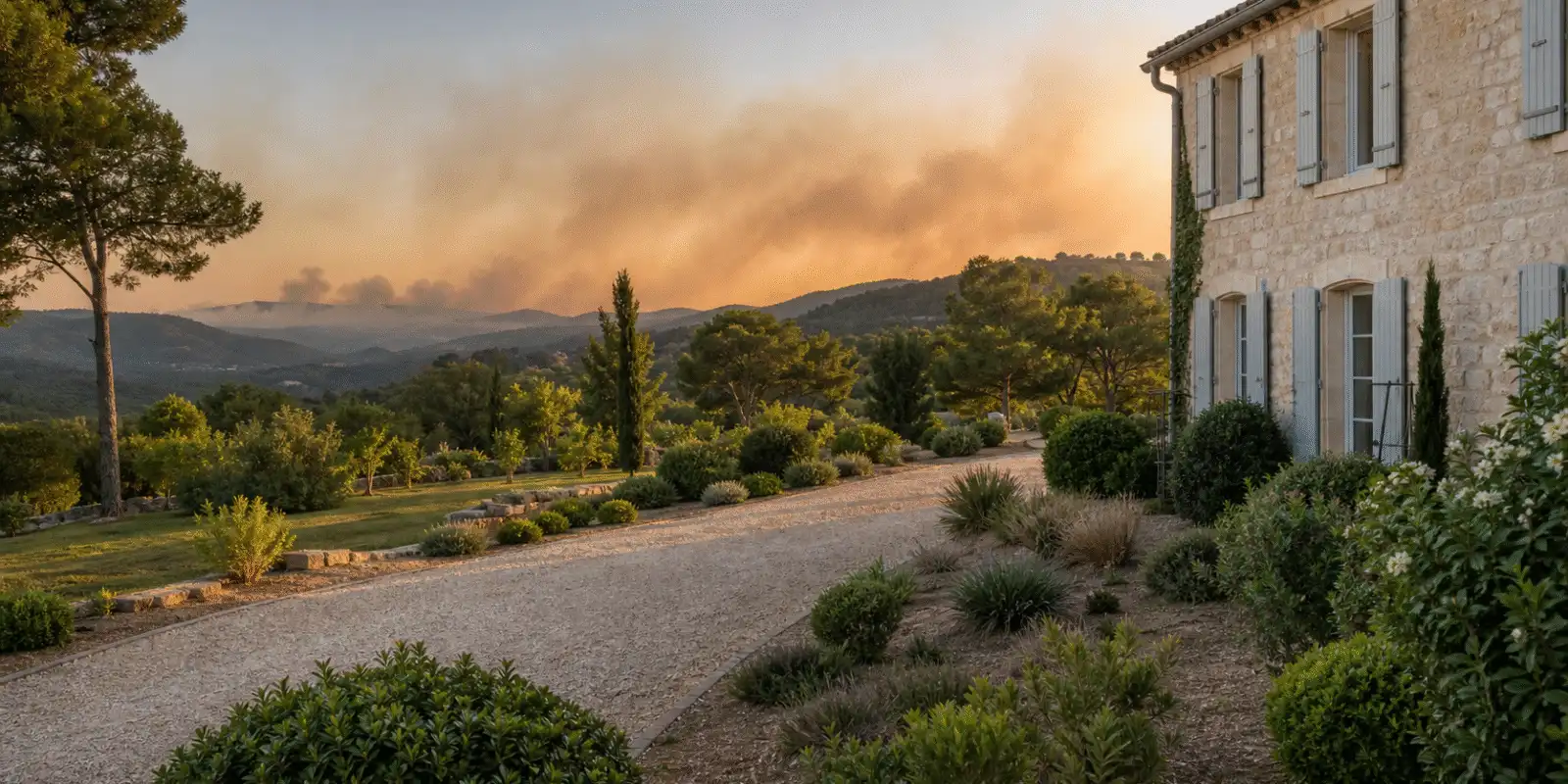
Low-fuel estate garden around a stone house with distant wildfire smoke

Protecting a home garden from wildfire starts by breaking fuel continuity. Remove dry debris, separate shrubs from tree crowns, keep a clean non-combustible edge beside the building and maintain clear access. A defensible garden is not bare ground; it is a layered landscape in which embers find fewer places to lodge and ignite.

This practical guide belongs to our cross-garden wildfire resilience series. It complements the advice in this garden section but never replaces emergency services, local authorities or a professional site assessment. Outdoor Design.

Rules and local advice to check

UK fire and rescue guidance varies by area. London Fire Brigade advises cutting grass below 7 cm and, where possible, clearing a 2–3 m break around the property. Check your local Fire and Rescue Service, local authority restrictions and any hosepipe ban before acting.

The Chatelain Method

Observe the evidence, diagnose the true severity, correct the immediate risk and prevent recurrence. That order prevents emotional pruning, watering and buying from making a stressed garden worse.

Priorities and timing

Situation First action Timing
House edge Remove mobile fuel and clean entry points Now
Beds and hedges Create gaps and remove dead material Cool season
Emergency access Keep route and signs clear Year-round

Observe before changing the site

Walk from the roofline outwards and trace every possible fuel bridge: leaves in gutters, timber decking, a dry hedge, shrubs below a tree and long grass beyond. Ember entry points and small combustible objects beside walls often matter more than the botanical label on a plant.

A measured action plan

  • Clear gutters, roof valleys, vents, paths and the foot of walls.
  • Use gravel, paving or low well-maintained planting next to the building.
  • Lift lower branches and separate shrub masses from tree crowns.
  • Move sheds, log stores, gas cylinders and dry compost away from the house.
  • Keep gates, access tracks, water points and the property number visible.

Mistakes to avoid

  • Treating one “fire-resistant” plant list as a guarantee.
  • Leaving dry prunings or mulch where they were cut.
  • Using spark-producing tools in hot, windy conditions.
  • Watering lawns while ignoring embers and roof debris.

The decision grid before acting

For protecting the property before fire reaches it, begin by ranking each action with four questions. Does it first protect people, emergency access or an exposed structure? Does it reduce a fuel chain, erosion or contaminated runoff? Does it respect local rules on clearance, water use, green waste and unsafe trees? Does it leave enough evidence to understand later what actually worked? An action that answers those four questions takes priority over an action that only makes the garden look tidier.

This grid prevents two common reactions: cutting everything because the site feels frightening, or watering everything because the garden looks shocked. In a refined garden, the useful decision is often quiet. Separate the risks: safety distances first, then water, then soil, then plants whose recovery is still uncertain. If two options look equally reasonable, choose the one that preserves information: an untreated reference patch, a mark on a branch, a photograph before pruning, or a water test before correction.

Three contexts that change the answer

A small garden close to walls needs clean breaks: dry leaves removed, dead wood cleared, visible access routes and flammable planting moved away from facades. A large property requires a sector map instead: emergency entrance, woodland edge, slope, orchard, pond, water reserve and areas that can remain wilder without threatening the house. Risk is not identical everywhere, so the plan should not be uniform.

On a slope, the priority changes again. After fire, bare soil can lose fine earth in the first storm. Before replanting, slow the water, protect paths, stabilise burnt areas and avoid amendments that may wash into a pond or street. In a garden with water, ash, foam, extinguishing residue and fine debris become a water-quality issue. The right response is slower: block runoff, remove the source, test, aerate, then correct only if the trend requires it.

A thirty-day proof plan

Days 1 to 3: secure the site, photograph it, identify hot spots, doubtful trees, ash deposits and water movement. Days 4 to 10: act only where the situation could worsen in the short term, then record the effect. Days 10 to 30: compare sectors and watch regrowth, soil cracks, mulch behaviour, odour, fresh shoots and returning wildlife. This calendar gives a truer reading than trying to restore everything in one day.

Every decision needs an observable success criterion. A cleared area should remain readable and accessible. Protected soil should absorb water without rilling. A retained tree should show a coherent trend or be reviewed by a professional. A cleaned pond should become stable, not merely clearer for twenty-four hours. Without a criterion, action is easily mistaken for progress.

What this guide must not promise

A garden article does not replace a municipal order, fire-service guidance or an arborist's judgement. It cannot guarantee that a property will be saved, that a tree will recover, or that soil life will return within weeks. Its value is different: it gives an order of priority, reduces harmful reactions and helps the reader know when to continue alone and when to call a specialist. Naming that limit makes the advice stronger, not weaker.

Prioritise without flattening the garden's character

Wildfire resilience should not turn a property into a bare plot. The aim is to make the garden readable for emergency access, less continuous for fire and easier to monitor while preserving its strong lines: paths, terraces, structural trees, views and shade. Removing everything without hierarchy often weakens the place. It is better to choose what interrupts a dangerous continuity: dry leaves against a wall, stacked wood under a pine, a dense hedge linking a slope to the house, or low branches that carry flame from ground to crown.

The useful question is not "what can I remove?" but "which continuity must I break?" A gravel path, wall, mown strip, temporary bare soil, pond, mineral terrace or low planting band can all become breaks if maintenance remains regular. The garden keeps its design, but stops offering risk a continuous route.

Materials, plants and purchases: stay restrained

After fire, readers are tempted to buy fast: hoses, mulches, testers, tools and replacement plants. The right purchase supports a decision that has already been made. A hose helps if the water point is accessible and watering will not create runoff. Mulch helps if the soil is no longer hot, if wind will not move it and if the area does not need daily inspection. A replacement plant helps only if its position, water demand and mature size do not recreate the same risk.

This restraint also applies to so-called firewise plants. No plant makes a garden invulnerable. Structure, soil moisture, maintenance, spacing and green-waste management matter more than a reassuring label. A Chatelain garden can remain generous, but its generosity must be organised.

Final check before scheduling the page

Before publication or before work, read the plan with one verification sentence: "if I do this today, what will be safer, more stable or clearer in thirty days?" If the answer is vague, the action should be delayed or simplified. Also check that the article gives no dangerous instruction: no return to a hot zone, no handling of injured wildlife, no pruning of unstable trees, no chemical correction of pond water without measurement, no promise of legal compliance.

Good editorial output should leave the reader calmer, not more hurried. It should explain the sequence, name the limits and provide observable criteria. That combination, more than length alone, creates SEO value and lasting trust.

A three-pass field check

The first pass is for safety: identify what may fall, remain hot, pollute water or block access. The second pass is for stabilisation: slow runoff, remove obvious fuel, protect bare soil and separate waste. The third pass is for choice: keep, prune, replace, test or call a specialist. These passes can fit on one sheet of paper, but they should remain separate. When everything is mixed together, people tend to correct appearance instead of correcting risk.

Stop work if a danger marker appears: heat smell, split tree, touched cable, injured animal, abnormal water, smoke, unstable slope or team fatigue. Mark the point, move people away and seek the right advice. Good garden judgement is not doing everything alone; it is knowing when the situation has left the field of gardening.

Why restraint usually protects the garden

Wildfire combines heat, dehydration, fallout and sometimes contaminated runoff. Treating every symptom with a different product can multiply the shocks. A more resilient approach keeps what still functions, addresses one immediate risk at a time and leaves small reference areas for comparison. Infiltration, regrowth and wildlife use then become visible evidence. The Chatelain garden recovers in deliberate stages without erasing natural processes that are already doing useful work.

Use three garden zones without stripping the landscape

Keep the zone touching the house visually simple: paving, gravel, maintained low planting and no storage. The middle zone can hold ornamental beds, but arrange them as separated islands divided by paths and avoid shrubs beneath low branches. At the outer edge, preserve access, monitor accumulating fuel and deal with dead material under local rules. This gradient retains the character of an estate garden while removing continuous routes for fire. Review it after pruning, storms and heavy leaf fall; defensible space is a maintained arrangement, not a one-off clearance.

Keep a useful field notebook

Divide the property into simple zones and photograph each one from fixed points. Record date, weather, odour, soil condition, leaf colour, water flow and the action taken. Make only one major correction at a time so that the result remains interpretable. Where safety allows, keep a small comparable patch untreated. That reference prevents natural recovery from being wrongly credited to a product and gives any visiting specialist a concise history instead of a collection of impressions.

Monitor instead of over-correcting

Photograph the same points weekly and record rainfall, wind, moisture and new growth. A short log separates slow recovery from decline and gives an arborist, wildlife rehabilitator or water specialist evidence they can actually use.

When to call a specialist

An unstable tree, a burnt wild animal, gasping fish or active smoke is not a gardening problem. Keep people away and contact a qualified arborist, wildlife rescue, pond specialist or the emergency services as appropriate.

Useful gear

As an Amazon Associate, we earn from qualifying purchases.

Metal garden rake

For removing dry leaves and needles from mineral surfaces.

View on AmazonSponsored link.

Folding pruning saw

For small accessible branches outside high-risk weather.

View on AmazonSponsored link.

FFP2 respirator

For dusty clean-up only when outdoor air is declared safe.

View on AmazonSponsored link.

FAQ

How wide should defensible space be in the UK?

There is no single garden distance that replaces local advice. Start with the closest 2–3 m recommended by LFB and ask your local service about the wider plot.

Are any garden plants fireproof?

No. Moisture, spacing, dead material and maintenance usually matter more than a marketing label.

Should every tree near the house be felled?

No. Prioritise branches touching the building, ladder fuels and dense continuous crowns, with professional advice for large trees.

Related reading

Useful sources

Written and checked by the editorial team of Les Jardins d’un Chatelain.