Fire-Damaged Fruit Trees: Are They Dead and What Should You Do?
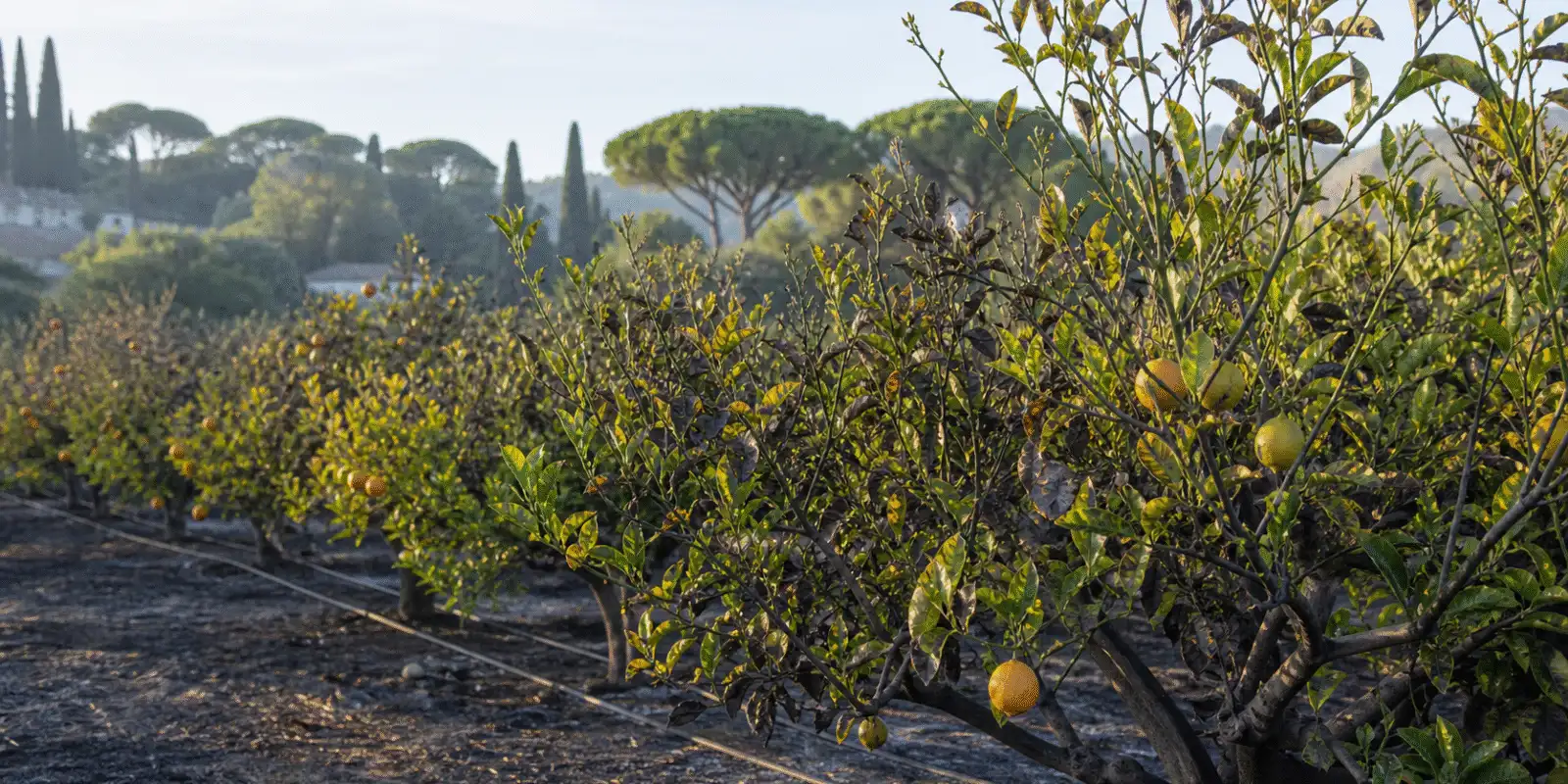
A blackened fruit tree is not automatically dead. Equally, one green shoot does not prove that its whole crown, grafted cultivar or future crop has survived. Once re-entry is authorised, give every tree one provisional outcome: make safe, monitor, seek expert advice, or replace. Base that outcome on stability, crown, cambium, root collar, graft union, root zone and irrigation, never on leaf colour alone.
This guide is for household fruit trees and citrus. It does not cover ponds, wildlife, buildings, defensible space or general soil restoration. For the tree’s wider growing context, return to Orchard and Citrus.
Do not inspect the tree until access is safe
Do not cross a cordon or return simply because the flames have gone. Oxfordshire County Council Fire and Rescue Service says not to enter until the fire and rescue service confirms that it is safe. A hanging limb, split trunk, damaged cable, smell of heat or renewed smoke takes the matter outside ordinary gardening: keep people away and report the hazard.
Before moving a hose, fruit or branch, photograph the whole tree and each side of its trunk. Mark its position and retain evidence for the insurer. The London Fire Brigade’s recovery booklet advises photographing damage, following access restrictions and speaking to the insurer before clearing affected property.
The first safe visits after authorised re-entry
This is a workflow, not a biological recovery timetable.
| Stage | Do now | Leave alone |
|---|---|---|
| First safe pass | Exclude the area beneath unstable wood, photograph the tree, note residual heat and identify what burned near the fruit. | Climbing, pulling hanging branches or tasting exposed produce. |
| First safe day | Inspect the water system from a safe position, isolate a leaking or melted section and label each tree. | Restarting the former irrigation programme across the whole row. |
| Following safe visits | Record root-zone moisture, root collar, graft union and accessible live tissue; assign a provisional outcome. | Structural pruning, fertilising or removing a stable tree because it looks black. |
The Chatelain Method is practical here: Observe → Diagnose → Correct → Prevent. “Correct” first means isolate the area, have a competent operator deal with a hazard, or restore an essential function — not reshape the tree.
A ten-minute inspection for each tree
Repeat the same sequence at every visit. A dated comparison is more useful than a single verdict.
1. Crown and framework
Record where flexible leaves, swelling buds or fresh shoots remain: away from the fire, inside the crown, on a scaffold limb or on the trunk. Also note split, sagging or detached main branches. Scorched foliage can sit above living cambium; a slower fire can injure the stem while some foliage remains green.
The public guidance from Agriculture Victoria on fire-damaged fruit orchards lists damage to foliage, cambium, roots, fruit and irrigation as separate observations. It also warns that some trees decline after producing new shoots. This is Australian orchard evidence, not a UK survival score.
2. Bark and cambium
Never peel a strip around the trunk. Start with a crack or the edge of an existing wound. If a check is necessary on a stable, modest tree, expose only a tiny, recorded window. Moist, pale cream or light tan tissue supports living cambium at that spot; dry reddish-brown tissue indicates local damage. Neither result describes the full circumference, roots or structural strength.
On a valuable tree, a large stem or any tree near people, leave intrusive checks to a competent arborist. More scraping does not create more certainty; it creates another wound.
3. Root collar, roots and irrigation
Look without broadly excavating the roots. Record burnt bark at ground level, cavities, lifting bark, exposed structural roots, organic matter that burned against the stem, a loose root plate, and soil that is persistently wet or unexpectedly dry. Then test one line and one emitter for that tree. Tubing can look serviceable beside the trunk while being pinched, melted or disconnected elsewhere.
A root collar that appears damaged around several sides, a newly leaning tree or movement of the root plate needs an on-site assessment. Do not answer uncertainty by cutting more bark.
4. The graft union
Find the graft before interpreting any shoot. Growth above it may belong to the scion — the named fruiting cultivar. Growth below it belongs to the rootstock. The RHS explains that suckers on grafted plants are rootstock growth, not the named cultivar; its fruit rootstock guide also shows why rootstock survival and fruiting identity are separate matters.
Do not remove every new shoot during the emergency inspection. Mark where it starts. If the scion is lost, a specialist may later compare regrafting the surviving stock with replacing the tree.
Choose one of four provisional outcomes
| Outcome | Evidence that points this way | Next step |
|---|---|---|
| Make safe | Access not authorised, heat or smoke, hanging limb, unstable trunk, damaged utility, dangerous irrigation or suspicious debris. | Exclude the area and call the relevant fire, utility or tree professional. Do not inspect closely. |
| Monitor | Stable tree, live tissue somewhere, identified graft, controllable moisture and no progressive structural sign. | Label it, photograph from fixed points, adjust water and set a review date. |
| Seek expert advice | Root-collar or graft injury, conflicting cambium signs, severe one-sided damage, heated roots, a large tree near access, high-value cultivar or uncertain contamination. | Obtain an on-site diagnosis before heavy pruning, stumping or major expense. |
| Replace or regraft | Death confirmed after an appropriate observation period, irreparable structure, or living rootstock with a lost scion when regrafting is not worthwhile. | Compare replacement and regrafting; record why the decision was made. |
Replacement is rarely a sound decision during the first safe visits. If a tree may fall, the first outcome is “make safe”: keep people away and have a competent operator deal with it.
Match irrigation to the remaining canopy
The pre-fire watering programme is no longer a reliable baseline. With fewer leaves, a tree usually transpires less, so the former dose can leave roots wet for longer. Yet dry soil and living feeder roots may still need water.
Check moisture at the same place and depth, repair leaks, give a short irrigation only when the root zone requires it, and check again before the next cycle. Separate severely defoliated trees from unaffected ones where the system allows. Increase water gradually as leaf area returns; do not use fertiliser to force a response before there is growth able to use it.
UC Agriculture and Natural Resources describes this mechanism for Californian citrus and avocado: leaf loss lowers water use and excess moisture can favour root problems. It does not provide a UK litre or frequency rule. Soil, container size, weather, species, drainage and surviving root function all change the answer.
When will recovery become clear?
There is no universal “two to six weeks” rule.
- During active growth, review buds, shoot origin, lesion spread and stability weekly at first. The boundary of dead wood can continue to retreat.
- After an autumn or winter fire, no immediate budbreak is expected from a dormant apple, pear or plum. Its next normal growth period is the first meaningful checkpoint.
- For citrus, particularly a protected or container-grown tree, growth depends on temperature and light. Older wood can take months to declare the extent of injury.
- For olives, France Olive’s professional guidance waits for regrowth before choosing structure and commonly places restructuring in the following spring. That is olive-specific practice, not citrus instruction.
- For avocado, widely quoted three- and six-month timings come from Californian groves. UC ANR describes avocado as unusually able to recover from trunk damage; it says significant citrus trunk damage has a poorer commercial outlook. Do not use avocado timing or circumference thresholds to condemn or save a lemon tree.
Unless dead wood is an immediate hazard, delay structural pruning until living and dead areas are readable. If it is a hazard, keep clear and have a competent operator remove it. Defoliated trunks and scaffold limbs can then be exposed to sun damage; use only a tree-appropriate protection recommended for the species and situation, not improvised coatings.
Grafted citrus: three different kinds of survival
A lemon, orange or mandarin tree may retain living roots and rootstock while losing the scion. It may retain part of the scion yet take much longer to rebuild a balanced fruiting canopy. Those are different outcomes.
Ask three questions in order:
- Are roots and rootstock alive and structurally anchored?
- Is there viable tissue or regrowth above the graft?
- Is a balanced, manageable fruiting framework realistically rebuilding?
A vigorous thorny sucker below the union answers only the first. It may eventually be regrafted, but it will not simply turn back into the named lemon or orange. A citrus specialist should consider cultivar, rootstock, plant health and growing conditions before recommending top-working or replacement.
Olive and avocado examples are useful only as contrasts. Olive recovery often relies on species-specific basal regeneration and orchard restructuring. Avocado can tolerate trunk damage that is much more serious for citrus. Neither biology may be copied wholesale into citrus advice.
Fruit and ash: first identify what burned
Damaged or contaminated food should be discarded, according to the London Fire Brigade. Beyond that, UK advice is incident-specific rather than a universal “wash and eat” or “discard everything” rule.
Public Health England’s Grenfell Tower advice allowed local garden produce to be used after washing and peeling, in the context of site monitoring and a defined assessment. That outcome cannot be transferred to another fire.
Use this decision sequence:
- Vegetation-only fire, source known: isolate fruit that was exposed during the event and follow the fire service, council or public-health instruction for that incident. Guidance for later harvests may differ.
- Building, vehicle, plastic, treated timber or industrial material burned: do not eat produce or disturb deposited debris until the relevant authority advises how it should be handled.
- Unknown source: treat ash and fruit as potentially contaminated until the source and local advice are clear.
An American university guide, After the Fire: Home Garden and Fruit Tree Safety, discusses staged washing and possible testing after urban wildfire. It is useful evidence that risk depends on proximity and contaminants, but it does not override a UK council or health instruction.
Survival, stability and cropping are not synonyms
| Observation | What it supports | What it does not prove |
|---|---|---|
| Living cambium in one window | Conductive tissue remains there. | The whole stem, roots and anchorage are sound. |
| Sucker below the graft | Rootstock or roots remain alive. | The named cultivar survived. |
| Shoot above the graft | Scion tissue is alive at that point. | A balanced crown or future crop. |
| Sustained new canopy | Vegetative recovery is under way. | Previous yield, fruit quality or tree life expectancy. |
Agriculture Victoria reports that surviving orchard trees may take several seasons to crop again and can retain reduced productive potential. That evidence supports the distinction, not a timetable for a UK garden.
For a commercial orchard. Also assess irrigation blocks, age, cultivar, rootstock, density, rehabilitation cost and seasons without saleable fruit. Preserve evidence before work and involve the crop adviser, insurer and accountant. A biologically recoverable block may still be commercially unviable; this household guide cannot make that decision.
Printable tree record
Use one sheet per tree and replace vague labels with precise observations.
- Tree number / position / species / cultivar: ______________________________
- Date, season and weather since the fire: _________________________________
- Access authorised and tree stable: yes / no / uncertain
- Crown: green / partial / defoliated; worst-affected side: _________________
- Bark and framework: split / lifting / hanging limb / nothing visible
- Cambium: not tested / tested at __________ ; pale-moist / brown-dry / uncertain
- Root collar and visible roots: sound / burnt / moving / uncertain
- Graft found: yes / no; regrowth above / below / none
- Irrigation: line __________ ; soil dry / slightly moist / moist / saturated
- Fruit present during fire isolated: yes / no / not applicable
- Outcome: make safe / monitor / seek advice / replace-regraft
- Minimum action and next review date: ____________________________________
FAQ
Can I cut off every black branch now?
Keep away from an immediate hazard and have a competent operator deal with it. Otherwise wait until the dead-wood boundary is stable and visible; premature pruning can remove useful living tissue.
Does a shoot at the base mean my lemon tree is saved?
No. A shoot below the graft is probably rootstock. It proves root survival, not survival of the lemon cultivar.
Should I water more to restart the tree?
Not by default. Check the root zone and remaining canopy. A defoliated tree uses less water; the aim is sufficient moisture, never persistently wet roots.
Sources and further reading
- Oxfordshire County Council Fire and Rescue Service — After a fire
- London Fire Brigade — After we leave
- RHS — Rootstocks and suckers
- RHS — Fruit tree rootstocks
- GOV.UK — Public health advice following the Grenfell Tower fire
- France Olive — Regenerating an olive grove after fire
- Agriculture Victoria — Recovery from fire damage in fruit orchards
- UC ANR — Care of Fire or Frost Damaged Trees
- UC ANR — After the Fire: Home Garden and Fruit Tree Safety
Written and checked by the editorial team of Les Jardins d'un Châtelain.