Outdoor Wedding Weather Plan: An Elegant Backup for Rain, Wind and Heat
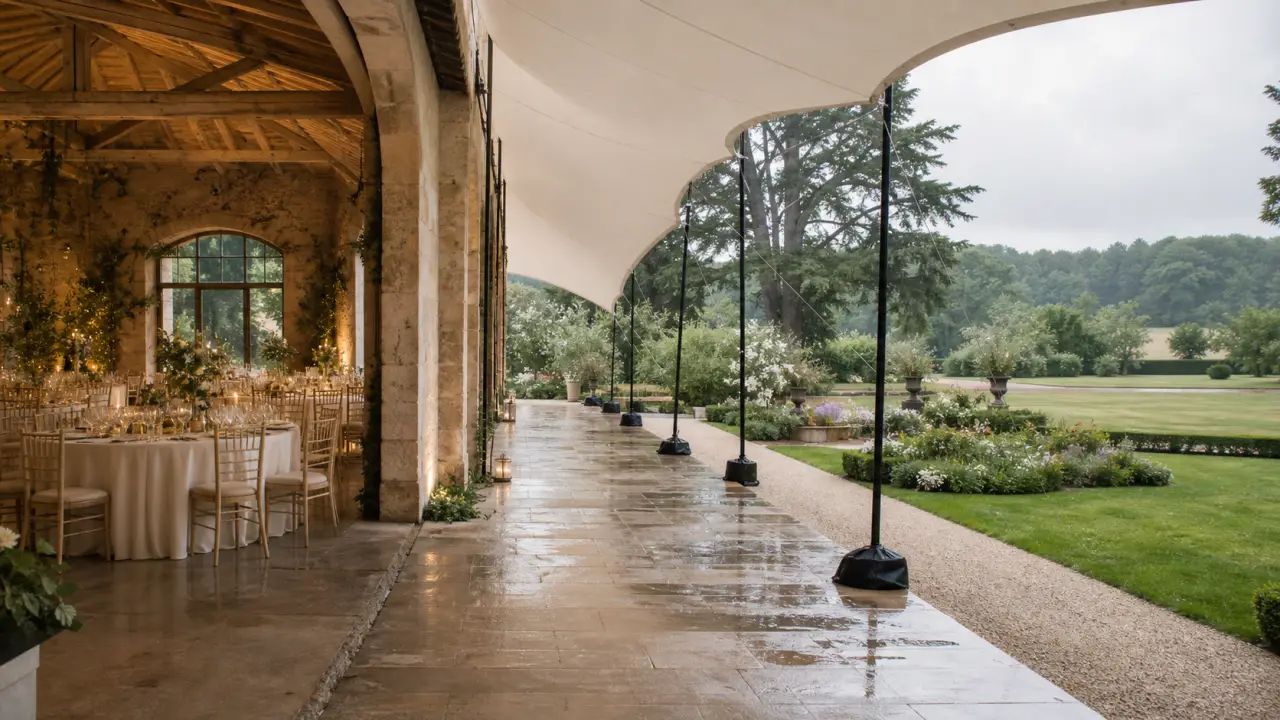
An outdoor wedding weather plan is ready only when the backup can run as a complete event layout. It needs verified capacity, an accessible route, workable service space, safe temporary power and a named person who can authorise the switch. That decision should use current Met Office warnings, the venue’s plan, written supplier and manufacturer limits, and the condition found on site. A marquee mentioned in a brochure or a room shown empty is not enough.
Elegance comes from continuity between the two layouts: a restrained palette, a few planned moves and the same priorities for hospitality. It must never delay action when wind, rain, heat, unsafe ground or an official instruction makes the outdoor setting unsuitable.
Les Jardins d’un Châtelain is an editorial gardening website. It does not hire out a country house, estate or wedding venue. The selected venue, competent contractors, applicable authorities and current emergency arrangements always take priority over this guide.
Make the backup a second operating layout
Draw the wet-weather version with the same guests, furniture, catering, toilets, staff routes and exits as the outdoor version. Ask for the usable capacity after service areas, circulation and accessibility have been allowed for. If the ceremony, drinks and wedding breakfast must share one space, show how each change will happen and where guests will wait.
Inspect the route to the backup, not just the room. A covered barn reached across a waterlogged lawn does not provide continuous shelter or access. Check thresholds, slopes, steps, door widths, lighting and the route available to a wheelchair, buggy or service trolley. Confirm what happens to coats, wet umbrellas, flowers, audio equipment and furniture awaiting removal.
Each supplier should give its own last workable decision point. That is a contractual and operational fact, not a generic number from an article. The florist may need to change mechanics before the caterer moves equipment; the structure supplier may require action earlier still. Put those dependencies into one sequence and identify both the decision owner and a deputy.
Use the Chatelain Method before choosing an action
The Chatelain Method applies four passes: Observe, Diagnose, Correct, Prevent.
Observe. Walk the guest route and the service route in both layouts. Record hardstanding, slopes, low points, drains, tree canopies, exposed corners, access for emergency services, temporary power positions and areas the gardener or venue has ruled out. If permission allows, inspect after ordinary rain as well as in dry conditions.
Diagnose. Read four evidence streams together: official weather information, the venue’s current arrangements, equipment instructions and the day’s site inspection. A reassuring forecast does not make already saturated ground load-bearing. A forecast chance of rain does not, by itself, define whether an identified professional structure can be used.
Correct. Move activities to robust surfaces, shorten an outdoor phase, open a covered route or activate the prepared indoor layout. Only the venue and competent suppliers can approve temporary structures, anchoring or ballast, electrical installation and emergency actions.
Prevent. Keep one dated weather switch sheet. Link every check to a source, decision and responsible role. Rehearse the move before the wedding. A drawing cannot reveal a cable pinched by a door, a bottleneck at the cloakroom or staff and guests being sent through the same narrow route.
Build a weather switch sheet
Use this as the skeleton of the venue’s working record, then replace every general phrase with the actual document, person and action for the site.
Start with the decision header:
| Site and date | Decision owner and deputy | Check time | Next review | Chosen state | Decision time |
|---|---|---|---|---|---|
| Complete on site | Complete on site | Complete on site | Complete on site | Continue / adapt / move / shelter | Complete on site |
Then record what was actually found and completed for every control:
| Check | Evidence and applicable written limit | Observation or result | Status | Decision or action completed | Confirmation: person and time |
|---|---|---|---|---|---|
| Weather | Current Met Office warning, forecast and venue plan | Phenomenon, period and local exposure observed | Green / review / stop | Continue, adapt, move or shelter | Named venue lead and time |
| Temporary structures | Supplier design, manual and installation record | Forecast and observed conditions compared with written limits | Green / review / stop | Close, alter, dismantle or evacuate as instructed | Competent supplier and time |
| Ground and garden | Dated inspection, photographs and venue restrictions | Bearing, water, grip and damage observed | Green / review / stop | Use hardstanding, protect an authorised zone or close it | Venue or garden lead and time |
| Access | Walked guest, staff and emergency routes | Continuity, lighting and usability observed | Green / review / stop | Open the backup route and remove conflicts | Site coordinator and time |
| Power | Temporary electrical plan, competent check and equipment limits | Equipment, connections, protection and cable route observed | Green / review / stop | Isolate or use the approved alternative | Electrical contractor and time |
| Heat | Warning, real shade, water, ventilation and guest needs | Exposure and comfort observed for this phase | Green / review / stop | Reschedule, shorten, shade or move inside | Named event lead and time |
Finish with a distribution log. A sound decision that does not reach people is not an operational switch.
| Audience | Agreed channel | Message owner | Sent at | Acknowledged by and at |
|---|---|---|---|---|
| Suppliers | Complete on site | Complete on site | Complete on site | Complete on site |
| Guests | Complete on site | Complete on site | Complete on site | Complete on site |
A blank box is not a green box. Avoid inserting a universal wind speed, rainfall total or temperature. The relevant figure must come from the identified equipment’s supplier or manufacturer, the venue plan or a competent authority, and it may depend on installation, ground, exposure and configuration.
Read rain through ground, routes and drainage
Rain affects more than the ceremony itself. It can reduce bearing capacity, create slippery transitions, flood a low point and make deliveries damage a lawn. HSE’s event site-design guidance asks organisers to consider ground conditions, flooding, prevailing wind, underground services and access as part of the site plan. This is a useful framework for Great Britain; the venue and applicable authority determine the actual duties.
Map a hard-surface chain between arrival, ceremony or backup, meal, toilets and departure. Do not improvise a shortcut through beds, root zones or drainage features. Temporary flooring must be selected and installed for the expected loads and surface by the venue or a competent supplier. A loose sheet placed over mud can hide a trip or drainage problem rather than solve it.
Reduce vehicle movements on vulnerable ground after wet weather. Give delivery teams a separately approved route and unloading area. Take dated photographs before installation and after removal. They support a fair restoration plan and help the garden team distinguish fresh damage from an existing soft area.
Treat wind as an equipment-specific condition
A marquee, parasol, sail, sign, floral column and wedding arch all respond differently to wind. Closing a side, opening a side or adding unplanned ballast may change the forces rather than make a structure safer. HSE’s cited outdoor-equipment page concerns supports for speakers, screens and lighting; its instruction to follow the design and assess weather, ground, slope and wind is used here only as a transferable principle. It does not approve a marquee or wedding arch, whose equipment-specific limits remain with its designer, manufacturer and competent supplier.
Ask the relevant supplier to record the configuration allowed, monitoring method and actions required when its written conditions are approached. Link that record to Met Office information and observations at the venue. A sheltered forecast location does not describe every exposed lawn or wind corridor between buildings.
Never drive a stake without the venue’s consent and information about underground services. If a rustic outdoor wedding arch cannot be moved under its agreed method, provide a separate background in the backup room. Do not invent a rushed lifting operation during the guest move.
Objects not essential outdoors should be removed early. Assign ownership of signs, loose textiles, parasols and empty vessels; “someone will bring them in” is not a control. Trees and branches also need the venue’s judgement, especially after sustained rain or in strong winds.
Plan for heat as a health and operating issue
The Met Office warning service and public-health advice provide the current context for periods of significant heat. The practical decision still depends on the site: how much shade exists at the exact hour, whether guests queue in sun, the distance to water and toilets, the ventilation of a covered structure, and whether anyone has disclosed needs that require additional support.
Canvas does not guarantee a cool environment. Test the installed configuration and follow the supplier’s operating instructions. Provide accessible drinking water and a genuine cooler retreat; do not count alcoholic drinks as hydration. Give guests accurate information about surfaces, walking distance and expected exposure so they can prepare.
Possible adaptations include moving a ceremony within the agreed timetable, shortening it, changing the procession route, increasing approved shade or using the indoor layout. These are choices for the venue’s plan, not promises that one accessory neutralises heat. A photograph planned for a particular patch of sun is never more important than an official warning or a person’s welfare.
Verify temporary power in both layouts
Outdoor sound, lighting, refrigeration and catering create a temporary electrical system. HSE guidance stresses competent design, weather protection and control of cables and trip hazards. A domestic extension lead added on the morning is not a substitute for that work.
The backup changes the installation. A cable may cross a new fire exit, a connector may be moved near a wet doorway, or an appliance intended for a sheltered position may become exposed. Ask the competent contractor to check both layouts, the isolation procedure and the point after which no unreviewed change is allowed.
Switch on the backup route lighting before it is needed. Inspect steps, ramps, thresholds and changes of surface from both directions. Decorative lights must not dazzle, create a new cable loop or send people towards a closed path.
Protect the garden during a fast move
Agree a site protection map with the venue’s garden lead. Mark permitted lawns, root protection areas, beds, drainage, buried services, hardstanding, unloading points and no-go areas. Loads and vehicle access should come only from venue rules and the relevant equipment information.
A weather switch concentrates footfall and trolley movements into a short period. Allocate tasks and insist on the robust route even if a path across planting appears quicker. Choose a place for wet furniture that does not lean against hedges, block drainage or occupy an emergency route.
After the event, inspect compaction, ruts, displaced edging, damaged branches and forgotten ties or fixings. Restoration may have to wait until the ground has drained sufficiently. Driving machinery onto saturated turf to “repair it quickly” can deepen the damage.
Rehearse the decision and the message
Run a tabletop exercise with the venue and principal suppliers. Use a plausible combination—an updated warning, a soft lawn and equipment that its supplier will no longer release—without inventing a public threshold. Each person states what they do, which route they need, how long their contracted action takes and who confirms completion.
Then walk the change physically: guest arrival to seat, seat to toilets, catering route to service area, outside ceremony to backup. Time it to understand dependencies, not to advertise a universal changeover time. Correct any point where two teams cross or no one owns the next decision.
Prepare one supplier notice and one plain guest message. Both state the confirmed location, any time change, the route and where assistance is available. The styling relationship belongs in the separate guide to garden wedding themes for a country house. This plan is concerned with making the alternative safe, complete and legible.
FAQ
When should an outdoor wedding weather plan be activated?
There is no universal clock time. Agree the decision sequence with the venue and suppliers using their real setup requirements, written equipment limits, current Met Office warnings and the inspected site condition. Name a decision owner and deputy, then record every review and each supplier’s contractual last workable point. If an authority, emergency arrangement or equipment supplier requires shelter, closure or evacuation, that instruction takes priority immediately.
Evidence, method and limits
Our contribution. The weather switch sheet joins official information, technical documents, site condition, access, temporary power, guest comfort and garden protection in one reproducible record. It is not a structural calculation, risk assessment or emergency plan.
Method. We compared UK outdoor-wedding search patterns with Met Office information and HSE guidance on site design, electrical safety and outdoor supports. The HSE outdoor-equipment material is transferred only as a planning principle for its stated equipment scope; commercial wedding pages establish search language, not technical limits.
Limits. Without a visit, drawings, contracts, equipment documents, service information, ground inspection and guest requirements, this article cannot approve capacity, anchoring, electrical work, accessibility or a weather threshold. HSE sources cited here apply to Great Britain; use the relevant authority in Northern Ireland and follow the venue’s current requirements throughout the UK.
Sources and further reading
- Met Office — warnings and advice, for current official warning information.
- HSE — venue and site design, for ground, flooding, wind, access, temporary structures and buried-service considerations in Great Britain.
- HSE — electrical safety at events, for competent temporary installations, weather protection and cable management.
- HSE — outdoor equipment, specifically about supports for speakers, screens and lighting; its weather, ground and manufacturer-check principle is transferable, but approval remains equipment-specific.
- Guides for Brides — outdoor wedding guide and Events Under Canvas — weather-proof your wedding, consulted to identify UK search expectations and supplier language, not to set limits for a particular event.
Written and checked by the editorial team of Les Jardins d'un Châtelain.