Garden Wedding Lighting: Guide Guests Without Lighting the Whole Garden
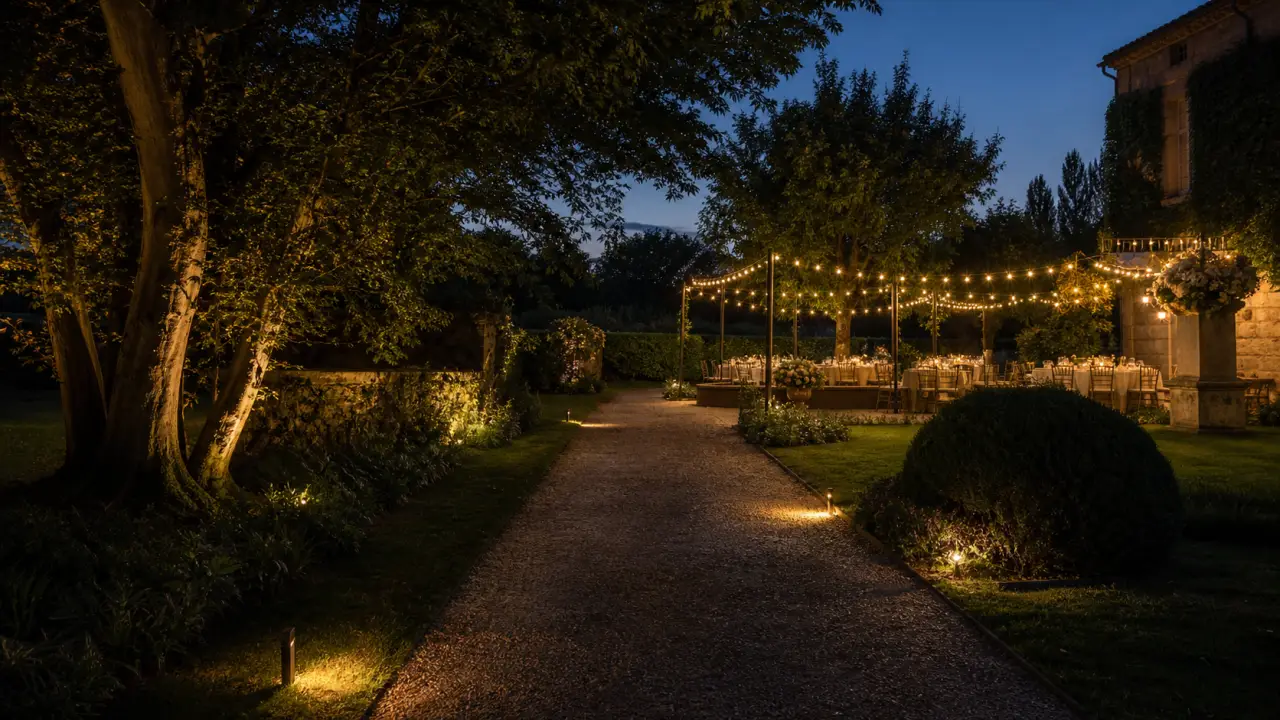
Plan garden wedding lighting in this order: exits and essential routes, working light for suppliers, comfortable light at arrival and tables, then decorative festoons and accents. Put temporary power and suspended fittings in competent hands, and test the completed scheme after dusk. A successful plan does not flood the whole garden. It deliberately retains dark hedges, tree crowns, water and boundaries that nobody needs to enter.
That order exposes faults which an inspiration photograph cannot show. A bright festoon canopy may look generous from the dance floor yet leave a threshold unreadable. A path marker may shine straight into approaching eyes. A catering floodlight may flatten every table. The test is not whether each lamp works; it is whether a person can carry out the intended task without glare, confusing shadow or an unprotected route.
Les Jardins d’un Châtelain is an editorial gardening website, not an electrical designer, venue or event contractor. The venue, organiser and suitably competent contractors remain responsible for the actual design, installation, documentation, operation and removal.
Draw the night-time event before choosing fittings
Start with the approved event layout. Mark the arrival, authorised parking or drop-off, reception point, dining, bar, toilets, dance area, first aid, exits, supplier routes and areas from which guests are excluded. Add the wet-weather arrangement. If the venue activates a marquee or indoor move, give that arrangement a separate register entry for routes, supply, controls, supports and an on-site test.
Write a visual task beside every zone: find the correct entrance, see a step, read a table number, identify a door, plate food, collect glassware or reach the isolation point. “Create atmosphere” is not yet a testable task. It becomes useful only when attached to a subject and viewpoint, such as revealing the stone entrance without shining into the upstairs rooms.
The lighting layout sits beside the outdoor wedding weather plan. It cannot make a structure safe in wind, make unsuitable equipment weatherproof or approve an alternative space. Record who has authority to change the lighting state if the event moves.
Use five layers, not one blanket of brightness
Safety and escape
HSE event electrical guidance asks organisers to account for emergency power, emergency-lighting requirements and exit signs as part of the temporary installation. The venue and relevant professionals establish what applies to the event. The handover record tests decorative states against that provision; it does not reclassify an ordinary battery lantern as emergency lighting.
Route and orientation
Connect authorised entrances, changes of level, steps, junctions and facilities. Aim to show the walking surface and the next decision without presenting a row of bare bright points. Check each route in both directions: a shield that works on arrival may expose the source on departure.
Work and service
Bars, kitchens, loading areas, toilets and technical control need light for their real tasks. Contain it. A supplier should be able to read controls and work safely without aiming a floodlight across the guests or into a wildlife boundary.
Hospitality and tables
Guests need to recognise faces, food, glassware, menus and nearby obstacles. Light may come from a well-positioned festoon canopy, reflected sources or suitable table lamps, but it must be judged with the actual linen, flowers and seating. White cloth, clear tent walls and glass can all produce reflections that were absent during a daytime survey.
Accent
Only now light the arch, façade, one tree trunk or a planting composition. Give every accent a subject, a useful viewing period and a switch-off decision. Permanent planting and architectural illumination belong in our separate landscape lighting guide. This page deals with a temporary wedding installation and its handover.
Apply the Chatelain Method after sunset
Observe. Walk the garden by day and again as natural light falls. Record steps, slopes, low branches, reflective surfaces, water, important views and habitat edges. Stand where guests will sit, not only where the photographer plans to stand.
Diagnose. Give each proposed source one primary function. Identify conflicting functions: a spotlight can reveal a sign from one angle and dazzle a person approaching from another. Note false shadows on changes of level, reflections in glazing and light that escapes into a hedge or bedroom.
Correct. First change position, shielding, direction or contrast. Move a table or sign if that is safer and simpler. HSE places selection, installation and maintenance of event electrical equipment with organisers and contractors acting competently; styling staff and guests therefore return electrical alterations, re-rigging and load changes to the responsible supplier.
Prevent. Divide controls into meaningful groups, name the authorised operator and write the shut-down sequence. Keep the installation layout, handover record, fault contact and isolation instructions available. Give removal its own checklist, with every cable, tie and fixing assigned to a named person for the final count.
Build a zone handover record
This record coordinates people. It is not an electrical certificate or a substitute for the event and escape plans.
| Zone | Visual task | Equipment and supply accepted by | Observable dusk test | Fault and correction | Switch-off and owner |
|---|---|---|---|---|---|
| Arrival | Find the entrance, host and essential information | Venue and technical lead | Two people arrive from the real drop-off without prompting | Sign reflects into view; angle changed | Reduced after final arrivals by coordinator |
| Main path | See steps, level changes and junctions | Lighting contractor with venue | Walked both ways, then with an empty tray | Bare source visible; shield or position corrected | Retained until the final departure |
| Dining tables | See faces, plate and menu comfortably | Lighting and front-of-house leads | Checked from different seats with linen and flowers installed | Floral shadow over plate; object or source moved | Dining group removed when area closes |
| Bar and catering | Prepare and serve without spill into dining | Catering lead and technician | Actual tasks rehearsed with equipment in place | Flood reaches tables; beam contained | Service lead after close-down |
| Toilets and exits | Identify doors, route and safety information | Venue under its applicable plan | Full route checked from occupied zones | Dark break at threshold; functional light corrected | According to venue procedure |
| Decorative accent | Reveal one agreed subject | Creative lead after technical approval | Subject readable, source hidden, no skyward spill | Crown and window lit; angle narrowed | After the relevant photographs or sequence |
| Dark reserve | Keep hedge, water, crown or known habitat unlit | Venue and ecologist where needed | Observed from adjoining lit areas | Spill reaches edge; fitting masked, turned or removed | No decorative switch-on |
Complete the record with a venue representative and technical lead. Photograph specific faults before and after correction. A generic tick saying “lighting fine” does not identify what was tested.
Put temporary electrical work in competent hands
The Health and Safety Executive’s event electrical guidance asks organisers and contractors to consider site layout, demand, supply, environmental conditions, generators, earthing, isolation, cable routing and access by unauthorised people. Its legal application depends on the work activity and event. This article uses that list as a handover structure and leaves the actual design and acceptance to the responsible people.
Ask who designed the distribution, who installed it, who inspected or tested it as required, what documentation is handed over and who may intervene. Record the supplies, distribution, connections, cable routes, controls and isolation considered by the contractor. The component schedule records each item’s intended conditions; it does not transfer one luminaire’s marking to connectors, extensions or enclosures.
HSE advises routing cables to minimise trip hazards and mechanical damage, using suitable protection where they cross routeways, and segregating electrical equipment from the public. Mark each unavoidable crossing and its contractor-approved treatment on the plan. The written fault procedure names who stops, isolates and investigates; guests do not alter or repeatedly reset the installation.
Keep the main intake or generator accessible to authorised staff and emergency action while segregated from the public, as HSE advises. Caterers, musicians and lighting suppliers must declare their demand before the distribution is agreed. The late addition of a heater, urn or sound system is a design change, not a spare socket question.
Treat overhead light as rigging, not decoration
Do not record a living branch as a rated suspension point without project-specific evidence and approval. Suspended loads go to structures and attachment points whose suitability is documented for the actual system. The lighting or structure contractor records the supports, loads, operating limits and retention method.
HSE says work at height must be properly planned, supervised and carried out by competent people, using suitable access equipment and taking account of the surface. The supplier records the access method for both installation and removal. The small mass of a string does not remove the fall risk for the person fitting it.
Natural England’s tree-guard specification says guards must not be fastened to a tree or installed so that they rub, constrict or damage it. That source concerns tree guards, not event rigging or load capacity; it is used here only for the direct contact mechanism. Any non-load-bearing decorative lead near planting therefore needs venue permission, no rubbing or constriction, and a removal count for every cable, tie and fixing.
Keep useful darkness in the design
Artificial light can affect wildlife at levels and in ways that differ from human vision. GOV.UK planning guidance on light pollution notes that position, duration, source and level all matter, and identifies water and sensitive wildlife receptors as particular considerations. The page is guidance for England; Scotland, Wales and Northern Ireland have their own systems, and protected sites or species may require specialist advice.
Mark dark reserves before choosing accents. Where the venue has identified a sensitive wildlife receptor, water edge or intrinsically dark boundary, record it before positioning fittings. GOV.UK advises considering where, when and how much light shines; the plan therefore limits direction and operating time to the agreed task or subject.
This restraint is also the article’s visual choice: use one agreed subject against an unlit background instead of filling every part of the garden. Darkness is treated as part of the night-time composition, not as an automatic defect.
Run the dusk walk from four perspectives
Test after natural light has fallen enough to reveal the actual contrast. Install tablecloths, flowers, signs, bar equipment and transparent marquee walls before the test. Temporary objects alter shadow and reflection.
Walk as an arriving guest, a departing guest, a server carrying an empty tray and the technician reaching controls. Ask one person to remain seated in each table group and report exposed sources. Include someone whose height, mobility or vision gives a different perspective, while following the venue’s accessibility arrangements rather than making assumptions on their behalf.
Now rehearse the states: arrivals, dinner, speeches, dancing, late departure, wet-weather move and a decorative circuit fault. Confirm which controls must remain available and who is allowed to operate them. Record changes on the plan, not only in a message thread.
Know the stop signs
Return the electrical issue to the contractor when equipment is exposed to weather without the specified protection, a cable crossing has no agreed treatment, the supply or isolation owner is unidentified, or guests can reach the distribution; these checks follow HSE’s event guidance. Pause the decorative sign-off when the wet-weather state is absent or the test makes an exit sign harder to identify under the venue’s plan.
On the visual side, remove or redirect a fitting that lights eyes more than the route, creates a false edge, washes out faces, reaches neighbours’ rooms or turns an ecological boundary into a bright wall. Another lamp rarely cures bad direction; it generally raises the adaptation problem.
FAQ
How many metres of festoon lighting does a garden wedding need?
There is no reliable universal figure. Length depends on approved supports, layout, mounting method, spacing of the actual system, other light and the intended task. Ask for a scaled plan and site trial. A photograph cannot establish safe supports or electrical demand.
Can festoon lights be hung from trees?
Do not assume so. The venue, contractor and, where appropriate, an arborist approve proximity to trees, while loads remain on documented supports. Natural England’s tree-guard rules are not rigging rules, but they provide a clear contact safeguard: do not fasten equipment so that it rubs, constricts or damages the tree.
Are solar path lights enough?
They may provide atmosphere or supplementary markers if their charge, duration and position are tested on the date. The register does not label them emergency or escape lighting without the venue’s applicable documentation; HSE treats emergency power, emergency-lighting requirements and exit signs as specific parts of event electrical planning.
Should wedding light always be warm white?
Warm, well-contained light often suits planting and is less visually harsh than blue-rich white, but a colour label alone cannot guarantee comfort or ecological care. Direction, intensity, duration, spectrum and the sensitivity of the site all matter.
Sources and scope
- HSE — Electrical safety at events, temporary systems, cables, weather and public segregation.
- HSE — Common work at height tasks, event lighting rigging and suspended fittings.
- HSE — Introduction to working at height safely, planning, competence, access equipment and surface conditions.
- HSE — Temporary demountable structures, structures supporting event equipment.
- GOV.UK — Light pollution, English planning and ecological considerations.
- Natural England and Rural Payments Agency — Tree guard specification, evidence limited here to rubbing, constriction and direct attachment damage.
Venue rules, the competent contractor’s design, applicable law, insurance requirements and the event plan take priority over this editorial guide.