Landscape Lighting for Trees and Borders
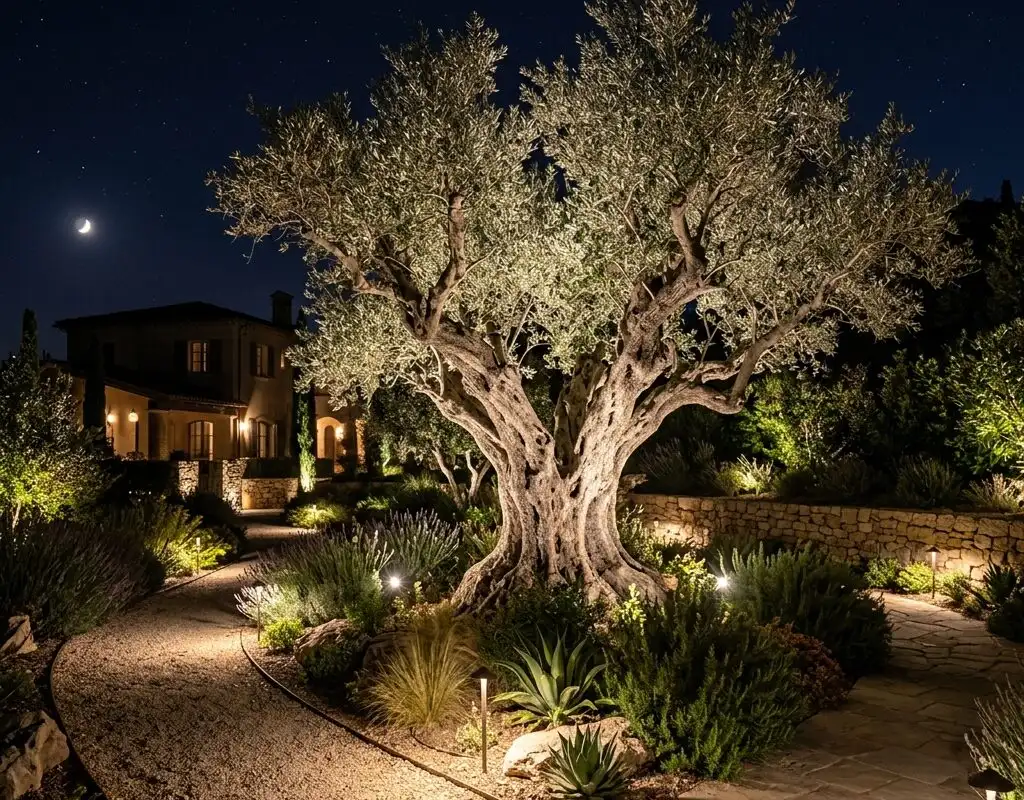
Successful landscape lighting picks a few subjects rather than flooding the whole garden: light a tree from its base (uplighting), mark a path with grazing light, highlight a border. The secret lies in warm light (2700-3000K), measured output and controlled contrast. Here’s the scale by use.
The Chatelain Method for garden lighting
You observe the subjects worth revealing (a striking tree, a façade, a path); you diagnose the effect wanted (reveal, mark a route, set a mood); you correct with the right output and colour temperature; you prevent light pollution by switching off what isn’t needed.
The lumen scale by subject
| Use | Indicative output | Effect |
|---|---|---|
| Path marking | 50-100 lm per point | Guide, keep safe |
| Border / shrub | 100-300 lm | Highlight the shapes |
| Small tree (uplight) | 300-500 lm | Reveal the canopy |
| Large tree (uplight) | 500-700 lm | Create a focal point |
| Façade / wall | 200-400 lm grazing | Texture, depth |
The Chatelain note. Aim for a 2700-3000K colour temperature (warm white) for a natural look that’s kinder to wildlife, and low-voltage (12/24V) fittings rated at least IP65 for outdoor use. Cool white (above 4000K) flattens a garden’s atmosphere and disturbs insects.
Techniques for highlighting
- Uplighting: a ground-level spotlight, beam upward, for trees and trunks.
- Wall grazing: raking light along a façade or dry-stone wall.
- Path marking: low bollards along walkways, without glare.
- Cast shadows: lighting through foliage to project patterns.
Plan lighting from the design stage, and under a pergola to extend evenings outdoors.
Limiting light pollution
Less is more: light downward or toward the subject, never up at the sky, and fit a timer or motion sensor. A successful night garden plays with light and shadow, not floodlit excess.
FAQ
What output do I need to light a tree?
Around 300-500 lm for a small tree, 500-700 lm for a large one, uplighting from the base with a tight beam on the trunk and canopy.
What colour temperature should I choose for the garden?
Warm white, 2700-3000K: natural, flattering for plants and less harmful to nocturnal wildlife than cool white.
Should I use mains voltage or low voltage?
Low voltage (12/24V) is safer in a garden and simpler to install with a transformer. Choose IP65-rated waterproof fittings.
How do I avoid glare?
Angle beams toward the subject or the ground, use anti-glare optics, and avoid visible light sources from walkways.