Whitewashing Tree Trunks: Protect Bark From the Summer Sun
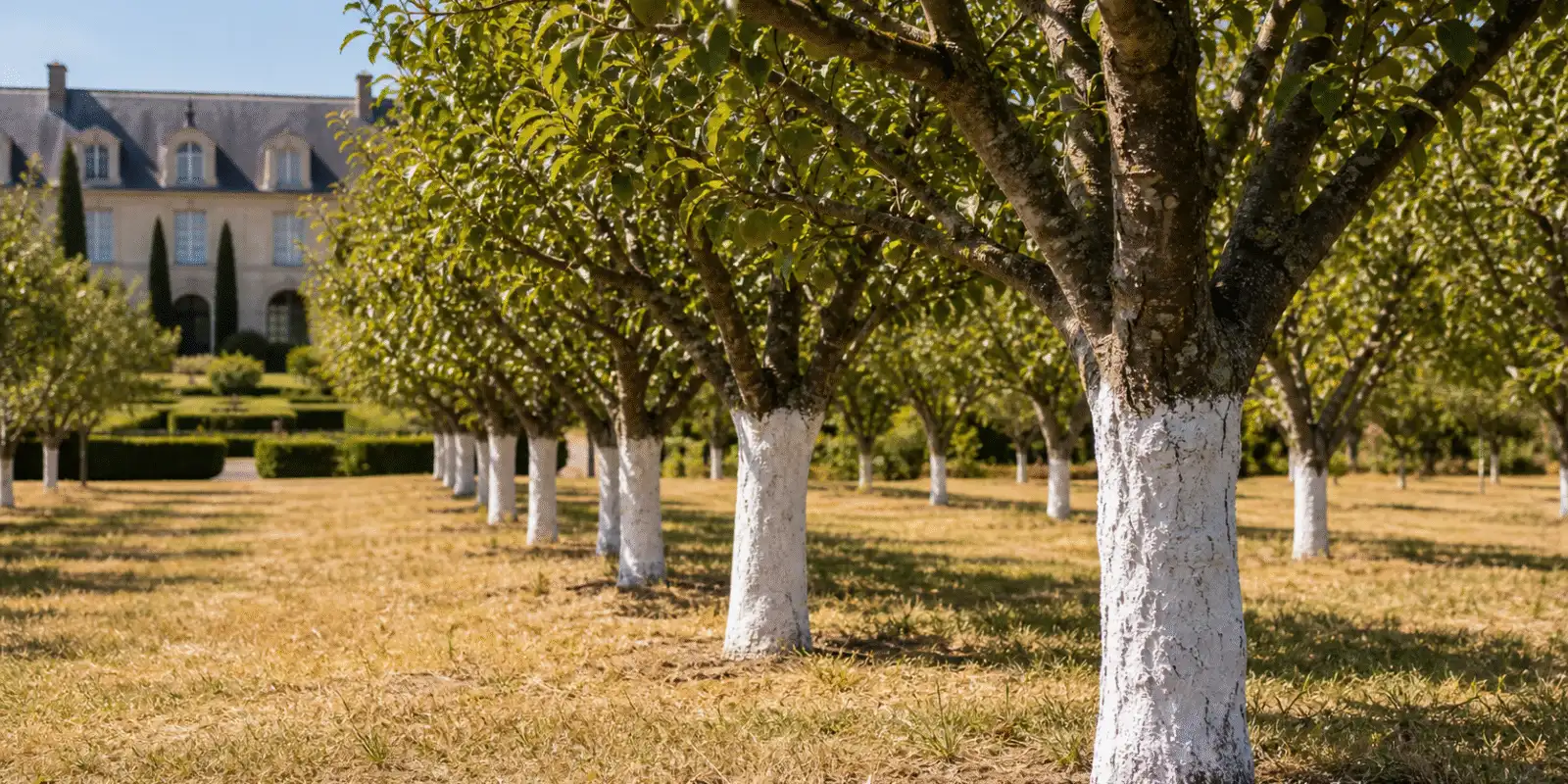
Arboricultural whitewash is a coating of slaked lime, clay and water applied with a brush to the trunk and main branches. Its white colour reflects the sun, limits temperature swings in the bark and protects the cambium from burns and cracks — while cleansing the bark of moss, lichen and pest eggs. This guide extends fruit trees in a heatwave.
The Chatelain Method for bark
We observe south-facing trunks and thin-barked trees; we diagnose the risk of overheating and splitting; we correct with a reflective whitewash; we prevent recurrence by renewing the coat.
Why whitewash tree trunks
Dark bark exposed to the sun can heat up sharply, then cool down fast: these repeated thermal swings crack the bark, and the cracks become entry points for parasites and disease. The most vulnerable are:
- Young trees with thin, smooth bark.
- Trees recently pruned or top-grafted, whose trunks have lost their shade.
- Isolated trees facing full south.
The Chatelain’s rule of thumb. Whitewash protects the trunk the way kaolin protects the fruit: by reflecting light. Its white coat sends the radiation back, lowers the bark temperature and cushions the thermal shocks that split the wood. A discreet gesture that extends the life of a fine estate tree.
The whitewash recipe
The traditional whitewash is simple and natural:
- Slaked air lime, diluted in water to the consistency of liquid paint.
- A share of clay (kaolin or green clay) for grip and flexibility of the film.
- Clean water to adjust the fluidity.
You can also choose a ready-to-use arboricultural whitewash, pre-dosed and homogeneous. Handle lime with gloves and goggles, as it is caustic.
When and how to apply it
| Period | Goal | Trees concerned |
|---|---|---|
| Late winter / autumn | Cleanse the bark + protect from frost and sun | All fruit trees |
| Summer (after pruning / young trees) | Protect newly exposed trunks from the sun | Fragile, exposed trees |
The application:
- Brush the bark dry to remove moss, lichen and dead bark.
- Apply the whitewash with a brush, from the collar up to the first main branches.
- Add a second coat once the first is dry, for full coverage.
- Renew after heavy rain that washes the protection off.
To avoid needlessly stripping trunks bare at the height of summer, see also the fruit tree pruning calendar.
Whitewash or kaolin: don’t mix them up
Both reflect the sun, but they have different targets:
- Lime whitewash protects the bark of trunks and main branches (burns, cracks, cleansing).
- Kaolin protects fruit and foliage from sunburn — see fruit sunburn.
FAQ
Why are tree trunks painted white?
The white coat reflects the sun, limits temperature swings in the bark and prevents trunk burns and cracks. It also cleanses the bark by dislodging moss, lichen and pest eggs.
When should fruit trees be whitewashed?
Traditionally in late winter or autumn, to cleanse and protect. In summer, it can be applied to newly exposed trunks (young trees, recently pruned trees) to shield them from the sun.
How do you make a homemade tree whitewash?
Dilute slaked air lime in water to a paint-like consistency, add a little clay for grip, then brush it onto a cleaned trunk. Gloves and goggles are required.
What is the difference between whitewash and kaolin?
Lime whitewash protects the bark of trunks and main branches; kaolin protects fruit and foliage from sunburn. Both work by reflecting light, but on different targets.