Pruning Fruit Trees: Calendar and Techniques for Abundant Harvests
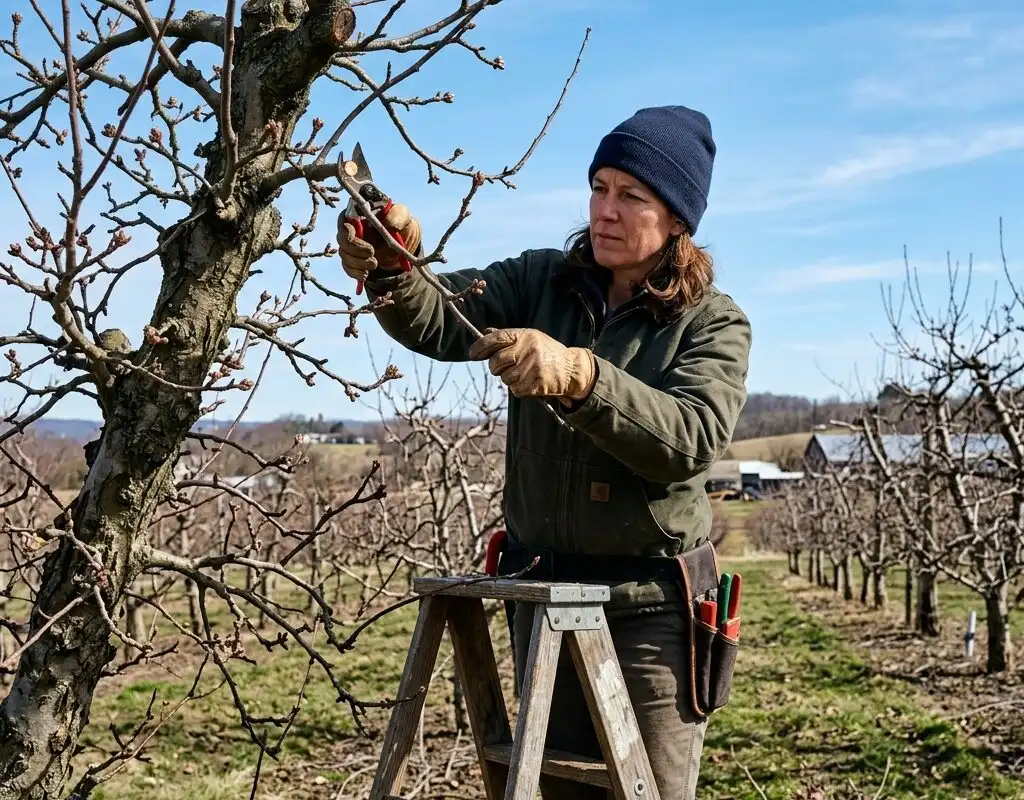
Pruning fruit trees follows a strict rule: seed fruit (apples, pears) are pruned in deep winter, during full dormancy; stone fruit (plums, cherries) are pruned in summer, after harvest, when wounds heal fastest and fungal infection risk is lowest. Get the timing wrong and you risk cutting off next year’s flower buds, or opening the tree to disease. Here’s the calendar and technique.
The Chatelain Method for pruning
You observe whether the tree is seed or stone fruit; you diagnose the right season; you correct with clean, well-placed cuts; you prevent disease with disinfected tools and sealed large wounds.
The pruning calendar at a glance
| Type | Examples | When to prune |
|---|---|---|
| Seed fruit (pome) | Apple, pear | Winter (November-March), fully dormant, frost-free |
| Stone fruit | Plum, cherry, peach | Summer, after harvest, or early spring for peach |
The Chatelain note. The RHS recommends pruning free-standing apples and pears every winter to keep them productive; restricted forms (cordons, espaliers, fans) are pruned in late summer instead, once growth has slowed. Plums are best pruned in early spring or mid-summer specifically to avoid silver leaf disease, and stone fruit pruning generally should be finished by late August to limit fungal risk.
Why prune? Three goals
- Formative pruning: done in the tree’s early years, it shapes the framework (goblet, espalier, spindle) so main branches can carry the weight of future fruit without breaking.
- Fruiting pruning: balances vegetative growth (wood-producing shoots) against fruiting wood (spurs bearing flower buds), bringing fruit closer to the framework branches for better sap supply.
- Cleaning and airflow: removes dead wood, diseased branches and vigorous vertical « water shoots » that drain energy for nothing. Opening the centre lets sunlight ripen fruit and limits the damp that fuels fungal disease.
Technique for seed fruit (apple, pear)
Fruiting pruning on seed fruit shortens side shoots to trigger wood buds turning into fruit buds.
- Identify dead or crossing branches and remove them at the base.
- Cut vertical water shoots growing on the trunk or framework branches to redirect sap to lateral branches.
- On lateral spurs, apply the three-bud rule: cut just above the third bud from the base — the terminal bud pulls sap into wood growth, while the two below, better fed, turn into flower buds the following year.
- Always cut at a 45° angle, the higher side above the bud, so rain runs away from the eye rather than promoting rot.
Technique for stone fruit (peach, plum, cherry)
Stone fruit are far more sensitive to pruning than seed fruit. Wounds heal poorly in winter and become an easy entry point for the fungi and bacteria behind canker and gumming (gummosis).
For peach, pruning must be annual and fairly hard, since this tree fruits only on the previous year’s wood — a branch that has fruited once never fruits again, so cut it back to encourage vigorous new shoots.
For plum and cherry, pruning should be light and occasional: aerate the centre and remove dead wood at the end of summer. Apply a natural healing paste on any cut wider than a coin.
The right tools for a healthy, disease-free prune
Good pruning starts with sharp, well-maintained tools: secateurs for small branches (up to 2cm), loppers for medium branches, a pruning saw for larger sections.
Essential hygiene rule: disinfect your blades with methylated spirit between trees. It’s the only effective way to avoid spreading serious wood diseases such as fire blight or canker.
FAQ
When should I prune apple and pear trees?
In winter, during dormancy, frost-free — typically November to March for free-standing trees; restricted forms are pruned in late summer instead.
When should I prune plum and cherry trees?
In summer, after harvest, or early spring, never in the depths of winter, to avoid silver leaf disease and canker.
Why does my peach tree need such hard annual pruning?
Because it only fruits on one-year-old wood. A branch that has already fruited must be cut back to make room for vigorous new growth.