Orchard Wedding: Hold the Ceremony Without Damaging Fruit Trees
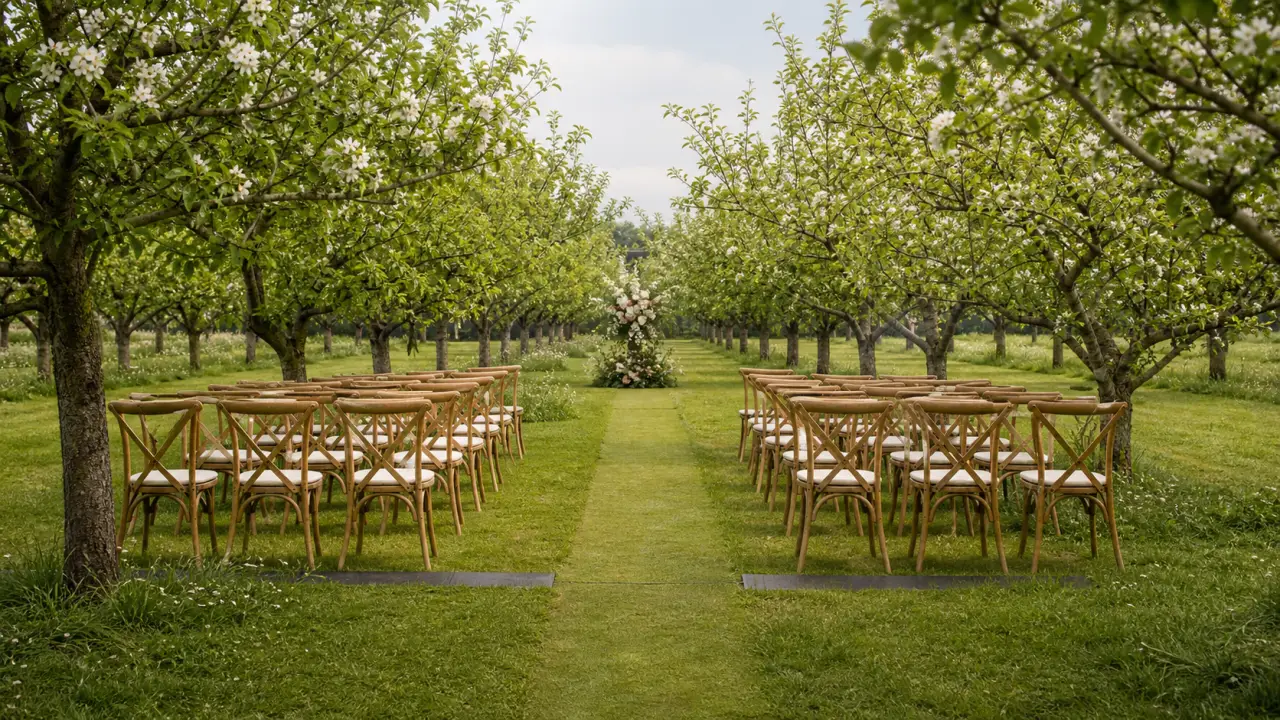
An orchard wedding should begin with the strip of ground and the trees that can genuinely accommodate the ceremony, not with the prettiest camera angle. The safe and respectful layout is then drawn as a reversible layer: freestanding furniture, protected routes, clearly closed areas and a removal sequence agreed with the person responsible for the orchard.
Apple blossom, dappled shade and late fruit can make a remarkable setting, but none is a guaranteed wedding service. Roots remain active beneath apparently empty grass; low limbs may be part of a trained crown; irrigation and support wires may cross an inviting aisle. A working orchard also has a production calendar which the event must not quietly displace.
Les Jardins d’un Châtelain is an editorial gardening website. It does not hire out an estate, orchard or wedding venue. The landowner’s rules, current permissions, competent contractors and applicable authorities always take priority over this guide.
Keep three decisions separate
Treat immediate safety, tree health and fruit production as three related but separate questions.
Immediate safety concerns people and the event as it stands now: a cracked or suspect limb, slippery windfall fruit, an unstable chair, an unlit surface change, a service vehicle meeting guests or an emergency route being blocked. A questionable tree or area stays outside the public layout until the owner and, where appropriate, a competent arboricultural professional have assessed it. Styling cannot overrule closure.
Tree health unfolds over a longer period. Soil compaction, bark abrasion, buried root collars, root injury and altered drainage may not announce themselves during the reception. Finding no broken branch at midnight does not prove that the orchard was unaffected.
Production has further variables: species, cultivar, rootstock, age, flower development, pollination, water, frost, pests, crop load and orchard management. Protecting the trees is essential, but it cannot guarantee blossom for the photographs or a particular harvest. The orchard manager decides how the event fits around necessary operations.
Read the kind of orchard before using it
A traditional standard-tree orchard is not an intensive fruit plantation, and neither is the same as six mature apple trees in a private garden. Widely spaced trees can give an impression of unlimited capacity, while the grassland, veteran features and wildlife are part of the place. A commercial orchard may contain trellis wires, irrigation, compact tree forms and working alleys that must stay available.
Young trees are especially easy to overlook. Guests may gather around stakes and watering circles, or a delivery trolley may clip a slender stem. Cornwall Council lists large deadwood, broken or hanging branches, splits, cavities and decay among signs to check and advises professional help when there is concern. Have the landowner’s competent tree specialist inspect the actual tree before placing a standing area below a suspect crown; this article cannot diagnose it from a photograph or foliage colour.
Ask the landowner or orchard manager to mark tree forms, young planting, monitored trees, water and drainage, supports, buried or overhead services, crop areas, machinery routes and no-go ground. Add the wedding to this map without deleting the orchard’s ordinary work.
Use the Chatelain Method on site
The Chatelain Method has four passes: Observe, Diagnose, Correct, Prevent.
Observe. Walk guest, accessible, service and emergency routes in both directions. Note slopes, depressions, ruts, chambers, irrigation, supports, low limbs, windfalls, bee activity and existing hard surfaces. If permission and timing allow, see how the ground behaves after normal rain as well as when dry. Take dated photographs from fixed viewpoints.
Diagnose. Match every activity to the condition found. A green sward may still be wet and vulnerable; an unglamorous track may be the most reliable route. Obtain real furniture weights, loading methods and fixing requirements from suppliers. Any concern about a crown belongs with a competent person, not with a wedding mood board.
Correct. Move the aisle, reduce the outdoor phase, close an interval, use a freestanding background or transfer service to hardstanding. The lightest correction usually changes the event rather than the trees.
Prevent. Mark exclusions, assign each inspection, issue one version of the plan and inventory everything that must leave. Set opening, closing and follow-up checks. Protection that exists only in one person’s head will not survive a busy installation.
Write a reversible orchard layout sheet
Use one working sheet for the venue, orchard manager, organiser and suppliers.
| Area or function | Evidence on site | Risk to control | Agreed layout | Opening evidence | Owner and removal |
|---|---|---|---|---|---|
| Guest arrival | Surface, slope, obstructions, route length | Slip, trip, conflict with deliveries | Signed route on approved surface | Walked and photographed | Venue lead |
| Ceremony | Trees, crown review, soil, real shade | Falling material, compaction, heat | Freestanding seating and decor in an approved bay | Drawing checked on site | Organiser and hire firm |
| Service access | Ground condition and manoeuvring space | Rutting, trunk strike, guest conflict | Unload on robust ground; use agreed onward handling | Driver brief acknowledged | Caterer or production lead |
| Stakes and services | Roots, irrigation, drainage, buried services | Puncture and hidden damage | No unapproved ground penetration | Written venue and supplier approval | Competent installer |
| Closed area | Saplings, soft ground or monitored tree | Damage or public exposure | Stable, legible boundary | Barrier inspected | Orchard manager |
| Breakdown | Route, storage and weather condition | Rushed trafficking and forgotten parts | Ordered removal and count-out | Matched inventory and photographs | Breakdown lead |
This sheet is not a risk assessment, arboricultural report or structural design. Its value is accountability: every activity is connected to a finding, a decision, evidence and a named person. A blank box is not permission.
Reduce pressure on soil and roots
Compaction reduces pore space in soil and changes the movement of air and water. Its effect varies with texture, moisture, previous management, load and repetition. That is why this article does not prescribe a universal number of guests, a standard mat or a fixed radius around every trunk.
Reduce the demand before adding protection. Keep vehicles to authorised routes, consolidate deliveries, carry smaller items from hardstanding and hold only the ceremony—not an entire meal—between trees if that is what the ground can accept. Use existing orchard alleys only after the manager has confirmed that they are suitable for guests and do not conflict with operations.
Temporary ground protection is an engineered choice, not a roll of carpet. It must suit the surface, expected load, weather, drainage, grip and duration without concealing a depression or covering the root collar. The venue and a competent supplier should specify and install it. An impermeable sheet over wet soil, rocking boards or carpet laid over crushed windfalls can introduce new hazards and stress.
Do not place ballast, bottle cages, generators, refuse or stacked chairs beside trunks. Do not level a hollow or shave a ridge to make chair rows look exact. A stake, screw, trench or temporary service needs landowner approval, information about roots and services, and an agreed method. The absence of a visible root is not evidence of empty ground.
Forest Research explains that compaction reduces soil pore space and can restrict root development. Its published figures relate to particular research and regeneration contexts; they are not a wedding load limit. The orchard’s actual soil and use must be assessed on site.
Keep trunks, root collars and crowns out of the rigging plan
Because this guide has neither a site-specific structural calculation nor a tree assessment, the wedding plan treats every trunk and limb as a no-fixing zone. Use structures designed to stand independently, installed under their instructions and outside the ground protected by the orchard manager.
The orchard manager’s approved plan keeps the root collar—the transition between trunk and roots—visible and clear, and places candles or heat sources outside the vegetation areas it excludes. HSE guidance requires competent temporary electrical design, suitable weather protection and controlled cable routes. The venue and electrical supplier document those points for the real installation; no cable is routed through a tree by default.
If a limb interrupts the view, change the view. Pruning for a photograph may be wrong for the species, season, crop and tree condition. The orchard manager decides whether work is required for the tree itself and, where necessary, appoints a suitably qualified professional. Never let an installation crew make an opportunistic cut.
Plan around blossom, wildlife and fruit
Flowering dates vary between species, cultivars, locations and seasons. A visit one year earlier is inspiration rather than a forecast. Choose colours and materials that still work with bud, blossom, leaf or fruit. The orchard remains convincing when its actual stage is accepted.
During flowering, grass margins, any hives and crop protection remain under the orchard manager’s documented management. The wedding brief maps them but does not prescribe pesticide use or hive movement. If an essential crop operation conflicts with the ceremony, the event moves or changes time.
Near harvest, the orchard manager inspects fruit load and windfalls and decides collection under the orchard’s working practice. The event team records whether the routes remain usable and follows that decision; it does not pick fruit to lighten a branch. Guest picking stays outside the programme until maturity, hygiene, supervision, responsibility and landowner consent are documented.
The venue records the approved event footprint and every local condition supplied by the competent body for the actual site. This article does not infer a permission, duty or exemption from the fact that the site is an orchard or outdoors.
Draw four routes through the site
Draw guest arrival and departure, an accessible route, service movement and emergency access separately. HSE event guidance for Great Britain asks organisers to understand the audience, ground, site features, access, temporary structures and responsibilities. It does not provide a universal orchard capacity.
Look for crossings. A charming single aisle can fail when a catering trolley moves against the departing congregation. Low branches can make people step sideways into a root collar; a wet edge can push everyone onto the same narrow strip. Remove conflicts through timing or layout before adding signs.
Identify unavoidable changes of surface and provide appropriate lighting without glare. Keep emergency access and relevant water or site equipment unobstructed. Describe distance, slope and surface honestly to guests in advance, and arrange assistance or an alternative route where needed. Accessibility is a continuous journey, not one portable ramp at the final threshold.
The outdoor wedding weather plan must preserve all four routes. A covered fallback reached only across waterlogged orchard ground is not a complete backup.
Control opening, the event and breakdown
Before opening, the named lead checks the current Met Office information and the condition actually found. Walk for newly fallen branches or fruit, soft ground, shifted barriers, furniture stability, cable protection, route lighting, clear access and packaging left behind. The plan needs authority to close or move an area without a last-minute debate.
During the event, keep an orchard or venue contact available. Suppliers should not move a barrier, add ballast beside a trunk or open a shortcut on their own initiative. Collect glass, cigarette ends, wire, cable ties and small metal parts before they enter grass or cultivation equipment. Manage windfalls according to the landowner’s instruction.
Breakdown requires its own light, route and sequence. Remove delicate and hand-carried items before bringing in heavier handling equipment. If rain changes the ground, wait or change method rather than driving on simply to meet an arbitrary collection time. Count bases, ties, cables, signs and panels against the installation inventory.
Hand the orchard back with evidence
The following day, repeat photographs from the same viewpoints. Record rutting, smeared or polished soil, new ponding, bark scuffs, broken shoots, crushed fruit, displaced irrigation and forgotten fixings. Separate an immediate safety action from a symptom that needs monitoring or professional diagnosis.
Do not automatically cultivate, aerate, fertilise, water heavily or prune. The right response depends on soil, species, injury and weather; an intervention on wet ground can worsen damage. The owner and appropriate professional decide, and an affected bay may simply remain closed until conditions improve.
Agree any later review the orchard manager considers necessary. Its purpose is not to pronounce the crop “saved”. It confirms that protection has been removed, observations have been transferred and normal orchard work can resume. The 180-day garden wedding timeline places this handback within the wider preparation and recovery programme.
FAQ
Can wedding chairs go beneath fruit trees when no roots are visible?
No visible roots does not mean root-free ground. Root distribution changes with species, rootstock, soil, water and orchard history, so a generic distance would be misleading. Ask the landowner or orchard manager to define protected areas, select a suitable bay and surface first, then minimise load and repeated passage. If the ground, a tree or a limb is in doubt, move the ceremony until a competent assessment is available.
Evidence, method and limits
Our contribution. The reversible orchard layout sheet connects each event function to the observed condition, control, opening proof, named owner and removal. It keeps immediate safety, tree health and fruit production visibly separate.
Method. We compared UK search results for orchard weddings with HSE event and electrical guidance, Forest Research information on compaction, Cornwall Council tree-inspection guidance, UK orchard guidance and current Met Office information. Venue and real-wedding pages establish the search vocabulary and visual expectation; they do not set tree-protection distances or ground loads.
Limits. Without a visit, tree and rootstock identification, soil history and moisture, crown inspection, service plans, event arrangements and current local requirements, this guide cannot approve capacity, structures, pruning, access or anchoring. It cannot predict blossom or harvest. HSE sources cited here concern Great Britain; use the relevant authorities and requirements in Northern Ireland.
Sources and further reading
- HSE — venue and site design, for ground condition, site suitability, access, structures, services and allocated responsibilities in Great Britain.
- HSE — crowd management controls, for arrival, onsite circulation and departure as planned phases.
- HSE — electrical safety, for competent temporary design, weather protection and cable-route controls in Great Britain.
- Forest Research — soil compaction, for the mechanism by which compaction affects soil and roots; its project figures are not event thresholds.
- Cornwall Council — managing your trees, for the signs to check—including deadwood, broken or hanging branches, splits, cavities and decay—and the boundary requiring professional advice when there is concern.
- The Orchard Project — planning and designing an orchard, for UK orchard considerations around soil, spacing and development.
- Met Office — warnings and advice, for current official weather information.
Written and checked by the editorial team of Les Jardins d'un Châtelain.