Electric Wheelbarrow on a Slope: How to Choose Safely
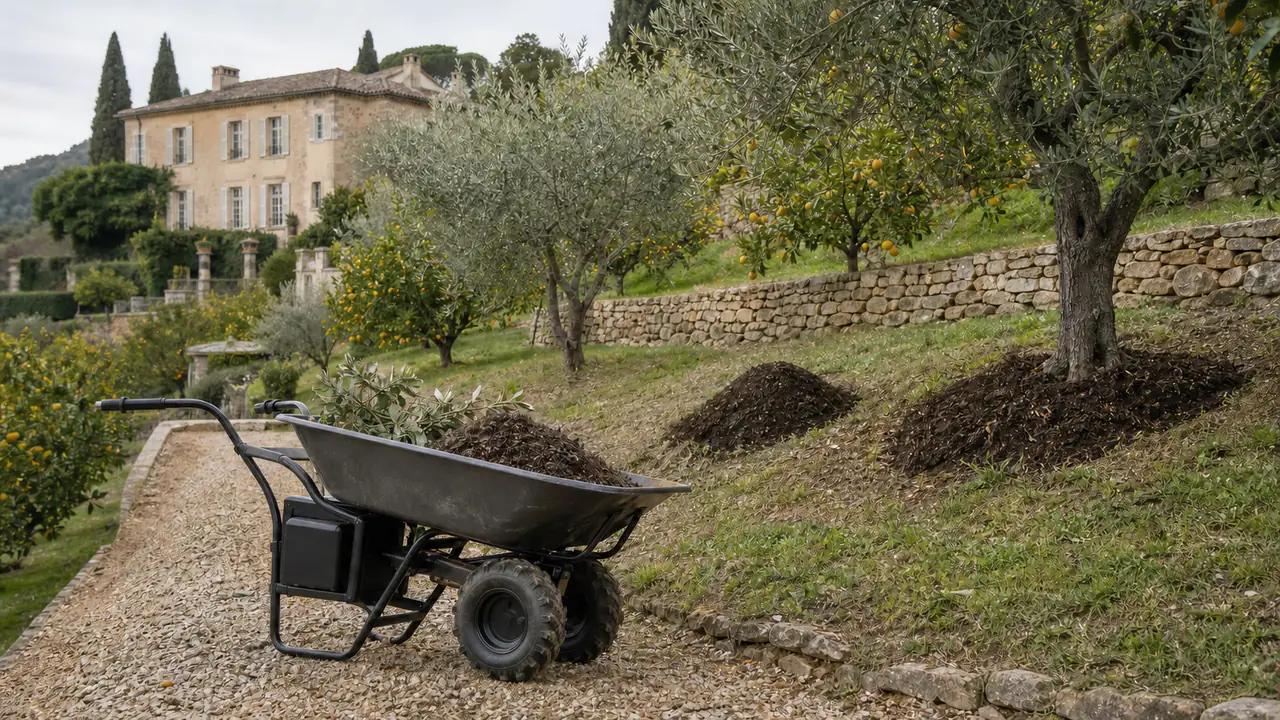
A powered wheelbarrow is worth assessing when repeated loads, a long route or a genuine slope make ordinary garden transport a limiting task. It is not automatically safer than a manual barrow: on a descent, mass still pushes downhill, while crossfall can reduce lateral stability. Start with a measured route and the manufacturer’s slope, load and braking instructions, not with a headline payload. This guide forms part of Garden Tools.
The hero image is illustrative, not evidence of a product test. It shows an unbranded powered barrow carrying compost along a sloping path, with terraced orchard ground and visible mulch: precisely the kind of route that must be surveyed before a machine is selected.
First decide whether power solves a repeated problem
Assistance has value when it removes a recurring transport constraint. A machine bought for one annual delivery may spend more time being stored, charged and maintained than working. A lighter manual barrow can remain the better tool where routes are short, reasonably level and used only occasionally.
| Garden workload | First option to assess | Reason to refuse or step back |
|---|---|---|
| Short, level route and a few light seasonal trips | Well-balanced manual barrow | Powered weight and storage add little useful gain. |
| Repeated compost, mulch or log movements on a firm incline | Battery-powered barrow | Refuse if the manual does not cover the measured slope, load and braking conditions. |
| Narrow paths but modest loads | Compact powered or two-wheel manual barrow | Overall width must leave hand and obstacle clearance. |
| Soft, rutted or frequently wet ground | Machine with a documented drive and tyre/track arrangement | Marketing language about traction is not a substitute for route compatibility. |
| Persistent crossfall, tight turning on the slope or steps | Redesign the route or use another method | Assistance does not remove overturning, trapping or runaway risk. |
| Rare bulk job | Hire, delivery nearer the work or split loads | Ownership may not be justified by the number of rotations. |
The decision is therefore not simply manual versus electric. It is whether a particular machine can travel a particular route with a conservative working load, while remaining controllable downhill and serviceable afterwards.
Make a terrain sheet before reading product claims
Walk the complete route from loading point to unloading point. Record both directions because the loaded leg may be uphill for compost and downhill for harvested wood on the return task. Do not measure a convenient straight line through a bed; measure the path the machine can actually follow.
Record these six variables:
- Longitudinal gradient: the rise or fall in the direction of travel. If measured with rise and horizontal run,
gradient (%) = rise ÷ run × 100. - Crossfall: the lateral tilt across the track. Keep it distinct from longitudinal gradient; a route can look gentle ahead while leaning strongly sideways.
- Usable width: the narrowest gate, path, corner and storage entrance, including clearance for hands and controls.
- Surface: firm paving, compacted gravel, grass, loose stone, mud, roots or ruts, noted in the wettest conditions in which work is expected.
- Distance: the actual one-way travel distance, plus bends, reversing points and unloading space.
- Transitions: thresholds, drains, steps, cambers and changes from hard to soft ground.
A phone inclination reading can be a screening aid, but it is not a safety certificate. Check the measuring method and repeat doubtful sections. If the route contains a sharp local ramp, that short section matters even when the average gradient appears mild.
This route discipline also helps with other equipment: the access and storage questions overlap with choosing a corded, battery or petrol lawn mower, while a hose should remain routed away from the wheel track using an appropriate wall reel, cart or retractable box.
Calculate rotations, not just one impressive payload
Nominal payload is not a promise that the same mass is appropriate on every slope. The ALTRAD FORT instructions in the source pack explicitly require load reduction on slopes; the exact conditions remain those of that manual and machine. Treat flat-ground capacity, permitted slope and the load you choose for the surveyed route as three separate facts.
Start with the total material to move. Then use:
planned rotations = total material mass ÷ conservative working load per trip
Round up to a whole trip. The conservative working load is not a new universal percentage. It is the lower value left after checking the current manual, terrain, traction, braking, tub volume and safe handling. If material mass is unknown, weigh or estimate a small representative container and state that it is an estimate rather than disguising it as a measured total.
For bulky mulch, volume may fill the body before mass becomes limiting. Wet compost or soil can reverse that relationship. Loads should sit low and remain stable without obstructing the controls or the operator’s view. Split awkward stones or logs even when their combined mass appears to fit a headline figure.
Rotations expose the real trade-off. A manual barrow making three modest trips may beat the setup and storage burden of a powered machine. Twenty controlled trips over a long incline may justify assistance even when each load is deliberately well below the published maximum.
Separate climbing ability from downhill control
Product pages tend to make uphill traction easy to notice. The decisive check is often the return down the slope. A loaded machine may accelerate under gravity, and a drive that climbs strongly does not automatically provide an adequate holding brake.
Before purchase, find the exact manual and identify:
- the permitted operating gradient and whether the figure refers to ascent, descent or both;
- any load reduction required on a gradient;
- the service and parking brake arrangements;
- instructions for turning, reversing and travelling across a slope;
- tyre pressure, support-wheel or track conditions that affect stability;
- emergency stop, neutral and loss-of-power behaviour;
- prohibition on steps, public roads or particular surfaces.
After delivery, follow the manufacturer commissioning procedure. Check controls and braking on the lowest-risk suitable area, initially empty and only then with a small, secure load if the instructions permit it. Stop if the machine cannot hold a controlled walking pace, pulls sideways, loses traction, requires a turn across the slope or makes the operator brace against the handles. This is an acceptance check, not permission to exceed the manual.
Plan movement predominantly straight up and straight down the fall line. Avoid contouring across the slope: crossfall shifts the combined centre of mass towards the downhill side. If the route requires a lateral traverse or a tight turn on the incline, the honest correction is to change the route, create a level turning area or choose another transport method.
Check width, grip and storage as one system
Overall width includes tyres, hubs, handles and anything that moves during steering. Measure the machine specification against the narrowest point, then retain working clearance. Passing a gate with millimetres to spare is not useful if a hand can be trapped or the loaded body cannot turn beyond it.
Surface changes deserve equal attention. Loose gravel can roll under a driven wheel; wet grass can reduce grip; a rut can tilt the body; a threshold can stop a small support wheel. Tyres or tracks must be chosen from documented use conditions rather than a general claim that one architecture is always superior. Tracks can add traction on some surfaces but also add mass, turning effort and storage demands.
Plan the parking location before buying. It should allow safe charging, inspection, cleaning and battery storage in accordance with the instructions. Confirm parts availability for brake components, cables, tyres, tubes, drive components, switches, charger and battery. A machine whose battery or brake parts cannot be identified may have a short practical life even if its motor still runs.
Verify UK electrical and conformity documents
The GOV.UK Office for Product Safety and Standards report in our source list concerns one identified electric wheelbarrow; it is not evidence that every imported powered barrow is unsafe. It does, however, show why electrical conformity must be checked rather than inferred from a marketplace listing.
For a mains charger supplied for the UK, verify that the plug and charger documentation are appropriate for the UK supply. Where a BS 1363 plug is claimed, look for the correct fused construction and traceable markings rather than accepting a travel adaptor as an equivalent. Ask the responsible UK manufacturer or importer for the applicable Declaration of Conformity and ensure its product identifiers match the machine and charger supplied. A logo in a photograph is not the same as a traceable declaration.
Also check the charger label, input rating, battery chemistry, charging environment and damaged-cable procedure in the current instructions. Do not substitute an unapproved charger because the connector happens to fit. If the seller cannot identify the responsible economic operator, provide matching documentation or explain spares and recall support, do not treat the low-friction purchase as a bargain.
The Chatelain Method: observe, diagnose, correct, prevent
- Observe the longitudinal gradient, crossfall, width, surface, distance, transitions and likely weather state.
- Diagnose total material, number of rotations, loaded direction, storage and the task that presently causes delay or strain.
- Correct with the least complex format that covers the measured route: manual, stable two-wheel, battery-powered or a different transport plan.
- Prevent loss of control through a conservative slope load, high-to-low trajectory, downhill brake check, matching documentation, maintenance and a clear refusal rule.
The refusal rule is deliberately strict: do not buy the powered barrow if the manual is unavailable, the measured route is outside its documented conditions, downhill retention is unclear, the path requires cross-slope turns, the machine does not fit with clearance, or battery and brake parts cannot be sourced. On a domain garden, restraint is part of good equipment stewardship.
Documentary selection: three formats to compare
These sponsored searches are not a product ranking. Compare the exact current manual, route compatibility, brake, working width, parts and conformity documentation. No price is reproduced here.
Evidence, method and limits
Our contribution. The article turns a generic payload comparison into a reproducible garden decision: route sheet, rotations calculation, separate longitudinal gradient and crossfall, distinct flat and slope load, downhill retention check, high-to-low trajectory and refusal test.
Provenance. UK electrical and conformity risks were checked against GOV.UK/OPSS report 2606-0272. Operating principles and the need to reduce load on a slope were checked against the English ALTRAD FORT E-PowerBarrow instructions. Product-page claims were represented by Titan Pro UK and remain attached to that listed model. The three English-market sources were consulted for the F14 review on 11 July 2026.
Method. We compared sources by route variables, payload context, slope wording, brake and support-wheel instructions, controls, documentation, battery, parts and storage. The formula for rotations is a transparent planning calculation; its working-load input must come from the exact manual and conservative site assessment.
Limits. This is documentary comparison, not a practical product test or site safety assessment. We do not publish a universal maximum gradient, slope payload or battery runtime because models, loads, surfaces, temperatures and battery condition differ. The OPSS report is product-specific. A remote guide cannot certify the reader’s terrain, competence or machine; the current instructions and a suitably qualified assessment prevail.
Can a powered wheelbarrow be driven across a slope?
Do not assume so. Crossfall shifts the combined machine-and-load centre of mass towards the downhill side, and some manuals restrict or prohibit transverse travel. Plan a straight high-to-low route wherever possible. If the only route requires contouring, turning on the slope or crossing a persistent camber, redesign the route or choose another transport method unless the exact manufacturer instructions and a competent site assessment explicitly support it.
Sources consulted
- Product Safety Report: Electric Wheelbarrow 2606-0272 — GOV.UK / Office for Product Safety and Standards
- E-PowerBarrow safety and operating instructions — ALTRAD FORT
- Battery powered barrow — Titan Pro UK
Read next
- Garden Tools
- Wall reel, hose cart or retractable box
- Corded, battery or petrol lawn mower
- Garden Care & Permaculture
Written and verified by Les Jardins d’un Châtelain, Organization author.
Editorial status — documentary comparison / editorial selection. This guide compares uses based on manuals, horticultural guidance and mechanical criteria; we have not carried out laboratory product testing or ranked brands.